




There is just something about mariachi. It is a unique blend of instruments—horns, strings and vocals—that can manufacture emotions, from magical to melancholy. It truly is Mexico’s gift to music.
And now, Metropolitan State University-Denver has just announced that beginning in the fall, it will offer an Individualized Degree Program in Mariachi Performance and Culture. In making the announcement, MSU-Denver says the new offering will combine “music performance with Chicana/o Studies, World Languages and business coursework.”
The addition of the new degree has been a long time coming, perhaps even overdue, for students who want to pursue music as a career as well as faculty who have long wished for its arrival. “It has been a ten-year journey,” said Dr. Lorenzo Trujillo, MSU-Denver Artistic Director of Mariachi Music. A decade ago, he said, it began with “a single class in mariachi music,” for music majors. But with students matriculating from high schools, especially Adams County, and wanting to grow their knowledge and skills in the music they’d been playing from childhood and through high school, the program went from expansion to explosion. From a 2015 single class, Trujillo and others, nurtured it to full-scale concerts at the school’s King Concert Hall.
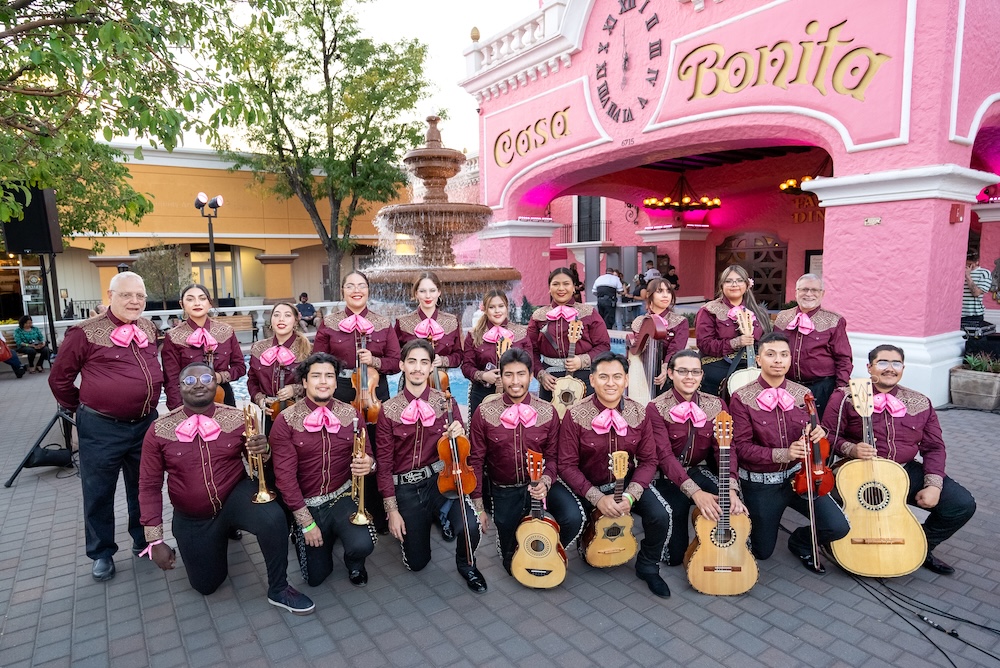
In preparation for the fall classes in mariachi, the university has opened its 8th and Kalamath Santa Fe Arts District building for mariachi students like Javier Becerril and others. Becerril is president of MSU-Denver’s mariachi ensemble, Los Correcaminos.
In an MSU-Denver news release, Becerril echoed the sentiments of the students taking part in the first day of the summer program. “This program is going to make (studying mariachi) so much easier and better,” Becerril said. “It’s what I was looking for, and it wasn’t available before. Knowing it’s here now, really encourages me to study mariachi more.”
While mariachi is a Mexican form of music, students in the summer program reflect a growing diversity. It is a phenomenon that is growing geographically, said Trujillo. “I’ve traveled all over the world,” he said, “and it’s now in symphony halls” wherever he travels. Indeed, at mariachi festivals around the country, mariachi musicians from every state and around the world are found in attendance. Impromptu performances combining New England mariachi with Japanese musicians or any other combination of nationalities can be seen and heard.
It may be arguable exactly when the seeds for this music were planted or even where exactly in Mexico they first sprouted. But the evolution of mariachi has been unstoppable. More recently, Trujillo said, seventies-era rock star and Mexican American Linda Ronstadt gave it a major jolt in the arm with her “Canciones de mi Padre’ album. “She was a godsend,” Trujillo said. “Her singing it was validation” of its beauty.
But while Ronstadt was doing her part in bringing it to an international audience, at MSU-Denver, Trujillo said, it was “student initiative” that powered its growth at the school. It was a single student, Isahar Mendez, an Adams City High School student, who “got the department to get a class going.”
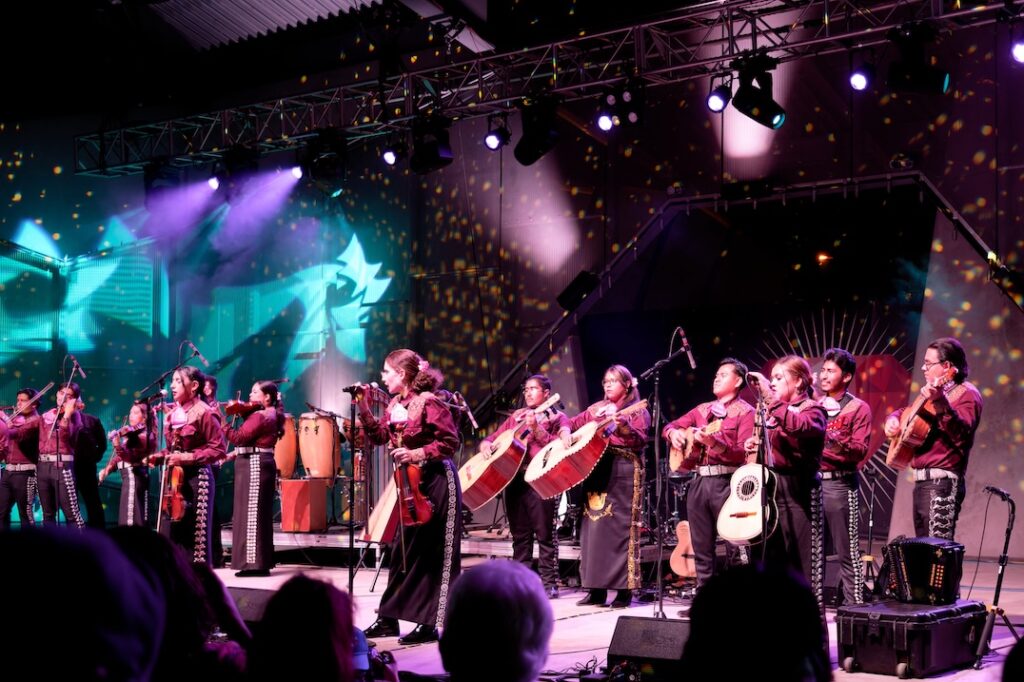
“One of the things that attracted me is the way instruments are used,” said MSU-Denver’s Dr. Philip Ficsor, who greeted and performed with students at the Kalamath street classes. Ficsor, a trained classical musician, was first introduced to the music just five years ago. He’s since become a fixture with the students and program. “It is just so attractive…its contents so rich and harmonic. It is hard not to like.”
Ficsor, whose parents migrated to America following the Hungarian revolution in the fifties, says adding the new degree option for students might fly in the face of anti-DEI efforts but experience tells him that it might actually do the opposite.
He tells the story of a time when he brought his students outside to play. It was spring, and campus was roiling with students protesting the anti-DEI cloud hovering over campuses not just in Denver, but the country. But after Ficsor’s students began playing, they got the attention of some of the protestors and what happened, surprised. “Protestors,” he said, “began having fun and came over and talked to us. It was humans relating to humans.”
In a time when an American administration is blotting out accomplishments and contributions of a diverse set of Americans, aggressively fanning the flames against diversity and perhaps creating an unwarranted tension over the creation of a degreed academic offering, Dr. Leonor Xớchitl Pérez applauds the university’s move.
“Mariachi is not foreign to American soil—it is deeply rooted in the U.S., especially in the Southwest.” Far from being “low hanging fruit” for detractors, she said, “it prepares students not just for a job (as musicians), but for a meaningful, engaged life.”
Pérez, who has performed as well as lectured internationally on this unique school of music, said of mariachi, “It represents one of the most timely and transformative investments higher education can make. A degree in mariachi is about far more than performance; it is a powerful affirmation.”



