




Try and imagine a period of a dozen years. As you do, you realize just how long or ephemeral it seems. That is the nature of time. For some it’s an eternity, for others a freeze frame of a long ago past, a moment preserved in memory.
Now imagine the dozen years that are encapsulated in the period 1929-1941, the length of The Great Depression. And while ‘depression’ is what it was called because of what it did to the economy, it also may be the perfect word for what it did to America’s psyche. The country was beaten down. Who could blame it?

At the height of the Depression, it is estimated that national unemployment hovered at nearly 25 percent, spiking higher in some places. One in four Americans was out of work, but not out of hope. The sun would rise again. Just when, however, was the big mystery.
Reflecting this glimmer of hope and fate are thousands of photographs now housed in the Library of Congress. They are of the men, women and children who endured the era. New York author and filmmaker Alberto Ferreras has compiled a small and, perhaps, hidden sampling to share with the world.
His undertaking, a fifteen-minute video time capsule, was both an accident and epiphany. “I stumbled on this collection when I had the time,” he said. It was during the pandemic when personal time for millions was in abundance. “The photographs are beautiful,” he said before pausing and sighing, “but some of those people (who were photographed) probably never saw those images.”
The massive collection of frozen in time reality was the work of photographers sent across the country by the government, not entirely to record the bleak reality of the moment but, very pragmatically, to put people to work. While they were, in fact, artists, like thousands of other WPA hires, they were simply, and more accurately, employees.
The Works Progress Administration was one the New Deal’s efforts to provide jobs and incomes for workers of all stripes. An estimated 8.5 million people were hired to build everything from roads to schools to public buildings. Also, to preserve the moment.
In the deep South, writers were dispatched to seek out of luck farmers for their stories, while others sat with the earliest versions of tape recorders, to memorialize other narratives, including those of Black men and women that only a few generations earlier were considered property. They were former slaves. Across a sprawling America, few communities were omitted.
City Hall in Aguilar, Colorado, was a WPA project. In Pueblo, it was a golf course and zoo. Imagination seemed to run a wild gamut of ideas and projects.
So eclectic was the WPA undertaking that it included a spectrum that on one end was Colorado’s iconic Red Rocks amphitheater, on the other Diego Rivera’s Rockefeller Plaza murals.
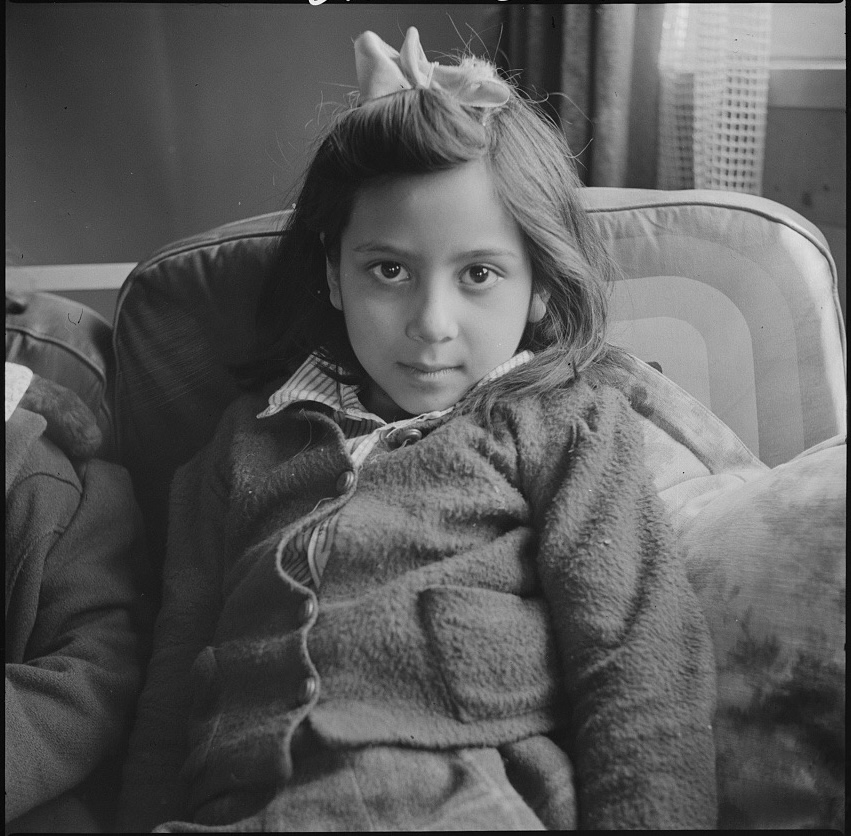
Ferreras collection is a sample size of the people, their hopes, dreams and, so often, their despair. “I chose what I did,” said Ferreras, to feature images of people too often afterthoughts of the era: Latinos. They are the dangling threads in the tattered cloak of the Depression. He calls his project, “American Latinos: 1935-1945.”
Photographers Dorthea Lange, Russell Lee, Jack Delano and others, unknown at the time, are today considered the gold standard of their craft. Their images can easily be thought of as opposite sides of a coin; one side pain, the other, the tiniest glimmer of hope.
Lange’s most famous image, and possibly the era’s most iconic, is that of Florence Owens Thompson. It is a stark, shades of gray image of a young mother flanked by two small children, their young heads buried behind her shoulders. The image is often called ‘Migrant Madonna’ or ‘Madonna of the Depression.’
The photographers roamed the country and in Taos County, New Mexico, where a WPA school still stands, is the captured image of a young girl in her classroom, a sanctuary from a world still too complex for her to comprehend.
While scores of photographs recorded the despair of the Depression, Ferreras said, there are also images reflecting an indomitable buoyancy of the men, women and families enjoying themselves at events like the Taos Fiestas. “I think people would be surprised,” he said.
The collection from which Ferreras chose the images that would be included in his project, he said, reframed his own perceptions of the era. For the first time, it reflected for him a true collective of the American Depression.
While some of the communities explored by the WPA photographers are long gone, there remains ghostly reminders that they once pulsed with activity and were home to Latinos. “Every town and landmark has a Spanish name,” Ferreras said.
But beyond farm workers and their families, perhaps the low-hanging fruit for the WPA photographers, Ferreras’ Latino Portraits 1935-1945 is a moving and emotional tribute to often marginalized, the invisible victims of a darkness few and more likely none had any role in creating.
‘Latino Portraits’ is also a tapestry whose borders defy geography. As testament, Ferreras said, “There are photographs of Puerto Rican soldiers” whose stories are sadly rendered vague. Because of language differences—an inability to truly connect artist with subject—a deeper story line has been lost. “The photographers do not always understand the language,” and cutlines are all that remain to offer context.
Ferreras, a Spaniard by way of Venezuela, plans showings wherever there is interest. One early stop took place earlier this fall at Alamosa’s Adams State University. He chose the school because it lands on the same path taken by long ago visual historians whose job was to record an era. Instead, they ended up capturing a thousand lives each now frozen as a moment in time.
More information on Ferreras and ‘Latino Portraits,’ can be viewed at www.alberto-ferreras.com.



