




Note from the Publisher – I recently became aware that Veteran Teofilo Serna’s wife, Ida, was part of the Eustacio and Elena (Martinez) Vigil Family who lived across the highway from my own family in Costilla, NM. Ida married Teofilo Serna, her beloved soldier whose posture, charm and love of family still remain. We honor your service and we salute you this Veterans Day.
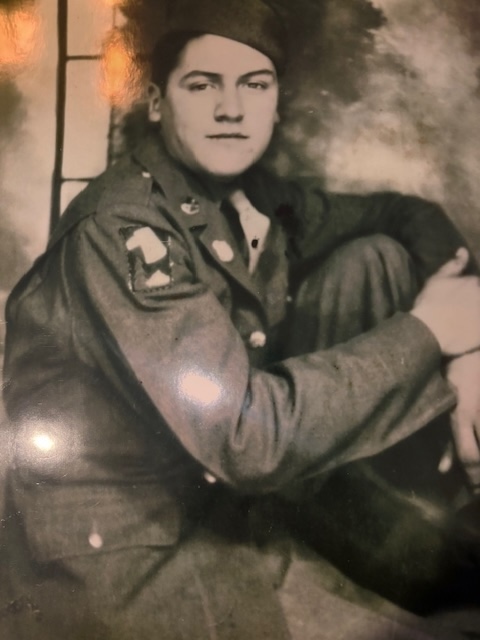
It may seem—actually, kind of is—ancient history to think about what happened September 14th, 1925. I mean, that was a long time ago. But here are two things that happened on that long ago day.
The first is that on September 14th a century ago, Charlie Chaplin’s silent movie classic, “The Gold Rush,” debuted. Chaplin would later say it was the movie of which he was most proud. But something else happened that day. Right here. In Colorado.
It was the day Pueblo resident and WWII veteran Teofilo Serna was born. The centenarian, who still lives alone and takes daily, unaccompanied walks around his eastside neighborhood, entered the world on a typical fall day in Durango, Colorado.
Though born in Durango, Serna was raised in San Luis and the nearby hamlet of San Acacio where his family ranched sheep. Back then, life was different, especially in off the grid mountain towns.
Short on help and, very likely, the luxury of paying a hired hand, Serna’s family ‘hired’ him to help tend the family’s sheep, as many as a thousand. In the high country, where the sheep grazed in summers, he joined “my Grampo,” as he called him, to watch the flock.
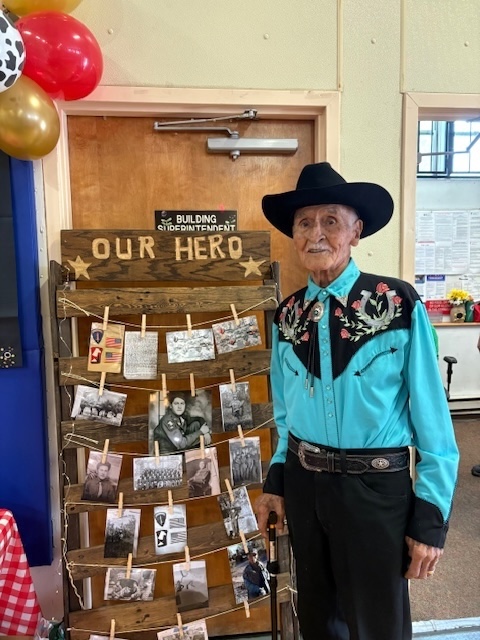
Soon, his summer job became full time when he left school. It was sometime around “the second or third grade,” he said. Today, it is hard to imagine a child with a full-time job, let alone one watching hundreds of sheep.
“I don’t think they had much of a choice,” said daughter Evelyn Baldonado who sat nearby for the telephone interview. “They needed the help,” she said, irrespective of his young age. Still, as a mother herself, she laments sending such a small child off to the mountains as, perhaps, not the best of decisions. “They’re still too little,” she sighed, a bit of melancholy in her voice.
Serna’s recollection of life in the high country remains bittersweet. While he loved the mountains, shepherding could be a tough life. “I suffered quite a bit,” the charming, long ago soldier said. “I had a tent and a wagon,” and not much more. Beyond learning the A-to-Zs of herding, he laments, “I didn’t learn too much in the mountains.” The life, though, taught him resilience.
When WWII broke out in 1941, Serna, then in his mid-teens, was drafted into the Army and trained in field artillery. After quick stops in Oklahoma and Missouri he found himself crossing the Atlantic.
“I got off the boat in Marseilles (France) and then on to Germany. Both stops, he remembers, found him in combat. “The bombs were coming pretty close,” Serna remembers. His wartime experience won him “two battle stars,” said his daughter.
After the Army, Serna returned to the Valley, but only briefly. He followed his parents who, while he was away, left the ranch and moved to Pueblo.
There, Serna took a job at the now decommissioned Pueblo Army Depot. His daughter said, “he stenciled” labels and information on munitions for shipment. He would also retire there.
In Pueblo, he met his wife, Ida. It was, his daughter said, “love at first sight.” They married in just weeks. As the family grew, said Baldonado, there was loss. Of five children, only she survives. Her siblings all died young with none living beyond age 14. But the Serna’s marriage lasted more than 70 years. His wife passed away two years ago.
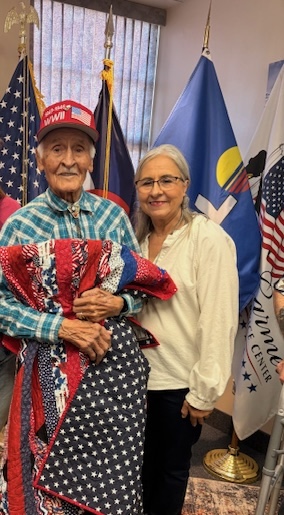
Serna sometimes forgets or repeats his distant memories, including a few of when he went to war. But his energy, enthusiasm and kindness remain strong.
It is also those qualities that are reflected in daughter, Evelyn, who drops by every day, not just to check up on him, but to spend time. She is also the repository of his memories.
“Every day I will come by about nine-thirty. If there is stuff to do, I do it, the laundry, straighten up the house,” she said. “I try to be here for him.” She is also ready to step in when the mist clouds a memory. She’ll gently prefaces her comment with, “Daddy, you remember,” before filling in the blank.
As Baldonado reminisces about her father, she recalls long ago family visits to where he grew up, where the Sernas’ ranched. “We would go back to Costilla. Mama would go to help my grandparents.”
Sitting in the same house where she grew up and where her father still lives, Baldonado recalled how fastidious he was about tending his yard. Others handle that for him nowadays.
But more than anything, she remembers parents who were “always respectful…treated people good and…always had the table set” in case someone dropped by. “He’s always been a wonderful Dad; both my parents were good at that.”
Today, the long ago soldier stays close to home but still takes pride in his service to country and a family that now includes great grandchildren. His daughter says they lift his spirits.
When the youngest family members drop by, Serna will engage playfully with them or enthrall them with drawings which, lately, are pumpkins. “They just like to be around Grampo.”
It’s all a family affair for Serna. Baldonado’s children, three daughters and a son who works out of town, find time to visit. “One of my daughters takes him to his doctor or to the bank.”
At age one hundred, Serna remains cheerful and seemingly unconcerned about mortality. Perhaps, it’s because he has good company, a loving daughter, grandchildren and great grandchildren. It is not an incumbrance, said Baldonado, but an opportunity to give back to someone who has given so much.
“I just try to be here for him,” she said, not a pause or hesitation in her voice. “They were always good to me. It’s just my turn.”



