






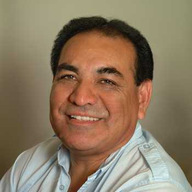
I am on the southern border of the United States in the Rio Grande Valley of Texas. I have crossed the border to see both sides of a reality that has been so much in the news.
I was born less than 10 miles from the border with Mexico in this region. My early memories of the area include living in a house in Weslaco, Texas and visiting family in La Villa in a home next to one of the many canals that formed the irrigation system of the Valley.
The memory that I most cherish is that as a 2-year-old walking with a tin cup down a set of stairs that led to the back yard where grandfather was milking a cow. There, grandfather filled the cup, and I drank the milk on the spot.
Sometime later, the family and many of the relatives began a long period as migrants working the fields of the Southwest and Midwest. I never returned to live in the Rio Grande Valley.
However, I have continued to keep in touch with people in the region because so much of my family still lives there. As a matter of fact, our 2008 family reunion was held in South Texas as a way of keeping in touch with those that could not travel to other venues in the country.
I arrived in McAllen, Texas on the border and stayed overnight. One would think that with all of the media commotion, the place would be a beehive of activity with Border Patrol, National Guard and other federal and state agencies filling the space.
Not true. It was a “normal” day with people going about their daily activities.
I remember running into a group of young locals getting ready to board buses for the State of Nebraska. They were contracted to work in the corn fields topping corn stalks.
On the other side, I saw a lot of people rushing to get to work. Among the leading employers are the assembly plants that dot the area.
The plants seem to work round the clock. I have a relative that works the night shift.
I also found that many are allowed to work only halftime. I wonder if that is the case because there are so many applicants for the jobs.
I saw very little law enforcement personnel on both sides. On the American side, the police were busy giving tickets for traffic violators.
On the Mexican side there also appears little police presence other than National Guard patrols in pickup trucks. There was, however, a strike by taxi drivers that sought to blockade some streets in protest for having to pay taxes on their earnings.
For me, the Southern Texas Rio Grande border has always been a special place for hearing the sounds of Spanish, listening and dancing to Onda Chicana, Tex-Mex and Northern Regional music that have unique influences on American country songs. The fast-speaking Spanish on both sides of the border along with the delightful mixing of Spanish and English in the same sentence on the American side makes for unforgettable moments.
This is to say that the border continues to be a cultural enclave that defies the stereotypes being mounted by the media and people that are out to make political points. The anti-immigrant campaign seen in the commercials of Secretary Kristi Noem are loud in this regard.
People on both sides know there are problems of all kinds. The arch of solutions is also there.
The views expressed by David Conde are not necessarily the views of LaVozColorado. Comments and responses may be directed to News@lavozcolorado.com.



