





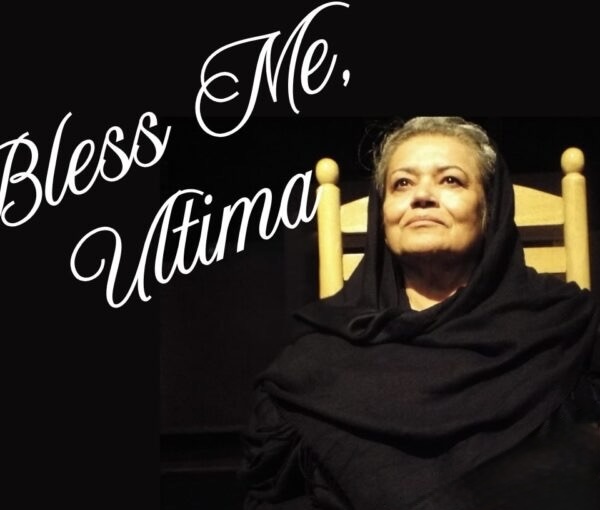
Rudolfo Anaya’s novel Bless Me Ultima (1972) is currently being offered (October 16 – November 2) in the form of a play at Su Teatro. The most powerful character in the work is Ultima played by Yolanda Ortega, well known in the community as a great artist, university administrator and community leader.
Time and space has allowed the coming together of this character with an actress that manifests some of those same attributes in her own life. Yolanda Ortega and Ultima share the magical foundation that makes for great art.
We had just arrived at New Mexico Highlands University (NMHU) in Las Vegas, New Mexico a year after the novel was published when I heard President Angel’s first-hand account of a conversation he had with Anaya sometime before the novel was written. The author had come for advice about his passion to write and was given a lot of encouragement by Dr. Frank Angel, then the first Chicano president of a university.
Bless Me Ultima was the first of three novels that featured a drive toward self-realization. The other two are Heart of Aztlan (1976) and Tortuga (1979). All 3 employ magical figures such as the Ultima in his first work, Crespin in the second and the Tortuga mountain in the third.
Antonio the protagonist in Bless Me Ultima is 7 years old when the curandera Ultima comes to live in his home. Her presence represents a dichotomy contrasting the colonized world of Catholic belief and the pre-Columbian landscape of the “llano” manifested in the magical insight of Ultima and her companion the owl who carries her spirit and harmonizes it with nature.
Thus, the normal questions about faith, belief, truth and life that are part of a child and adolescent’s upbringing are magnified because there before him are choices that most young people do not have and decisions that they do not have to make. In Antonio, Rodolfo Anaya, in essence, is portraying the embryonic Chicano and the sometimes-confusing search for identity.
The Chicano Movement was, in large part, a public drama because it was of utmost importance that “la Raza” come out of the shadows of history and assume a visible place in our national priorities. But then, there was a less visible and just as important struggle to deconflict cultural origins and establish definition in identity.
A question like this can only be addressed through the spiritual enactments of art and ritual. Anaya’s work, especially with its emphasis on magic realism, puts on the table a unique gathering of choices in this regard.
That space has been intimate to Ortega’s public life. Whether as a member of a Chicano Studies staff, as a Latina at the highest levels of higher education administration, as an effective community activist and political leader or as an artist of elite stature, her path reveals the spiritual side of history.
It is in this context that Ultima as a symbol of origins and Ortega’s acting that mirrors it with a passionate rendition that they come together to make the play a very special experience.
Bless Me Ultima has also been made into a movie. However, the dramatic facility of the stage brings more immediacy to the core message of the work. Su Teatro is offering an opportunity to see the work of an era when Chicanos woke up the country to their presence. This performance may not come again for a long time. Tickets are still available. Please honor the story by attending.
The views expressed by David Conde are not necessarily the views of LaVozColorado. Comments and responses may be directed to News@lavozcolorado.com.



