Home Blog Page 122

Early in-person voting available statewide

The deadline to mail in your ballot has passed; however, you can still drop off your ballot at one of 400 drop boxes available to voters statewide

Early in-person voting is available statewide, with the minimum number of required voting centers open to eligible voters. On October 31st, the minimum number of drop boxes became available to voters. This year, over 130 voting centers and 400 drop boxes will be available for eligible Colorado voters to submit their ballots for the November 7th Coordinated Election.

“Voting in Colorado is accessible and easy. Voters who received a mail ballot may return it to a voting center or vote in-person,” said Secretary of State Jena Griswold. “Today is the last day to return your ballot by mail and ensure it is received by Election Day.”

Coloradans can still register to vote, receive a ballot, and vote in person at a voting center until 7 p.m. on Election Day.

Colorado voters can also find their closest drop box or voting center at GoVoteColorado.gov. Voters who plan to return their ballot by mail using the U.S. Postal Service should do so by today to ensure their clerk receives it by November 7th. Voters should return their ballot to a drop box or voting center.

Important information for Colorado voters:

  • Coloradans should always use trusted sources when searching for information on elections. Information from the Colorado Secretary of State’s Office is distributed via ColoradoSOS.gov or GoVoteColorado.gov. Websites ending in “.gov are government websites.
  • Voters can visit GoVoteColorado.gov and select “Contact my County Clerk” to ensure they are only visiting legitimate Colorado Clerk websites.
  • All Colorado voters can sign up to track their ballot from when it is sent to when it is counted using BallotTrax.
  • After October 30, Coloradans can still register to vote, receive a ballot, and vote in person at a Voter Service and Polling Center (VSPC) until 7 p.m. on Election Day.
  • After October 30, voters should return their ballot to a drop box or voting center.
  • In person voting on Election Day, Tuesday, November 7, will be available from 7 a.m.-7 p.m.
  • This year more than 130 voting centers are available and more than 400 drop boxes are available for voters. Voters can look up their locations, opening date, and hours at GoVoteColorado.gov.

Important upcoming dates for the 2023 Coordinated Election in Colorado

  • November 7 – Election Day. Eligible voters must submit their ballot or be in line to vote by 7 p.m. for their ballot to be counted. Ballots cast by military and overseas voters must be sent no later than 7 p.m. on Election Day and received close of business on the 8th day after the election (November 15).

Colorado voters can visit GoVoteColorado.gov to:

  • Register to vote or update their voter registration
  • Find their local County Clerk
  • Find their closest drop box or voting center
  • Sign up to track their ballot using BallotTrax
  • Learn about Colorado’s secure election processes
  • Find accurate election information

Our Government

White House

President Biden issued a landmark Executive Order to ensure that America leads the way in seizing the promise and managing the risks of artificial intelligence (AI). The Executive Order establishes new standards for AI safety and security, protects Americans’ privacy, advances equity and civil rights, stands up for consumers and workers, promotes innovation and competition, advances American leadership around the world, and more. As part of the Biden-Harris Administration’s comprehensive strategy for responsible innovation, the Executive Order builds on previous actions the President has taken, including work that led to voluntary commitments from 15 leading companies to drive safe, secure, and trustworthy development of AI.

Colorado Governor

Governor Polis issued two Executive Orders affirming verbal action taken in response to the Iron Fire in Moffat County and an incident in Fremont County. The first Executive Order issued by the Governor affirms a verbal disaster declaration for the Iron Fire in Moffat County on September 30, 2023. The Executive Order allocates funds for costs associated with the State’s fire suppression, response, consequence management, statewide hazard mitigation, and recovery efforts. As of October 9, 2023, the fire has been fully contained.

Denver Mayor

Mayor Mike Johnston officially announced the remaining appointments of the communications team within the Mayor’s Office. Jordan Fuja, Press Secretary, focuses on establishing relationships with media outlets to share achievements and information about Mayoral objectives efficiently and effectively to the media. Jose Salas, Deputy Director of Communications, establishes, guides and develops strategic and crisis communications for the Mayor’s Office; Erin Powell, Deputy Communications Director of Digital Media, will help set the tone for the administration’s digital messaging and portraying the City and County of Denver’s values. “We believe an informed community is an engaged community,” Mayor Mike Johnston said.

A Week In Review

0

Africa

Suspected fake doctor arrested in South Africa

Matthew Lani, a popular South African TikToker, was arrested in South Africa after allegedly claiming to be a doctor. He is accused of stealing the identity of a medical intern and was arrested at a hospital after he allegedly attempted to enter the building. Lani posted medical content and sold his own brand of pills on TikTok and had previously entered the hospital to make misleading content.

Ethiopia watchdog says abuse occurring in northwest region

Ethiopia’s state-appointed rights watchdog said there have been incidents of extrajudicial killings and sexual violence in the country’s north- western Amhara region. The area has seen local militias continue to fight government troops. In late September, civilians were killed by strikes in three towns, including an 18-month-old child. The watchdog also said at least 200 women and girls have reported being raped since August.

Asia

Explosions target Jehovah Witnesses in India

At least three people were killed and more than 50 others were injured in a series of blasts on Sunday at an event held by Jehovah’s Witnesses. Police arrested a man after he posted a video claiming responsibility for the attacks. The incident took place during a prayer meeting. Police are investigating whether an improvised explosive device placed inside a tiffin box might have caused the blasts.

South Korea court upholds law banning gay relations in military

South Korea’s constitutional court upheld a law banning same-sex relations in its military. South Korean men between the ages of 18 and 28 are required to serve for around 20 months in the country’s military. Same-sex relations between civilians is not a crime in South Korea, but many activists have said the court’s recent decision is a setback for LGBTQ rights.

Europe

Report says Spain’s Catholic clergy sexually abused thousands

A recent report from an independent commission found that Spain’s Catholic clergy sexually abused more than 200,000 children. The report is 700 pages and found that 0.6 percent of the country’s adult population, or nearly 39 million people, said they suffered sexual abuse as children by members of the clergy. Spain Prime Minister Pedro Sanchez called the report a milestone in the country’s democracy.

Russia accused of executing retreating soldiers

The United States accused Russia of executing its own soldiers who try to retreat from the battlefield in eastern Ukraine. Russian and Ukraine troops have been in conflict near the town of Avdiivka since mid-October, and Russia is thought to have had significant losses since. Ukraine said there have been mutinies in some Russia military units. The country also said Russian troops were refusing to attack Ukraine positions near Avdiivka because of heavy losses.

Latin America

Eleven Mexican police officers killed

At least 11 Mexican police officers were killed when a security patrol was ambushed by unidentified gunmen. The attack occurred in Mexico’s southern Guerrero state, and some of the victims were reportedly handcuffed before being shot dead. The Guerrero area is home to various groups who are battling for control of drug routes. Mexican authorities blamed the attack on a criminal gang linked to a drug cartel.

Police search for Liverpool player’s father

Authorities in Colombia are searching for the father of Liverpool forward Luis Diaz. The large-scale search includes more than 120 soldiers and police who are searching for Luis Manuel Diaz. Reports suggest armed men had taken him and his wife. The player’s mother, Cilenis Marulanda, was found over the weekend. Authorities are offering a cash reward of up to 200 million pesos for information about the situation.

North America

U.S. introduces actions around Artificial Intelligence

President Joe Biden issued an executive order requiring Artificial Intelligence (AI) to share safety results with the United States government. The White House called the move the “most significant” actions ever taken by any government to advance safety around AI. The order includes new safety and security standards for AI, protection of consumer privacy, and more.

Pence withdraws from presidential race

Former U.S. Vice President Mike Pence has withdrawn from the 2024 presidential race. He made the announcement at the Republican Jewish Coalition in Las Vegas over the weekend. He said he knew his campaign would be an uphill battle and is the first major Republican candidate to suspend his campaign. Pence struggled to gain the support of Republican voters.

Alma-Lincoln Park in the Fall

Photo courtesy: Diana Russell

October 26, 2023 – Alma-Lincoln Park – Denver Colorado

GOP chaos, It really is a ‘house divided’

0

The United States House of Representatives, for the first time in history, is without a Speaker. It may also remain that way until its Republican members figure out a way to operate without animus and settle on a single figure who can herd its members into something resembling not just an opposition party but one that works and serves its constituents.

On October 4th, Speaker Kevin McCarthy was ousted in a movement led by Florida Congressman Matt Gaetz. Gaetz, along with seven colleagues, objected to what he perceived as an abdication of traditional Republican politics. McCarthy voted with Democrats on a measure designed to keep the government open until at least November 17th when, unless Congress acts again, it faces the same threat.

While setting a whole new precedent in ousting McCarthy, Republicans again put themselves in the spotlight by clumsily rejecting two candidates ready, willing and, perhaps, even overanxious to fill the vacancy. Many observers have written that the party has embraced chaos as its unofficial policy platform.

Louisiana Representative Steve Scalise and Ohio’s Jim Jordan both stepped up and, as in old Hollywood, pronounced themselves ‘ready for their close-up.’

Scalise won the party’s first ballot over Jordan, 113-99, still well short of the necessary 217 votes. But following a private meeting with Jordan, the Louisiana announced just hours later he would no longer seek the job, leaving Jordan the lone candidate. There have been whispers that Jordan forced Scalise’s announcement, including having his supporters underscore Scalise’s health. He recently announced that he was undergoing treatment for blood cancer.

With Jordan running alone, two votes on successive days resulted in two embarrassing outcomes for the far-right, pugnacious politician. He got 200 votes on the first ballot and one fewer on the second.

Despite his desire for the job, his backroom lobbying and private phone calls to fellow Republicans, it became clear that a third vote would only show another embarrassing decline in votes. Caucus members were showing obvious disdain for the Trump acolyte. He later quietly announced he would not seek another vote.

For Democrats, Jordan’s false-start campaign for Speaker was less a shock and more a repudiation of a congressman better known for making noise than policy. “There is nothing in the entirety of Jim Jordan’s record that indicates he can put the good of the country over partisan politics,” said Colorado Democratic Congresswoman, Diana DeGette.

Jordan, a wrestling legend from rural Ohio—was a four- time state champion in high school with a 150-1 record, and a two-time NCAA champion at Ohio State University—has earned the animus on both sides of the aisle.

Fellow Ohioan and former Speaker of the House John Boehner is blunt in his characterization of his fellow buckeye. “A terrorist, a legislative terrorist” he called Jordan. “I just never saw a guy who spent more time tearing things apart—never building anything, never putting anything together.”

Jordan, who chairs the powerful House Judiciary Committee, has other baggage. In sixteen years in Congress, he has never passed a single bill or even a resolution. There is also a story connecting Jordan to a widespread Ohio State wrestling program sex abuse scandal involving as many as 400 young men and one woman.

A number of former OSU wrestlers have accused Jordan of knowing about the exploitation but doing nothing. Jordan remains adamant that no one ever came to him. The Congressman’s office issued a statement saying only that Jordan “never saw or heard of any abuse, and if he had, he would have dealt with it.” Jordan was an assistant wrestling coach at OSU from 1986-1994. The University has officially apologized to the victims along with paying out an estimated $60 million in settle- ment money.

A university probe conducted by an independent law firm concluded that OSU coaches and university leadership knew for years that the team doctor—who died by suicide in 2005—was molesting male students but did nothing to stop him.

Jordan’s name also stands out in the bipartisan January 6th Congressional Investigation. He has never fully explained his role in the January 6th insurrection. For example, he has failed to address numerous phone calls he had with the former president on that day. Jordan is also one of 147 House members who voted to decertify the 2020 Presidential Election results.

A number of House Republicans have announced their interest in filling the historic void and one, ideally, may emerge this week. But the self-inflicted wounding of ‘the party of Lincoln,’ much orchestrated by the always camera-ready Gaetz, will linger.

The House, divided now for weeks, has been characterized as both rudderless and chaotic. “That describes it well,” said Metropolitan State University-Denver’s Rob Preuhs. “It’s clear the House decided to pare its leadership down without thinking about how the next step would look like.”

The House’s disarray, said the Metro State professor and chair of the Political Science Department, is also dangerous in other ways. “It’s important to have a unified voice with national affairs,” he said. With wars on going in Ukraine, Israel and Hamas again at the precipice of a new Mideast war and China’s desire for dominion in the Pacific, the Republicans’ frat fight “comes at great cost.”

Preuhs is guessing that the GOP caucus may still struggle naming a new leader, but it’s possible one could emerge by week’s end. What may hasten things, he said, is the reality that the 2024 election is not that far away. “There are implications both internally and procedurally,” Preuhs said that won’t allow this political food fight to linger on too much longer.

Of course, any acceleration of the process may be stymied by Gaetz and his solid and loyal ‘gang of seven.’ They, after all, did play an integral role in both placing McCarthy in the Speaker’s chair last January as well as orchestrating his October fall.


Tobacco use among Hispanics/Latinos

0

It’s no secret that historically, Hispanic/Latino residents have faced racial, ethnic, and anti-immigrant prejudice in the country. But one industry that has caused countless deaths and addictions particularly preys on the Hispanic/ Latino population.

Today, 9.8 percent of Hispanic/Latino adults currently smoke cigarettes, according to the Truth Initiative, a nonprofit public health organization committed to combatting tobacco and nicotine use/addiction. While that percentage isn’t high, compared to the overall adult rate of 13.7 percent who smoke cigarettes, rates of smoking differ among Hispanic/Latino subgroups and by gender. For example, adults who identify as Puerto Rican have reported the highest current smoking compared to other subgroups. Hispanic/Latino men are also more likely to smoke than Hispanic/Latino women.

Meanwhile, a 2019 National Youth Tobacco Survey found that 3.8 percent of Hispanic/Latino high school students currently use cigarettes compared to 5.8 percent of high schoolers overall. E-cigarettes are the most commonly used tobacco product among Hispanic/Latino high students at 23.2 percent, according to the Truth Initiative.

Tobacco companies have historically heavily advertised Spanish-language cigarette brand names like “Rio” and “Dorado” to Hispanics and Latinos. Those companies turned their attention to Hispanic/Latino people in the 1970s and 1980s when they began to launch marketing initiatives tar- geting them. According to the Truth Initiative, big tobacco companies were interested in the Hispanic/Latino community because they deemed them “lucrative,” “easy to reach” and “undermarketed.”

Those companies have historically included ads in many Spanish-language publications and have even donated to influence community groups, universities and colleges, and scholarship programs supporting Hispanic and Latino people. Tobacco companies also specifically displayed advertisements in predominantly Hispanic/Latino neighborhoods.

Outside of advertising, stress can increase commercial tobacco use, according to the Centers for Disease Control and Prevention (CDC). Residents who face stress from issues like financial problems, discrimination or unsafe neighborhoods are more likely to smoke. Hispanic/Latino people are more likely to have lower socioeconomic status than white people, the CDC said, and nearly a third of Hispanic/Latino people in the country said they have personally been discriminated against because of their ethnicity.

Each year, more than 43,000 Hispanics are diagnosed with tobacco-related cancer and more than 18,000 die from tobacco-related cancer, according to League of United Latin American Citizens. Lung cancer is the leading cause of cancer death among Hispanic men and is the second leading cause among Hispanic women.

To combat tobacco use in Latino/Hispanic communities, organizations like the League of United Latin American Citizens encourage citizens to use their voices and advocate for communities to change policies.

If you or someone you know is struggling with tobacco addiction, you can call 1-800-QUIT-NOW or visit smokefree.gov for resources. If you are trying to help someone stop using tobacco, it’s important to understand and respect that they are trying to make change and it can be difficult. To be helpful to someone trying to quit using tobacco, you can spend time with them to help them keep their mind off smoking and let them know that you are there for them.

Broncos outlast the Green Bay Packers

0

On Sunday the Denver Broncos hosted the Green Bay Packers the first time facing Green Bay’s quarterback Jordan Love. Love was drafted by Green Bay in 2020 while Aaron Rodgers was heading into his 17th season with Green Bay.

Rodgers didn’t take too kindly that the Packers brass made a decision to draft a quarterback without getting his input. Rodgers shopped around the league that season in hopes of a new potential landing spot but eventually played another season with Green Bay before his departure to the New York Jets last year (Rodgers suffered a season ending achilles injury on the first play of the Jets season).

The last time Green Bay faced the Broncos was in 2019 when a Aaron Rodgers led Packers team defeated Denver 27 – 16.

On Sunday’s game the Broncos jumped out to a 9 – 0 lead heading into halftime. The Broncos lead by as much as 19 – 0 before Green Bay’s offense finally woke up and scored 17 unanswered points taking a 17 – 16 lead over the Broncos after a controversial touchdown by Green Bay appeared to actually be an interception by Denver Bronco’s corner Patrick Surtain II.

The Broncos led by Russell Wilson managed to move the ball within field goal range after Jordan Love tossed a critical interception which ultimately cost Green Bay the game.

This week the Broncos will face the Kansas City Chiefs (Sunday, October 29th, at 2:25 p.m.) who beat Denver last week 19 – 8. Although the Broncos lost last week’s game, they still managed to play well in hostile territory to their divisional foes.

This week the Broncos will have home field advantage but will be without safety Kareem Jackson after he was ejected from Sunday’s game for putting a defenseless hit on Packers tight end Luke Musgrave. Jackson was also hit with a four-game suspension after his second ejection this season.

In other sports the Colorado Avalanche are enjoying a 5–0 start to the season after defeating the Carolina Hurricanes on Saturday. The Avs are still without team captain Gabriel Landeskog but remain favorites to reach the Cup.

This week the Avs are on the road on the East Coast to face the New York Islanders (results not available at the time of publishing), the Pittsburgh Penguins (Thursday, October, 26th, at 5 p.m.) and the Buffalo Sabres (Sunday, October 29th, at 11 a.m.) before returning home to host the St. Louis Blues (Wednesday, November 1st, at 7:30 p.m.).

The NBA Champs, the Denver Nuggets are at home this week to kickoff the season at home against the L.A. Lakers before heading to Memphis to face the Grizzlies this Friday at 5 p.m.

The Nuggets will unveil their championship banner at Friday night’s game at Ball Arena.

I-25 train derailment causes major delays, single driver killed

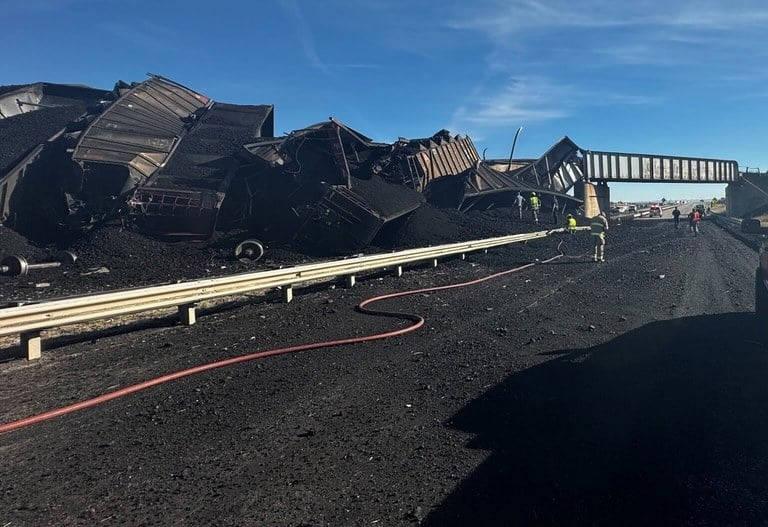
Colorado’s main north-south arterial, Interstate 25, is once again running smoothly or nearly so following an October 15th train derailment that shut down and later merely slowed the flow of traffic for days. The derailment also cost a long-distance driver his life.

Photo courtesy: CoDot.org

The train carrying thousands of tons of Wyoming coal to Pueblo’s Comanche Power Station hit a stretch of faulty track north of the city causing the derailment. The accident impacted thousands of drivers who were forced to detour, sometimes adding hours to their commute.

Investigators from both state and federal agencies say the derailment occurred just north of Pueblo between mileposts 106 and 107. The accident caused 30 railcars to go offtrack and the collapse of a bridge that joins the east to the west sides of the interstate. It is precisely where the truck driver was at as the bridge collapsed. He is identified as Lafollette Henderson of Compton, California.

Governor Jared Polis was on site to inspect the accident. “This is a terrible tragedy,” he told reporters. “But I want to thank our partners, both the railroad and federal government for working with us to minimize the disruption to Colorado, motorists and to interstate commerce.” Polis also shared his condolences to the driver killed in the accident.

It’s undetermined just how many drivers were inconve- nienced by the derailment, with some saying that it added as many as two to three hours to the trip from Pueblo to Denver, normally an hour and forty-minute commute.

“If you look at a map of Colorado,” said Colorado Department of Transportation’s Amber Shipley, “the nearest point getting back to Denver is Highway 115.” But, said one driver heading back to Denver from a weekend in Taos of the unexpected gridlock, “no one seemed to know how to get to the detour.”

Shipley said CDOT and Colorado State Patrol tried to direct traffic to the detour, but “people were ignoring our recommendation of 115.” The confusion or frustration only exacerbated an already difficult situation.

Shipley acknowledged that “there was a little bit of confusion…but there was signage pointing to 115.” The Highway 115 and I-25 connection is two miles south of where the accident occurred. From there it is 29 miles west to Penrose on Highway 50 and the recommended alternate route which takes drivers to Colorado Springs.

Repairs and cleanup went on around the clock, with much of the roadwork on the northbound side of the road. Interestingly, the stretch of track that investigators have pinpointed as the cause of the derailment had been inspected by BNSF just a short time before the accident.

While the stretch of I-25 is now accommodating a normal flow of traffic, speeds may continue to be at a slightly slower level and remain that way for a few more days or longer. Shipley also said that while near normalcy has returned, drivers may have to plan on delays in the days or weeks ahead as crews work to complete repairs on both the bridge spanning I-25 and the damage on the road caused by the weight of both the coal cars and their cargo.

Both Pueblo and Colorado Springs Fire Departments assisted in the aftermath of the accident.

For more information on the roadway and any restrictions on travel consult the Colorado Department of Transportation or visit Homepage- Colorado Department of Transportation (codot.gov).

National Prescription Drug Take Back Day highlights importance of proper disposal of medications

Protect your family and the environment by responsibly disposing of your unneeded or expired prescription drugs and over-the-counter medication at the Oct. 28 Drug Enforcement Agency’s National Medication Take Back Day.

Many Colorado communities will host events for National Prescription Drug Take Back Day from 10 a.m. to 2 p.m. A list of drop-off locations is available at the National Prescription Drug Take Back Day website.

If you can’t make it to the take-back event, the Colorado Department of Public Health and Environment’s Medication Take back Program has numerous permanent drop-off sites throughout the state.

Almost half of teens (47 percent) say it is easy to get prescription drugs from a parent’s medicine cabinet, according to the U.S. Substance Abuse and Mental Health Services Administration.

Proper disposal of unused medication prevents the potential for accidents and misuse, protecting children and teens from harm. Medications flushed down the toilet or thrown in the trash can contaminate water systems and threaten wildlife.

“Disposing of unused medication is easier than ever, and I’m thrilled our Medication Takeback program makes it so easy for Coloradans to do their part to protect their families and their community,” said CDPHE’s Division of Environmental Health and Sustainability Director, Jeff Lawrence.

Coloradans can responsibly dispose of their medications, free of charge and year-round, at Medication Takeback boxes at 300 locations across the state. The process is simple: gather unused or expired medications, remove any personal information from the packaging, place them in a sealable bag or container, and locate the nearest drop box at the Medication Takeback collection site. Almost all expired or unneeded prescription or over-the-counter medication can be disposed of in a Medication Takeback Dropbox. This includes:

  • Opioids and other controlled substances.
  • Prescription patches.
  • Prescription creams and ointments.
  • Unused medical inhalers (if empty).

Drop boxes do not accept:

  • Trash.
  • Sharps or syringes.
  • Thermometers.
  • Chemotherapy medication.
  • Illicit substances.

The Medication Takeback Program is also currently partnering with community organizations and non-profits statewide to continue promoting take backs even after National Prescription Drug Take Back Day ends.

For more information, visit the Medication Takeback Program website or TakeMedsSeriously.org.
Source: Colorado Department of Public Health & Environment

Latino key cultural characteristics

0
David Conde, Senior Consultant for International Programs

We cannot leave discussions and commentary on Latino heritage and cultural history without considering characteristics that have extensively influenced, in both positive and negative terms, the evolution of the Spanish speaking communities that came to colonize and be colonized by European expansion into the Americas.

They begin with stoicism that allowed for so much perseverance in the face of a history of conquest and colonialism in the Americas, the relatively brief moments of violence that ensue when patience reached its limits and the vertical hierarchies laid out in relationships like the patron system.

These topics remind me of my family’s experience in a Texas farm before leaving for Colorado. Since a child, I saw my father as a serious person that accepted without complaint whatever burdens came his way be it in the fields or at home.

I had heard that during the prohibition era and before marriage to mom he lived a somewhat violent life along the border. I am convinced that much of his activities at the time came from the collective effort to contribute to the well being of the families in the Rancho Solis Village in South Texas.

In this instance, we had just moved to a different farm because the farmer at the previous one had cheated us out of the income generated by sharecropping 40 acres of cotton. My father immediately went to work there driving a tractor and cultivating cotton fields from sunup to sundown.

One day during the early part of our stay, my father was leaving the field after sunset when the farmer came by and demanded that he continue to work at night indicating that it was why the tractor had lights.

My father hesitated and the farmer opened the glove compartment of his pickup revealing a gun in what looked like a threat mainly to his manhood. My father immediately got on the tractor and headed home followed by farmer. He went in the house, got his rifle and walked after the farmer who had gone into his house. Along the way, he dragged my mom who was begging him to calm down enough to think things through and find another way. My father’s story illustrates how a stoic tries to order those things that can be controlled and endures those that cannot until it becomes too much. Suffering the pain of conquest and life of a colonized people are things that have left a deep mark on Latino communities.

That tolerance however, can go too far and lead to violence. The Mexican historical experience is a great example of a nation that reached the limits of coping, sparking the uncontrolled conflict that was the Mexican Revolution.

The “overboard” experience can also be seen in Latino soldiers disproportionately wounded and dead in the battle fields. In this instance, the value of life is diminished to the point that, “la vida no vale nada.”

One of the major characteristics of colonial life was a vertical hierarchy of trust and authority among the class. That meant that you do what the person “above” you wants and in return he will protect and look after you. That relationship typified by the patron system has done a lot of damage to the acculturation of Latinos to American life. That is because in this country, we live in a horizontal society where everyone is theoretically equal.

Those characteristics have influenced Latino life over the centuries for both good and bad. Also, not all have enriched the American experience.

The views expressed by David Conde are not necessarily the views of LaVozColorado. Comments and responses may be directed to news@lavozcolorado.com.