David Conde, Senior Consultant for International Programs
As Russia begins its spring offensive and Ukraine is preparing to do the same, the rush to bring troops, ammunition and equipment to the front is on. It is reported that Russian losses is approaching 200,000 casualties and has had to go to its reserves to make up for them.
Ukraine is asking for help that includes German and American heavy battle tanks among other things. Both countries will come out of their trenches and the bloodletting is expected to continue.
Lurking in the background is the potential confrontation of Europe, the United States and Russian over NATO’s assistance to Ukraine. Also, the continuation of heavy Russian invasion loses can tempt its leadership to use battlefield nuclear weapons and risk a deadlier conflict that can involve the world.
This potential doomsday scenario is what the Cold War was all about. The threat of a nuclear exchange was always part of that circumstance and there were several times that America and its allies reach the brink of catastrophe with the Soviet Union.
Things changed somewhat with the fall of the Soviet Union toward the end of the 20th Century. However, a diminished Russia still has a vast nuclear arsenal and continues to pose a threat to the world.
We learned many military lessons from the Soviet Union. However, the economic might of the United States combined with the Soviet inability to compete in that area led to their downfall.
Not so when it comes to China. Although it is under communist rule, China nevertheless is an economic giant in the making and a growing military power.
The fact is that China is strong in commerce and trade, and that makes it possible for the world free market econo- mies including the United States to develop a different way of dealing with this adversarial relationship. One of the best initiatives in the area was the Trans-Pacific Partnership (TPP) negotiated under the Obama administration and signed in 2016.
The TPP organized an economic block of 12 Pacific rim countries including Australia, Brunei, Canada, Chile, Japan, Malaysia, Mexico, New Zealand, Peru, Singapore, Vietnam and the U.S. It proposed to set the rules for international trade in the Pacific and Eastern Asia and require everyone, including non-member countries like China, to follow those rules and stop violations of such things as intellectual property rights as part of a trade relationship.
Waiting on the sidelines to also join were Taiwan, the Philippines, Colombia, Thailand, Indonesia, Bangladesh, India, Sri Lanka and Cambodia. The block represented 40 percent of world GDP and one third of global trade.
The United States Senate did not get to ratify the treaty because President Trump withdrew from the agreement in 2017. But the way for a more healthy rivalry using business rather than military competition was discovered and could be done again.
World commerce is the stock and trade of market economies like the United States and the other developed countries. Given our history with capitalism and free enterprise this approach is also to our advantage.
It is time to think of a different dynamic to get along bet- ter as a community of nations. The world is being threatened by serious issues affecting all people and we need to think more of coming together to confront common challenges.
One way of doing this is to compete with ideas, creativity and the production of goods and services for the marketplace and not try to find military solutions to issues. Genuine economic competition with China provides a start.
The views expressed by David Conde are not necessarily the views of la Voz bilingüe. Comments and responses may be directed to news@lavozcolorado.com.
The Zoo Launches a Naming Contest and Fundraiser to Ensure Its Adorable New Arrival Grows Up Strong…and Slow
After months of patiently waiting, the Denver Zoo welcomed a baby Linne’s two-toed sloth to its Tropical Discovery habitat on Jan. 26. Born to mom, Charlotte, and dad, Elliot, the healthy pup is a conservation win for the slow-moving species, and the adorable result of the exceptional care the Zoo’s animal care and animal health teams provided throughout Charlotte’s pregnancy. Now, the Zoo is revealing that the pup is a boy and inviting the community to choose his name.
For a $5 donation per vote, sloth and Denver Zoo fans aselected by the sloth family’s adoring keepers. All donations will go towards the care of Charlotte, Elliot, baby sloth (name TBD) and the Zoo’s other 3,000 wild residents. Name options include:
Photo courtesy: Denver Zoo
RAIN: Inspired by the tropical rainforest from which this species hails, a vote for RAIN will make sure the little guy is always showered with love.
WICKET: The Zoo’s last sloth naming contest, did, in fact, let the Wookiee win—so it’s only fittingthat his little brother be named after an Ewok!
CAPPUCCINO: While the little guy is NOT caffeinated, he does have a beautiful café con leche coat— and he’s perfectly sweet, even sin azucar.
February 2023 is the last month that temporary additional SNAP benefits, also known as emergency allotments, will be paid. This will have an impact on SNAP households that have been receiving the additional emergency allotment for the past two years. The federal, pandemic-era benefit, officially known as the Supplemental Nutrition Assistance Program, was implemented to help low-income families and individuals buy groceries. Beginning March 1, 2023, SNAP households will see a reduction in benefits to the pre-pandemic monthly amount.
The Denver Department of Public Health & Environment (DDPHE) recognizes this change may have a significant impact on many SNAP families. To help reduce the impact on households, DDPHE recommends families and individuals who rely on SNAP prepare now for the decrease in benefits.
Start now. Figure out how the decrease in SNAP benefits will affect your grocery budget and adjust it now.
Conserve and roll over unused SNAP benefits to thenext month. Unused benefits can remain on EBT cards for up to nine months. This may help cushion the impact of the reduction in benefits.
Stock up on non-perishable items now, while you have the additional benefits.
Prepare a shopping list with items that you really need and stick to it. For example, omit beverages like soda pop and fruit drinks, which can be expensive. Instead, try to stick to water and milk at home.
Utilize free online resources for affordable meal and snack ideas. Some sites have SNAP-friendly suggestions
Come up with substitutes for items that have been and may be hard to find. This will help you stick to the items you really need.
Buy perishable food items that you can freeze to help stretch out SNAP benefits.
FREE At-Home Test Kits Still Available
Testing for COVID-19 continues to be one of the best ways to minimize the spread in our community. At-home test kits are still available:
Every home in the U.S. is eligible to order four free at-home tests from the federal government.
Free testing kits are available at most Denver recreation centers.
At-home test kits are available for purchase on retail sites like Amazon, CVS, Walmart and Walgreens.
In-person and drive-thru testing is available at pharmacies and drug stores like Walgreens, CVS, King Soopers and Safeway.
Statement from President Joe Biden on Travel to Kyiv, Ukraine: “As the world prepares to mark the one-year anniversary of Russia’s brutal invasion of Ukraine, I am in Kyiv today to meet with President Zelenskyy and reaffirm our unwavering and unflagging commitment to Ukraine’s democracy, sovereignty, and territorial integrity.” Read President Biden’s entire statement at https://bit.ly/3Z2rM0I.
Colorado Governor
Governor Polis appointed Reid R. Stewart to the La Plata County Court in the 6th Judicial District. The vacancy was created by the appointment of the Honorable Anthony Nathaniel Baca to the 6th Judicial District Court and is effective immediately.
Denver Mayor
The Denver Department of Public Safety formally opened the Assessment, Intake, and Diversion (AID) Center to serve as a connection point to free comprehensive community and systems-based services. “One thing is clear, and that is public health is increasingly at the center of public safety, and bringing these two elements together is essential to any strategy to make our streets safer and healthier,” Mayor Michael B. Hancock said.
Hundreds of militants reportedly killed – Authorities in Somalia said they killed 300 al-Shabab militants in an operation. The attack involved air strikes with international partners, including the United States. The al-Shabab group has recently been losing controls of parts of central and southern Somalia. No civilians were injured in the attack, and al-Shabab has yet to comment on the incident.
Spies hack Kenya phones – Kenya has accused Israeli hackers of hacking into private conversations of aides to Kenya President William Ruto. The hacking occurred shortly before Kenya’s 2022 election, and it is unknown who hired the hacking team. It is believed the hackers were attempting to launch a disinformation campaign against Ruto. He won the election when he defeated main opposition leader Raila Odinga.
Asia
South Korea removes women-only parking spaces – South Korea officials plan to remove women-only parking spaces, saying the spaces aren’t necessary. The idea of women-only parking spaces was first installed in 2009 after numerous crimes in basement car parking garages. Data shows 66 percent of violent crimes in Seoul, South Korea that occurred in the city’s parking garages were sexual crimes like assault and rape. The parking spaces will be converted to family parking spaces.
Elderly residents protest in China – Protests in China among elderly residents occurred against cuts to medical benefits. In Wuhan, provincial authorities announced they planned to cut the level of medical expenses retirees can claim back from the government. Protests have been widespread in China. Toward the end of last year, young Chinese residents protested China’s strict zero-COVID measures.
Europe
Spain announces new gender changing laws – Spain introduced a new law that will allow people over age 16 to change their legally recognized gender without medical evaluation. Meanwhile, Spanish lawmakers also passed a law that includes paid menstrual leave for women who are suffering severe menstrual pain. Denmark became the first European country to pass a similar gender change law in 2014.
Dozens of migrants missing – The International Organization for Migration announced last Tuesday that at least 73 migrants are reported missing and presumed dead. Last week, a shipwreck off the Libyan cost occurred. Authorities say only seven survivors made it back to shore. Those survivors were admitted to a hospital and are considered to be in “extremely dire conditions.” The ship was headed to Europe at the time of the wreck.
Latin America
Arrests made over Haiti president assassination – Four people have been arrested for alleged roles in the plot to assassinate Haitian President Jovenel Moise. The arrests were made by the United States, and there are now 11 suspects in custody. Moise was shot and killed at his home in July 2021. Hati’s investigation into the incident has been slow as three judges have resigned from their posts because of security concerns.
Machu Picchu reopens – After being closed for more than three weeks because of anti-government protests, Machu Picchu in Peru has reopened. Tourism is an important economic generator in Peru. Protesters had been blocking key access routes to Machu Picchu. Protests have ensued since December when Peru President Pedero Castillo tried to dissolve congress before it could vote to impeach him.
North America
Oakland Police Chief fired – Oakland Police Chief LeRonne Armstrong has been fired after allegedly failing to adequately discipline a sergeant involved in a hit-and-run. The police department has been under federal oversight for more than 20 years because of a police corruption scandal in 2000. Armstrong is the seventh police Chief to leave the department in the past seven years.
Photo courtesy: Rachel Welch Twitter
Raquel Welch dies at 82 (September 5, 1942 – February 15, 2023) – Raquel Welch, who is credited for paving the way for action heroines, passed away peacefully last week. She is known for playing a bikini-clad cavewomen in a 1966 film and for winning a Golden Globe for her role in “The Three Musketeers.” Welch appeared in more than 30 movies and 50 television shows throughout her career.
Adorned as if it were a professional wrestling match and repeatedly yelling ‘Liar!’ at the top of her lungs, Georgia Republican Congresswoman Marjorie Taylor Greene perversely stole the show and any thoughtful Republican response to last week’s State of the Union Address.
Surreally dressed in all-white complemented by faux fur—to symbolize, she said, the Chinese balloon that had captured headlines as it drifted across the country— Greene’s choice of clothing and raucous behavior seemed almost overlooked by colleagues, many of whom were pictured staring straight ahead or scrolling through their phones all through Greene’s choreographed performative rage. Meanwhile, President Joe Biden sailed through his speech stopping periodically to sometimes subtly, other times teasingly, joust with the other side.
The two parties seemed almost to be watching the President’s address to the nation through opposite ends of a telescope, Democrats applauding Biden for his promise not to cut Social Security and Medicare benefits as Republicans sat either silently or alternately jeering at the same lines.
As these annual addresses go, the 2023 version may have set a new standard in decorum or absence thereof. Once thought extreme and outrageous when at 2009’s State of the Union Address South Carolina Republican Congressman Joe Wilson yelled out, ‘You lie!’ as President Obama spoke about immigration, this year’s version lowered the bar to subterranean levels with mainly Greene nearly drowning out any vision of the nation’s state, political though it may be.
Seemingly oblivious to what the country watched, Colorado Republican Congressman Doug Lamborn focused instead on party talking points, overlooking the country’s steady resistance against challenging economic headwinds conceived by COVID and the subsequent supply chain snarls that ensued and continue to impact world economies.
“Domestically, American families are struggling,” said Lamborn, punctuating his words with specific responsibility he laid at the doorstep of the President and his party, especially on “social and climate justice policies.” The Colorado Springs Republican pointed directly at the President for rising prices and an ever-growing national debt, overlooking that same debt’s growth over the previous administration.
Colorado Democratic Senator Michael Bennet touted President Biden’s message and accomplishments over the course of the last two years, calling it “historic progress.” Bennet praised the Biden effort of “keeping millions of kids out of poverty” with the Child Tax Credit legislation and jump starting work on rebuilding the nation’s aging infrastructure thanks to the passage of the bipartisan infrastructure bill.
The nationally televised speech was viewed by the second smallest audience to view a State of the Union. The latest version drew only 27.3 million viewers compared to 38.2 million who tuned in last year. While it was a decline of 28 percent, last year’s numbers may have been a reflection of an audience tuning in to hear what the President had to say after the pandemic’s toll had eased.
The cacophony from Greene, especially when Biden stood fast against any cuts to Social Security, seemed odd considering it was actually the platform put forth by Florida Republican Senator Rick Scott in his 2022 ‘12 Point Plan to Rescue America.’
Scott’s plan specifically states, “All federal legislation sunsets in 5 years. If a law is worth keeping, Congress can pass it again.” When it was released, the plan was enthusiastically endorsed by former Republican Speaker of the House Newt Gingrich.
“Like the Contract with America it will help win the election,” said the former Speaker. “More importantly,” Gingrich said just months ago, it would “serve as a blueprint for the new Republican majority to focus on solving problems and creating a dramatically better American future.” The entire plan can be read at rescueamerica.com.
Colorado Democrats watching the President saw a man who answered the tempest of criticism from Republicans who have sharpened their spears on the grindstone of immigration, climate and social parity. “The thing that really made my heart glad,” said former Thornton Democratic Representative Joe Salazar, was the president’s message that “progressivism is very much alive.”
Salazar, who was term limited and ran unsuccessfully for Colorado Attorney General, also said he cringed at the comportment of Greene and a handful of her colleagues. “I know you can never count out Republicans for exhibiting the worst of behavior and that is exactly what happened.” What the country witnessed, Salazar said, was a disrespect for our “institutions, our President, history or the solemn dignity of the State of the Union.” It was, he said, a party’s “race to the bottom.” On Republicans remaining silent on Greene’s theatrics, Salazar said “it reminded me of the police where good cops sometimes just sit on their hands” as others despoil their profession.
Following the State of the Union, newly elected Arkansas Governor and former Trump press secretary Sarah Sanders delivered the traditional out-of-power party’s response to the Biden address. But rather than tout a positive counter and different perspective to cutting Social Security and Medicare, critics called her response dystopian, laced with attacks on LGBQT rights, critical race theory and ‘wokeness.’
“The choice,” she said, “is no longer between right and left” but tantamount to one between “normal and crazy.” Sanders’ response highlighted a few of her first acts as Governor of Arkansas, including acts aimed at ‘ending racism’ in her state’s classrooms. Among them were banning the term ‘Latinx,’ and banishing CRT which she said, “emphasizes skin color as a person’s primary characteristic, thereby resurrecting segregationist values, which America has fought so hard to reject.” It should be noted that CRT a college course and not taught below the high school level.
Sanders’ banning of ‘Latinx’ and CRT effects only 22.3 percent of the state’s population while having only minimal impact on the remaining 87.7 percent of the state’s 3,025, 000 residents.
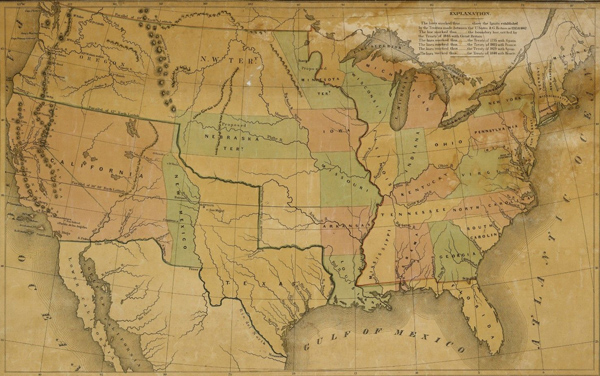
On the 175th anniversary of its signing, the Treaty of Guadalupe Hidalgo made its way to the History Colorado Center in Denver from Washington D.C. at the beginning of the month. And until May 22, Coloradans can see pages from the original document that significantly expanded the United States and set the stage for Colorado’s statehood.
The Treaty of Guadalupe Hidalgo’s pages are on display at the History Colorado Center’s Borderlands of Southern Colorado exhibit — a section of the museum that explores the shifting geopolitical history of Colorado.
Photo courtesy: U.S. National Archives
Map of the United States, Including Land Acquired by the Treaty of Guadalupe Hidalgo, that Accompanied President Polk’s Annual Message to Congress in December 1848.
The treaty, which was signed on February 2, 1848, ended the Mexican-American War and paved the way for expansion of the United States by shifting the border south from the Arkansas River to the Rio Granda and west to the Pacific coast of California. The signing of the treaty forced the Mexican Republic to relinquish all claims of Texas and the country lost 55 percent of its territory to the United States.
The land that the Mexican Republic relinquished would eventually become all or parts of Arizona, California, Nevada, New Mexico, Utah, Wyoming, and a large portion of western and southern Colorado.
In a release, the History Colorado Center noted that the redrawing of borders did not alter the linguistic, ethnic, and geological boundaries that were already taking shape in places like the San Luis Valley in southern Colorado.
“Many people are not familiar with this aspect of Colorado’s identity,” said Dawn DiPrince, History Colorado’s Executive Director and State Historic Preservation Officer in the release. “This borderlands’ history is very important to individuals, families, and communities of southern Colorado, and we are proud to collaborate and share this history with a broader audience to expand the way Coloradans understand the history of our state.”
The change of the U.S.-Mexico border transformed citizenship, rights, and property claims of Mexican nationals who lived in the region. Regional residents were dispossessed of their lands and wealth while women — who had a right to own land and property in the Mexican Republic — had those rights revoked following the signing of the treaty and occupation by the United States.
The History Colorado Center also acknowledged that the Treaty of Guadalupe Hidalgo is connected to the displacement of Indigenous tribes.
“In some ways, it is hard to fathom that old handwritten pages would wield such power over the lands and lives of so many in this part of the world, but this treaty dramatically altered the lives of many families who call southern Colorado home today,” DiPrince said in the release.
The National Archives and Records Administration in Washington, D.C. loaned four pages of the treaty to the History Colorado Center.
The museum is open every day of the week from 10 a.m. to 5 p.m. Tickets cost $15 for adults aged 19 and up while kids aged 18 and under can visit the museum for free.
Super Bowl 57 is in the books and for the most part it was an entertaining Super Bowl between the two best teams in the league going at it that is until it wasn’t.
For most of the 60 minutes of play on Super Bowl Sunday two teams laid it all out on the field trading scoring drives in a well evenly matched game where even the refs appeared to let the players play.
There were a combined 9 penalties for 47 yards one of which became a beacon for all that was wrong in Sunday’s game. While many see no fault in the call, many more were in utter disbelief as to how a single controversial play would solidify the winner in Sunday’s matchup.
The play? The Kansas City Chiefs were in Philadelphia territory on the inside of the two-minute-warning with third-and-8 to go. Chiefs quarterback Patrick Mahomes tried to hit JuJu Smith-Schuster with a lobbed pass into the end zone that appeared well out of reach. A flag was thrown and a defensive hold was called on Eagles defensive back James Bradberry.
After several replays were shown across the screen the nation could almost hear a collective sigh at just how ridiculous the call was. The penalty gave the Chiefs a new set of downs that allowed them to chew up the clock and kick a game winning field goal.
The opportunity for the Eagles to hold the Chiefs to just a field goal with almost 2 minutes left to play would have offered them the opportunity to either tie the game or even win with a touchdown.
Fortunately for the Chiefs, they picked up their third Lombardi trophy tying both the Denver Broncos, and the Las Vegas Raiders. The only team in the AFC West without a Super Bowl win comes from the L.A. Chargers who many thought would press the Chiefs for first in the division.
Next season the Chiefs are expected to see stiffer competition from its division rivals especially since there appears to be a culture shift on the horizon for the Denver Broncos after hiring Sean Payton.
In other sports the Denver Nuggets have won two of their last three games, which were all on the road since last week. Denver’s more recent win came against the Miami Heat in Miami on Monday night. The Nuggets were without Aaron Gordon and Jamal Murray who were out due to a rib contusion and knee inflammation.
The Nuggets are at home at Ball Arena to host the Dallas Mavericks on Wednesday who recently acquired Kyrie Irving from the Brooklyn Nets at the trade deadline. Irving played 37 minutes in his debut with the Mavericks last Wednesday against the Los Angeles Clippers where he scored 24 points and had 4 rebounds and 5 assists.
Both Murray and Gordon are expected to play in Wednesday’s game.
It is not a new story but one that continues to grow in importance and with a deeper and more alarming degree of concern. With an aging baby boom population along with sudden and unexpected health issues like a pandemic, the country’s nursing shortage is morphing into a critical need stage requiring additional if not immediate attention.
In Pueblo, places where two of Colorado’s premier nursing schools are located, newly minted candidates are funneling into the pipeline each year. And just in time.
In Colorado and nationwide, says the website nursejournal.org, there is an acute and ever-growing shortage of qualified professionals to fill this void. It is estimated that by the end of this decade there will be a shortage of 175,000 registered nurses across the country, despite an 11 percent annual growth rate in the profession.
Pueblo Community College and Colorado State University-Pueblo have for years been graduating and placing nurses into jobs across a region larger than even many U.S. states. Nurse openings do not remain open very long.
“A lot of our students will have jobs before they graduate,” said PCC’s Director of Nursing, Eva Tapia. That doesn’t mean placing an unqualified nurse but rather placing someone trained in the duties and responsibilities of a nurse yet under the mentorship of a nurse assigned to monitor his or her performance.
Besides Pueblo, PCC also operates nursing programs at its satellite campuses in Cortez, Durango, Fremont County and Mancos. The benefit of having these programs is providing smaller communities with someone who knows the people and who will remain in the community for the long term.
Graduates of the two-year PCC program leave with state licensure and are bestowed the title of Registered Nurse along with the privilege of working as such across the state of Colorado.
Each of PCC’s nursing students is, like all students, required to take the core general education classes, said Tapia. Nursing students, she said, are then required to have “750 clinical hours in the (nursing) program spent in hospitals and clinical settings.”
Ten minutes from the PCC campus on the city’s far northeast side, Dr. Joe Franta runs CSU-Pueblo’s College of Health, Education and Nursing. CSU-Pueblo’s nursing program is now nearing its sixth decade of graduating nurses.
“Our first class,” said Franta, “had about twenty students.” Today, Franta estimates, “our peak semester (spring) we have 300 students” in the program.
Still, while the rate of qualified graduating nursing candidates may seem able to fill job openings, jobs are occurring at an even faster pace. While the aging baby boom is creating more demand for nursing candidates, there is also the issue of aging baby boom nurses who are now retiring and leaving the profession.
Also creating holes in the nursing fabric is the stress level endemic in the profession, a level exacerbated by the COVID pandemic where more than a million Americans died of the virus and several million more were hospitalized but survived. Franta says the long hours necessitated by the patient overload and the constant exposure to pain, suffering and death naturally took a toll.
Managing stress that is inherent in nursing is addressed very seriously in both the PCC and CSU-Pueblo nursing programs. “Most programs,” Franta said, “have role portions to the course. We talk about seeking help early,” if the weight of the job is taking a toll. Also, said the veteran nurse and administrator, “If I see or think someone’s in trouble, I’ll talk with them. We intervene.”
And while schools are challenged to turn out qualified nurses, another challenge says nursesjournal.com is finding enough qualified instructors. Meanwhile, the healthcare deficit continues to grow even as salaries in the profession do, too.
Graduating nurses, said the CSU-Pueblo nursing director, can earn a starting salary of somewhere between $60- $80,000 per year. Salaries, of course, are predicated on location. Smaller communities will naturally have lower salaries. But in larger metropolitan areas, he said, nursing salaries can hover between $100-150,000.
Colorado now sits 21st in state ranking in nurses-to-patients ratio with an 8.95 per 1,000 patients ratio. Neighboring Utah has the country’s best nurses-patient ratio at 7.26 per 1,000 while Washington, D.C. ranks last with a 16.74 per thousand nurse-patient ratio.
Most of the nursing candidates at PCC and CSU-Pueblo are from Pueblo or the nearby region. But Franta thinks students considering the profession from Denver or other Front Range cities would be wise to consider Pueblo to train for a career he says has been fulfilling to him for more than 30 years.
“We’re a highly qualified program and do well at training nurses,” said Franta. “We believe and honor the mission of our university: “We’re the ‘People’s University of the Southwest.”
While Florence Nightingale may be the profession’s best-known nurse, it may be the words of another nurse who best sums up this invaluable vocation: “Nurses are a unique kind,” said nurse and professor Jean Watson. “They have this insatiable need to care for others, which is both their great- est strength and fatal flaw.”
Free Days occur throughout the year, thanks to funding from the Scientific and Cultural Facilities District (SCFD). Free Day at the Denver Botanic Gardens will be Thursday, Feb. 16. Advanced online registration is required to ensure that we can accommodate people safely given ongoing COVID-19 concerns. Free Days are for regular Gardens hours only and do not include ticketed events. Tickets will be available three months at a time (on a rolling basis) and the tickets will be released on the 1st of the month.
Join Scientific and Cultural Facilities District for a Free Day at both Wings Over the Rockies locations. Receive free admission on Monday, February 20 from 10 a.m. to 5 p.m. at Exploration of Flight.
Photo courtesy: LeAnn Fenton Casa Bonita Sopapilla
NEXT Gallery is thrilled to host the 6th Annual Casa Bonita Art Show! The show celebrates Casa Bonita – a 52,000 sq-ft restaurant in Lakewood, Colorado. The restaurant offers up a 3-story waterfall, gunfights, gorilla chases, puppet shows, a haunted cave and much, much more. You never know what you are going to get at this art show – The inspiration is endless.
Opening night: February 17th – 5-10 p.m.
Show runs: February 17th-March 4th.
Gallery hours: Fri 5-10 p.m., Sat/Sun 12-5 p.m.
Que Pasa? is compiled by La Voz Staff. To submit an event for consideration please email attractions@lavozcolorado.com with Que Pasa in the subject line by Friday at 5 p.m

























Economic competition with China is better than war
As Russia begins its spring offensive and Ukraine is preparing to do the same, the rush to bring troops, ammunition and equipment to the front is on. It is reported that Russian losses is approaching 200,000 casualties and has had to go to its reserves to make up for them.
Ukraine is asking for help that includes German and American heavy battle tanks among other things. Both countries will come out of their trenches and the bloodletting is expected to continue.
Lurking in the background is the potential confrontation of Europe, the United States and Russian over NATO’s assistance to Ukraine. Also, the continuation of heavy Russian invasion loses can tempt its leadership to use battlefield nuclear weapons and risk a deadlier conflict that can involve the world.
This potential doomsday scenario is what the Cold War was all about. The threat of a nuclear exchange was always part of that circumstance and there were several times that America and its allies reach the brink of catastrophe with the Soviet Union.
Things changed somewhat with the fall of the Soviet Union toward the end of the 20th Century. However, a diminished Russia still has a vast nuclear arsenal and continues to pose a threat to the world.
We learned many military lessons from the Soviet Union. However, the economic might of the United States combined with the Soviet inability to compete in that area led to their downfall.
Not so when it comes to China. Although it is under communist rule, China nevertheless is an economic giant in the making and a growing military power.
The fact is that China is strong in commerce and trade, and that makes it possible for the world free market econo- mies including the United States to develop a different way of dealing with this adversarial relationship. One of the best initiatives in the area was the Trans-Pacific Partnership (TPP) negotiated under the Obama administration and signed in 2016.
The TPP organized an economic block of 12 Pacific rim countries including Australia, Brunei, Canada, Chile, Japan, Malaysia, Mexico, New Zealand, Peru, Singapore, Vietnam and the U.S. It proposed to set the rules for international trade in the Pacific and Eastern Asia and require everyone, including non-member countries like China, to follow those rules and stop violations of such things as intellectual property rights as part of a trade relationship.
Waiting on the sidelines to also join were Taiwan, the Philippines, Colombia, Thailand, Indonesia, Bangladesh, India, Sri Lanka and Cambodia. The block represented 40 percent of world GDP and one third of global trade.
The United States Senate did not get to ratify the treaty because President Trump withdrew from the agreement in 2017. But the way for a more healthy rivalry using business rather than military competition was discovered and could be done again.
World commerce is the stock and trade of market economies like the United States and the other developed countries. Given our history with capitalism and free enterprise this approach is also to our advantage.
It is time to think of a different dynamic to get along bet- ter as a community of nations. The world is being threatened by serious issues affecting all people and we need to think more of coming together to confront common challenges.
One way of doing this is to compete with ideas, creativity and the production of goods and services for the marketplace and not try to find military solutions to issues. Genuine economic competition with China provides a start.
The views expressed by David Conde are not necessarily the views of la Voz bilingüe. Comments and responses may be directed to news@lavozcolorado.com.