






Home Blog Page 189

The role of the Latino community in a divided country

0

By: David Conde

Senior Consultant for International Programs

The history of the United States has been a series of ups and downs that include ultimate tests of our democracy. This includes issues such as slavery, the integration of immigrants, westward expansion, the American Civil War, two world wars, terrorism, increasing crisis in our natural environment, attacks on our institutions at home and challenges to our global leadership by forces of change.

Among these forces are those associated with social and political extremism driven by grievances of all kinds.

The Latino community lived a generation of expressed grievances in its struggle to find space and justice in American consciousness especially after World War II. Veterans returning from the war found the same or worse conditions than when they had left to fight and were ready to do something.

Rampant discrimination against these war heroes called for a major campaign to fight discrimination. The birth of the farm workers unionizing effort in California, the land grant recovery struggle in New Mexico and the Chicano Movement’s fight beginning in the American Southwest and spreading across the country, formed the basis for the appearance of extreme elements that characterized the street encounters to find redress.

The issues of oppression and relative lack of fair play were framed within a context of a majority in power acting against the interests of minority communities.

As predicted however, this context gradually changed as the community of minorities started the drive to become the majority.

This notice of change is creating deep divisions in American life caused by extreme elements of the White establishment that feel that they are losing control of the country and that they will be replaced in some fashion. There are other substantial elements of that same establishment that see this as a process of a maturing diversified nation.

These distinctions have found their way into the two major political parties with one, the Republican Party, being taken over by white racists concerned about power. So, in addition to traditional positions of small government, strong defense and an emphasis on business, the Republican Party now also represent White racial and ethnic bigotry.

The fight to maintain racial superiority by extreme elements of the White community is also leading to a stark competition between the rising forces of autocracy against a historical commitment to democracy. This is so serious that the great political experiment that defines American exceptionalism is in danger of falling.

Interestingly enough, the Democratic Party is heavily influenced by the Black community. This sets up a very visible contrast between racially conscious Black and White America.

In the middle of the two groups stands the Latino community, a relative quiet partner in what is a very noisy national political scene. Its growth by 2100 to include 1 of every 3 residents and more depending on the difficult to predict immigration trajectory will obviate a prevalent say in managing the country.

It has been a tradition to celebrate the diversity that comes from being an immigrant country. This diversity in race, ethnicity, language, color and cultural richness is something that together with a democratic history, are the building blocks of our exceptionalism.

It happens that the diversity we value is an inherent characteristic of the Latino community. Much of that community reflects the multiplicity of images, styles and desirable attributes in its cultural landscape.

In the face of our present division, the Latino community offers a vision that can bring our country together. It also offers a face and image of a new America.

Football season has finally arrived

0

This Saturday the Denver Broncos take the field at Empower Field at Mile High with a new pep-in-their-step.

For six years the Denver Broncos searched for a quarterback to take them back to the promised land, and for six years they came up short, really short. Since Denver’s Super Bowl win in 2015 under Peyton Manning, the Broncos have had just as many quarterbacks under center. Count them, Brock Osweiler, Trevor Siemian, Paxton Lynch, Case Keenum, Joe Flacco, Drew Lock, Brandon Allen, and Teddy Bridgewater.

Not all were the same but in the end, the results were the same, no postseason appearances. In the past six seasons, Denver has had a combined record of 39-58 with one season at number 2 in the AFC West, two seasons at number 3 in the AFC West, and three seasons last in the division including last season.

With the acquisition of Russell Wilson, things have certainly changed the attitude of Broncos fans, especially since the start of training camp. The offense has recently begun to mesh and Denver’s offensive coach Justin Outten has echoed that by his take on whether Wilson will be throwing the deep ball this season, “I would say yes, and we invite that,” said Outten.

The deep ball has been amiss since Peyton and although Lock attempted a few deep passes none were as accurate as Wilson attempts during training camp.

On Saturday the Denver Broncos will be hosting the Dallas Cowboys this Saturday at 7 p.m. however, some fans will get a preview of Saturday’s game with the Broncos announcing they will have joint practices with the Cowboys leading up to Saturday’s game.

In other news, the Colorado Rockies lost four of five to the San Diego Padres last week and two of three to the Arizona Diamondbacks over the weekend sending them back to the basement of the National League (NL) West.

The Rockies kick off a three-game series with the St. Louis Cardinals this week (results of game one not available at the time of this writing) before hosting the Diamondbacks in a three-game series that kicks off this Friday at 6:40 p.m. MST. The Rockies are now 28.5 games behind the L.A. Dodgers and 12 games behind the second-place Padres.

The Denver Nuggets are just two months away from the start of the preseason with both Michael Porter Jr. and Jamal Murray expected to return. It’s still unclear in what capacity both will return but fans are excited to see a healthy Denver Nuggets lineup heading into the upcoming season.

The Colorado Rapids have won three of their last four games with their most recent win over the Minnesota United FC 4-3. The Rapids were coming off a win over the New York Red Bulls four nights prior where they beat the Red Bulls 5-4. This Saturday the Rapids are in Columbus Ohio to face the Columbus Crew.


Pueblo Schools focus on a new school year, the future and post-COVID

Big things are happening in Pueblo’s School District 60, the largest school district in southern Colorado. For starters, the district has five new schools under construction, and each will be ready for occupancy next fall. But, for now, the most important focus is on the start of school for more than 15,000 students in just days.

Pueblo’s first day of school is scheduled for Tuesday, August 17th, said Superintendent Charlotte Macaluso. Though that means the doors open to the city’s 22 elementary, five middle schools and four high schools in just days, there has been a flurry of activity in the schools for weeks now as teachers and staff prepare buildings for a ‘new beginning.’

By that, it means for the first time in nearly two and a half years, the specter of COVID, the virus that took its toll on Colorado, the nation and the world, is not the primary focus. Though, as we have learned, it is never far out of the picture. “Right now,” said Macaluso, “we don’t require masks…until we get data from our community, we will just kind of navigate our way through.”

Macaluso, who has been in the city school’s top job since 2016, is also a Pueblo native and product of its schools. The native eastsider not only attended Spann Elementary, Risley Middle School and East High School, she also served as a teacher at Spann and teacher and principal at Risley before moving into administration.

Macaluso is proud of the trajectory the city’s school have had during her tenure, especially its decreasing dropout rate. That is not suggest that she has taken her eyes off it nor those students who may be considering dropping out. In fact, in a recent telephone interview, Macaluso said she periodically meets with a young person who is weighing their choices.

“I talk about how many doors are closed if they don’t have a high school diploma,” she said. She is candid in her chats and also mindful that college may not be what is best for those students she meets with. “Not all students,” she said, “need to go to college.” Instead, she’ll offer guidance about considering the military or, perhaps, a technical school. Her point is that learning is a lifelong undertaking. Like the students under her, learning is also something she makes the time for when she’s not overseeing the district and its nearly 2,400 staff.

Just like a student going from elementary school to middle school or middle to high school, Macaluso tries to sharpen her own skills and become better at her own job. She travels to educational gatherings throughout the summer for personal development. “I went to the NALEO (National Association of Latino and Appointed Officials),” she said. She said the gathering was “energizing.” The organization has also been a launching pad for some of the country’s highest ranking public officials.

Macaluso said as a superintendent it’s important to make sure you’re always “learning best practices alongside others.” She also spends a lot of time reading books by experts in education. The book that had the biggest impact on Macaluso’s summer reading list was “Culturally Responsive Teaching & The Brain,” by nationally recognized writer and former classroom teacher, Zaretta Hammond.

A review of Hammond’s book says it “blends practical brain science with the need for awareness of individual and collective culture.” It is a book that may be particularly important in a school district like Pueblo’s where the majority of the student population is Latino. Hammond writes that “culture programs the brain.”

Like every school district, from the nation’s largest to the tiniest and most remote, Macaluso said, educators have had to adapt to a pandemic that few if any had ever imagined would occur in their lifetime. But, she said, the virus has “shined a light on the continuing achievement and opportunity gap among our scholars.” As teachers, a job she knows well, Macaluso said, “We need to be careful as educators that we don’t exacerbate teaching gaps…making sure we’re engaging critical thinkers.”

For now, Pueblo District 60 is in the backstretch in completing the five new schools that open next Fall. Two of the new schools, Centennial and East, will replace high schools of the same name. Each of the old schools will be demolished before school opens next year. East, coincidentally, is Macaluso’s alma mater.

There might be a moment or two of melancholy seeing her old high school transformed into piles of brick and mortar, she said, but “I will always have and treasure the memories of the old East High.” But as she looks forward, Macaluso said she is more encouraged and uplifted by a city and a district looking and planning for the future.

Our Government

White House

Statement by President Biden on Senate Passage of the Inflation Reduction Act: Senate Democrats sided with American families over special interests, voting to lower the cost of prescription drugs, health insurance, and everyday energy costs and reduce the deficit while making the wealthiest corporations finally pay their fair share. Thirteen million Americans, covered under the Affordable Care Act, will see their health insurance premiums reduced by $800.

Colorado Governor

Governor Polis, Secretary of State Jena Griswold, and state legislators joined Colorado entrepreneurs and small business owners to announce that over 10,000 new Colorado businesses (LLCs) have been filed since July 1, when a new law signed by Gov. Polis and passed by the legislature took effect making it nearly free to start a business. “I am thrilled that this new money-saving plan has reduced costs for so many Colorado entrepreneurs, creating 10,000 new businesses,” said Gov. Polis.

Denver Mayor

This week, Mayor Hancock, Denver Parks & Rec. and our community celebrated the completion of the new Congress Park Pool! One of Denver’s oldest outdoor pools, Congress Park Pool was built in 1955. The new state-of-the-art pool was constructed to accommodate the growing neighborhood and recreational trends, as well as meet modern maintenance standards. The design process included community input to ensure the Congress Park Pool remains a special and valued asset for the neighborhood.

CDPHE confirms BA.2.75 variant in Colorado

No clinical cases have been confirmed

The Colorado Department of Public Health and Environment has confirmed the presence of the BA.2.75 omicron subvariant in wastewater samples in Colorado for the first time through its wastewater surveillance program. Public health officials discovered the presence of BA.2.75 in wastewater samples from Upper Thompson and Estes Park in Larimer County and Brush in Morgan County. There are no confirmed clinical cases at this time.

The BA.2.75 omicron subvariant was first identified in May of 2022 in India. Scientists are still learning about the characteristics of the variant but note that the number of mutations present in BA.2.75 suggest it could cause some degree of greater immune escape than other circulating omicron subvariants.

“This is exactly how the wastewater surveillance program is designed to work,” said Allison Wheeler, Waterborne Disease Unit Manager, CDPHE. “The virus can be shed in stool before someone shows symptoms and in this case has notified us about the presence of this variant in the community before we’ve seen it in clinical samples.”

Since August of 2020, CDPHE has worked with Colorado wastewater utilities to monitor COVID-19 in wastewater. Wastewater surveillance allows public health officials to identify the presence of a virus in a community before receiving results from clinical testing. At this time, the state’s wastewater program includes 55 participating utilities, and we continue to onboard additional utilities throughout the state.

Vaccines are the safest, most effective way to slow the spread of COVID-19 and its variants and to help avoid severe illness, hospitalization, and death). A complete list of COVID-19 vaccine clinics can be found on our website, as well as a list of over 2,000 vaccine providers throughout Colorado. If you test positive or think you might have COVID-19, you may be able to get treatment to help you recover. Visit covid19.colorado.gov/treatment to find treatment.

Continue to stay up to date by visiting covid19.colorado.gov.

Denver North High School alumni shines

0

Back-to-school items like binders, pencils and folders are popping up at local stores, and summer is nearing an end for students who will soon be back in the classroom.

Denver Public Schools students will be back in the district’s 207 schools on Aug. 22. As of October 2021, Denver Public Schools served around 90,250 students, according to the school district.

In honor of students returning to school and La Voz’ Special Edition on Education, we’re honoring alumni who graduated from Denver North High School — founded in 1883.

Denver North High School has a rich history in the area and was the first Denver public high school to officially use a directional name. About 11 years ago, the school got an updated look thanks to a $34 million renovation.

Though school architecture is important and historic to many people, the ongoing financial support from people via scholarships toward a student’s continuing education is a return on their investment.

Here is a look at some alumni from Denver North High School who have gone on to accomplish inspiring achievements after high school.

Barbara Martinez Casey

Graduation year: 1985

After graduating from Denver North High School in 1985 as salutatorian of her class, Barbara Martinez Casey attended the Metropolitan State University of Denver where she graduated with a Bachelor’s Degree in Accounting.

Her career included time with the Colorado Department of Transportation where she served as its deputy finance/ budget director and the Colorado Department of Local Affairs where she worked as its director of financial services and control. Martinez became a CPA and is currently retired.

Yolanda Martinez

Graduation year: 1990

Yolanda Martinez finished high school at Denver North High School in 1990 and attended the Metropolitan State University of Denver shortly after where she earned a Bachelor’s Degree in Finance.

Today, she serves as a business manager at a Westminster nursing home for people in need of short-term rehabilitation, long-term care, or post-operative recovery.

Wally Ginn

Graduation year: 1944

Wally Ginn was known as Mr. Viking and served as the president of the North High Alumni Association. Denver North High School’s “Ginn Family” Library is named after Ginn’s family. His father served as an educator and Denver Public Schools school administrator.

Ginn helped found the North Side High School Alumni Scholarship Fund which provides over 25 scholarships to seniors at the school each year.

Jennifer Nuanes

Graduation year: 1989

Jennifer Nuanes helped anchor Denver North High School’s girl’s basketball team to a city championship in 1988 before she went on to play basketball at the University of Michigan. During her high school career, Nuanes once made 22 free throws during a game against George Washington and scored 40 points against Denver East.

After college, Nuanes went on to work in the field of criminology at Lookout Mountain Academy and as a probation officer with the federal court.

Cindy Velasquez Peña

Graduation year: 1975

Cindy Velasquez a graduate of North High attended Colorado State University at Ft. Collins (CSU) acquiring a degree in broadcasting. Velasquez was hired by KUSA Channel 9 working her way from sales rep to Station Manager. In 1997 she became Denver’s first Latina General Manager at KMGH, Denver’s 7. Velasquez has since retired and serves on various local and national boards. Velasquez is married to former Denver Mayor, former U.S. Secretary of Energy and former U.S. Secretary of Transportation, Federico Peña.

Denver Public Schools ready to open post-COVID

0

It is that time of year when nature begins providing the subtlest of hints that things are changing; a time when a warm summer breeze suddenly drops a hint of chill and a fallen leaf shockingly lands with an autumnal glow. It’s also a time when young minds once again dream, set goals and abandon lazy, summer routines. It’s time, once again, for school.

In Denver, that means unlocking the doors to slightly more than 200 public schools that will play host to an estimated 88 thousand students. Denver Public Schools, of course, is the state’s largest school district.

For DPS staff, school’s already begun. It’s been preparing for the new school year for a while. Buildings are being readied; teachers and administrators are gearing up and both big and tiny details from classrooms to cafeterias are getting attention. But for students, the first day of school is August 22nd.

School year 2022-23 also marks the first time since March 2020 that school begins without the shadow of COVID shading the day. That, of course, doesn’t mean COVID’s passed. It only means that remote learning- –until and unless there’s a sudden spike of the virus—is over and classrooms will once again be full.

This school year, said DPS Deputy Superintendent Dr. Tony Smith, will also give an indication of the intellectual impact COVID had on students. “I think we understand better now than ever the impact the pandemic had had on us,” said the former classroom teacher turned administrator. “We’re understanding the learning loss.”

In March 2020, COVID, a then new and not nearly understood virus, forced the shutdown of schools in Denver and the nation ushering in a ‘learn-on-the-fly’, totally new learning method. DPS and schools nationally, suddenly went ‘remote,’ forcing districts to spend millions on Chromebooks and hotspots—devices for accessing internet- –allowing students to connect to classrooms from home.

Looking back, it was a great idea but not an entirely successful solution. Some students carried on, bad or no internet connections plagued countless others and, in some cases—teachers and administrators would come to learn—too many students just checked out, either because of lack of supervision, sometimes through necessity- –parents having to leave home to work or COVID claiming the lives of adult caregivers. The reasons are myriad. Practically speaking, ‘it is what it is.’ DPS and other school districts are now faced with the challenge of closing the learning loss gap.

Smith said early indications show Black and Latino students were the groups most adversely effected by the COVID shutdown, adding “these groups across the country have been identified with the (learning) gap.”

“We really have two main goals,” said Smith. The goals are simple but important. The first is to create “a welcoming and safe environment.” The second, he said, is getting the child near or back to where he or she should be. It will be a team effort involving both teachers and parents.

But DPS, as is the case with school districts across the nation, must find a way of dealing with teacher shortages. A DPS official did acknowledge that the district is looking at “at about 200 teacher openings,” but added shortages are “normal” for every start of school.

Some districts are offering incentives to place teachers in classrooms, a policy that DPS used selectively last spring in hiring substitutes when schools were trying to return to a post-COVID environment. Incentives, the official said, are so far not in the plans. But that is not the case in a number of other districts nationwide where signing bonuses of up to $2,500 are being offered or bumps of $50,000 in retirement plans are being dangled.

DPS also joins every major school district in the country in finding and hiring teachers of color. Black, Latino and other students of color make up 75 percent of DPS enrollment. But according to a report by Colorado Public Radio, the district’s teachers of color made up only 30 percent of all classroom teachers. The CPR report said of the district’s estimated 4,700 teachers, only 259 were Black, Latino or from a minority ethnic group.

When school begins on August 22nd, Smith said it will start without many of the COVID protocols from the previous two years. “In our situation,” he said, “we will support and welcome people masking” but will not mandate it. Instead, he said, DPS will simply recommend good hygiene and social distancing when appropriate. “We have looked at our systems,” he added. The policy will be “safety across the board…we will be proactive.”

Smith, who starred in college as an Adams State University football player, has switched teams and become one of DPS most enthusiastic cheerleaders. “We produce the gold standard of students, and we also have some of the best teachers in the country,” he said. But DPS, he said, is more than just students and teachers and no link is stronger or more important than staff—“the nurses, the people who gave out kids meals, janitors, data techs, paraprofessionals and the people who connected families with resources (during COVID). It was not just one group, but a collective effort for success. Everyone did exactly what they were supposed to do.”

A week in Review.

0

By: Joseph Rios

Africa

DR Congo suspends UN peacekeepers – The Democratic Republic of Congo announced that UN peacekeepers who were arrested over the killing of two civilians at a border crossing are forbidden from serving in the country. The border crossing incident resulted in 15 other injuries when the peacekeepers forced their way from Uganda through the town of Kasindi. The country and the UN peacekeeping mission are investigating the incident.

Nigeria warns against negative portrayal of police officer – Nigeria’s Inspector General of Police Usman Baba said movie scenes of actors as police officers must now be approved in accordance with local law. Actors and movie producers were warned against portraying police officers in a negative way without prior approval. Officials say the approval process is meant to “correct wrong perceptions” of would-be criminals.

Asia

New Zealand fully reopens borders – For the first time since March 2020, New Zealand’s borders are fully open. The country’s immigration authorities are now accepting visitors with visas and others with student visas. New Zealand has carried out a phased reopening plan since February. In May, the country started welcoming tourists who were on a visa-waiver list.

Myanmar military extends ruling – Myanmar’s military extended an emergency rule until 2023 that continues to allow the military to rule the country. Last year, the military took over after overthrowing Aung San Suu Kyi’s elected government. Reports suggest that many in Myanmar are concerned about whether or not the military will hold multi-party elections or transfer state power to an elected government.

Europe

Grain ship leaves Ukraine port after deal with Russia – For the first time since February, a ship carrying grain has left a Ukrainian port. Russia has been blocking Ukraine ports, but a new deal between the two countries paved the way for shipments to resume. Leaders hope the agreement will help combat the global food crisis and lower the price of grain. Ukraine’s infrastructure minister said unblocking ports will provide at least $1 billion in foreign exchange revenue to the economy.

Death of migrant in Italy sparks outcry – The death of a migrant was caught on camera in central Italy. The victim, Alika Ogorchukwu of Nigeria, was attacked in broad daylight and held to the ground by a white man. Authorities arrested his attacker on suspicion of murder and robbery. Video of the attack surfaced on social media. Italian politicians have condemned the attack.

Latin America

First monkeypox related death outside of Africa – Brazil reported its first monkeypox death after a 41-year-old man in the country died from the virus. The World Health Organization (WHO) recently declared the monkeypox outbreak a global health emergency. Brazil has reported more than 1,000 confirmed cases of the virus and 513 suspected cases. Health officials said those who are at high risk of exposure to the virus should be offered a vaccine.

Migrants escape abandoned truck – At least 94 people, mostly from Guatemala, escaped from an abandoned truck in Mexico that was heading for the U.S. border. The truck was abandoned by the driver ahead of a checkpoint, according to local reports. Many of the migrants were treated for injuries after jumping from the top of the vehicle. In June, 53 people died in an abandoned lorry in San Antonio, marking the deadliest human trafficking incident in U.S. history.

North America

NBA legend Bill Russell passes – Bill Russell, who won 11 NBA championships and five NBA MVP awards, has passed away at the age of 88. Russell also won a gold Olympic medal in 1956 and became the NBA’s first Black head coach. In 2011, he received the Presidential Medal of Freedom from former President Barack Obama. NBA Commissioner Adam Silver called Russell the greatest champion in all of team sports.

Al Qaeda leader dead – Early this week a U.S. drone-led attack killed Al Qaeda leader, Ayman al-Zawahiri in Kabul. President Biden addressed the nation on Monday night, saying, “Justice has been delivered, and this terrorist leader is no more.” al-Zawahiri placed Osama bin Laden after his death. alZawahiri was a key player in the 9-11 attack on U.S. soil.

Our Government

White House

President Biden named FEMA’s Robert Fenton as the White House National Monkeypox Response Coordinator and Dr. Demetre Daskalakis as the White House National Monkeypox Response Deputy Coordinator. Fenton and Daskalakis will lead the Administration’s strategy and operations to combat the current monkeypox outbreak, including equitably increasing the availability of tests, vaccinations and treatments.

Colorado Governor

Governor Jared Polis signed a new bipartisan law to provide free transit fares across the state and thanks to this new law, RTD and transit agencies across Colorado will provide at least a month of free transit fares for all Coloradans this summer and next — saving Coloradans money and increasing access to transit. Through the end of August, RTD and other local transit agencies in Colorado, via the Colorado Association of Transit Agencies (CASTA), are offering free public transit services to all riders. The Zero Fare for Better Air initiative is being administered by the Colorado Energy Office (CEO) through the two-year Ozone Season Transit Grant Program, which is part of the state’s broader effort to improve air quality, reduce greenhouse gas pollution emissions, and save Coloradans money on transportation.

Denver Mayor

Denver has submitted the city’s required American Rescue Plan Act (ARPA) annual report to the U.S. Treasury. The report demonstrates that over the last two years, Denver has met the work of building a better tomorrow head-on as officials faced challenges and created opportunities in this pandemic recovery for Denver residents and businesses across the city. Denver’s ARPA funds represent a critical component of the city’s comprehensive, multi-year financial strategy to leverage both federal and local funds for recovery. These funds include deployment of existing bond funds for infrastructure and a voter-passed general obligation bond program for citywide infrastructure improvements as an economic stimulant for local businesses.

Rents in Denver up 0.8 percent over past month

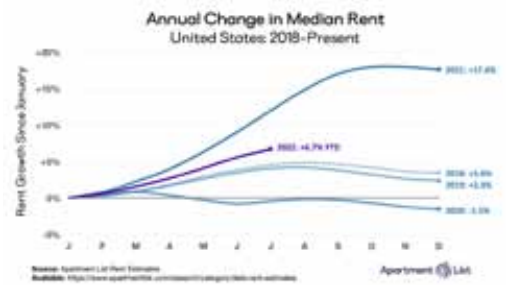
Inflation is currently at its highest rate in 40 years, and rapidly rising housing costs are a key contributor. While the market has cooled slightly from last summer’s peaks, the national median rent has still jumped by 12 percent in the past year. And with spiking mortgage rates now sidelining potentially homebuyers, the coming months could bring additional competition for rentals amid a market that is already historically supply-constrained.

The August Rent Report is below, complete with median rent and price growth data through July 2022:

  • Rents in Denver increased 0.8 percent month-over month in June, compared to a 1.3 percent increase nationally. Month-over-month growth in Denver ranks #64 among the nation’s 100 largest cities.
  • Year-over-year rent growth in Denver currently stands at 8.8 percent, compared to 10.3 percent at this time last year. Year-over-year growth in Denver ranks #71 among the nation’s 100 largest cities. Rents in Denver are up by 16.1 percent since the start of the pandemic in March 2020.
  • Median rents in Denver currently stand at $1443 for a 1-bedroom apartment and $1785 for a two-bedroom.

You can check out the full report (https://www.apartmentlist.com/co/denver#rent-report), and for a complete look at national trends visit https://www.apartmentlist.com/research/national-rent-data.