






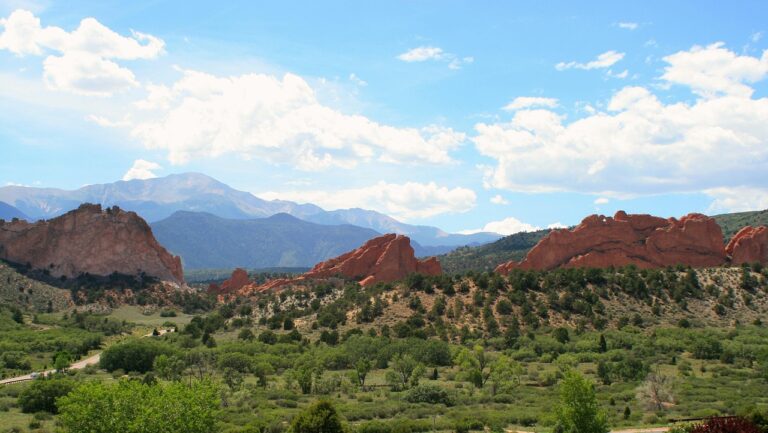
If the only thing you know about Manitou Springs, Colorado, is its famous ‘Incline,’ give yourself a pat on the back. But the Incline is only a slice of Manitou’s charm.
First, the world-famous Manitou Incline. It is not for casual hiker, by any stretch. Olympic athletes training nearby use the Incline—owned and operated by the city of Colorado Springs—to prepare for competition. From first step to the last—2,744 in all—it rises approximately 2,000 feet at a 68% grade. Exhaustion is the price you’ll pay. Otherwise, it’s free! Of course, you’ll need a reservation, snacks and sunscreen are also a good idea. But don’t even think about taking a pet. They’re prohibited.
“I try and do it once a year,” said Golden resident, Lisa Baxter who checked off her Manitou pilgrimage just last week. “But it does take some planning,” she said. While the opens at six each morning, without a reservation, it “gets filled up pretty quickly.” Baxter, an experienced climber and hiker, says she can go from bottom to top in “39 minutes.”
Without a reservation, Baxter said, a lot of climbers use an alternate route that connects with the Incline. One last thing she advises is to arrive early to get one of the cash-only, $15 parking spots. There is also an “outer parking lot” that is free.
If the Incline is, perhaps, too daunting, consider ‘Plan B,’ says Manitou Springs Public Information Officer, Casandra Hessel. “We also have a lot of accessible trails,” said the Colorado Springs native. “The views,” she promises, “are breathtaking.”
Manitou, ‘the Great Spirit,’ and name given by Native Americans to the region is blessed with minerals that result from the snowpack that seeps into limestone. The naturally occurring symbiosis creates a carbonated and uniquely tasting water that centuries of people, from indigenous to curious modern-day tourists, believe holds healing powers. It’s the gift that keeps on giving.
The town along with its waters made it an easy sell for tourists in the late 19th century when General William Palmer began its development. Palmer and businessman Jerome B. Wheeler pitched it as ‘the place’ to come to get well or, at least, better. Clean air, great water.
Today, tourism remains the economic lifeblood of the town. Visitors casually stroll the sidewalks, stopping periodically to sample any of the seven fountains, each with its own signage explaining the water’s minerals and unique taste.
Hundreds of thousands of tourists, from all fifty states and numerous international countries, are drawn to Manitou’s beauty.
The city, whose population holds steady at around 5,500, has something for everyone from the Broadmoor Manitou and Pikes Peak Cog Railway to a birds-eye peek into the past and its Native American history.
But tourism, while essential to the town’s economic base, can also bring with it periodic congestion. Plan, plan and plan.
Manitou Springs has its own schools and police and fire departments. But El Paso County, said Hessel, is there to lend a hand. “We work together,” she said. Otherwise, the town’s “self-sustaining.”
The town and the county worked together when 2012’s Waldo Fire scorched acres of Colorado Springs and threatened Manitou Springs, as well. The town survived unscathed.
Justin Snyder and his wife co-own the town’s version of ‘Cheers,’ a restaurant where everyone knows your name.’ The Loft is “a breakfast-lunch spot…and we make everything fresh every day,” he said.
While restaurant competition is significant in Manitou Springs there are offerings for every taste. Pizza, beer and burgers, sandwiches, vegetarian, upscale, Mexican and traditional ‘Americana,’ are easy to find.
Snyder’s menu includes a ‘Lucy in the Sky’ and “Lucy in the Sea’ bagels or signature blueberry cinnamon rolls. You’ll leave happy.
While summer traffic is always high volume, locals, he said, keep his place and the others all around humming through the winter. Asked ‘what’s the secret?’ Snyder sums it up simply. “This is a community.”









Tejanos forget they are in the majority
I had a close friend that, although he spoke only English, referred to undocumented Mexicans as “mojados.” I never asked him where he got that word from, although I often wondered how a “Texas” word got into his Colorado vocabulary.
The translation of the word in English, “Wetback,” did achieve a measure of notoriety especially after 1954 when the Eisenhower administration conducted “Operation Wetback,” a short-lived effort that used military tactics to remove undocumented Mexicans from the United States. It was rather unsuccessful because it had trouble distinguishing between Mexican and American citizens.
The word was ingrained in our Texas culture because it was a way of diferentiating a Mexican from a Mexican American. We looked alike, enjoyed the same food, spoke Spanish and few could converse in English.
Most knew the word but did not use it because of its pejorative implication. I heard it employed in anger at some non-citizens displaying arrogance or what is commonly referred to as “uppity” as they seem to feel superior because they were here before the new arrivals.
At the same time, most in the migrant worker groups and their home communities took their direction and orientation from their employers, their contractors and the leadership of the cities, towns and villages where they worked or lived. We knew that Mexicans and Mexican Americans were a second class not only because of economic conditions, but also because since 1836 we were a conquered people with agricultural attributes.
We lived separate lives but acquired the same sense of history and values as the White community because we generally attended the same schools. When war came, we were the first to volunteer for the Marine Corps or be drafted into the army and die in disproportionate numbers in foreign killing fields.
Our Tejano way of life deeply respects the authority of our political rulers as well as emulates many aspects of the common attitude and economic life. Large in this view is a variation on the notion of democracy.
“You lead and we will follow” was a preamble to our relationship with the “majority” community that somehow ruled our lives. Yet, a couple of years back, the Tex-Mex community in fact became the demographic majority (40 percent to 39 percent) and growing, but it does not seem to have sank in.
Every large city from Houston to El Paso has a Latino majority with the exception of Austin and Dallas. Austin has a 47 percent to 40 percent White majority and in Dallas the communities are actually even at 39.9 percent to 39.9 percent.
One of the legacies of the Mexican colonial era was a patronato system with vertical authority and trust. In other words, hierarchical control flowed from top to bottom and in return, those above had the responsibility of looking after those below.
As a result of war and conquest, the patronato system came into contact with American democratic horizontal egalitarianism. This created many of stereotypes such as laziness and docile endurance.
The Latino proven work ethic has since erased the notion of laziness and the civil rights movements that of docile endurance. Much of the progress, however, is being masked by cultural assumptions created by some 200 years of being on the margins.
The American South is generally Conservative and Texas is no different. Yet this one area in that region represents a new vanguard at the heart of demographic change. It is that reality that is causing so much anti-Latino turmoil. Tejanos have the opportunity to walk the walk of a majority.
The views expressed by David Conde are not necessarily the views of LaVozColorado. Comments and responses may be directed to News@lavozcolorado.com.