







Sacred Heart Catholic Church in Costilla, New Mexico has been and is the community’s foundation for faith, heritage, and is the key to the long-standing devotion of families who have lived there; some still reside there. Families have been celebrating their faith and heritage there long before New Mexico became a state in 1912, and at least half a century before then.
Although there is no official record of a settlement of the actual town of Costilla, there is record of mail delivery as early as 1848, the year of the Treaty of Guadalupe Hidalgo.
Many proud people like Santera Arelene Cisneros Sena (a relation to the Arellano and Martinez lineage in Costilla including this writer) with roots in Costilla remember their small-town bilingual upbringing and Catholic foundation.
For example, many visited and returned to their heritage, their land, for a 2019 Costilla-Amalia Reunion, then a second Costilla-Amalia 175th Anniversary Settlement Reunion in 2023. Thousands attended both celebrations, then attended Holy Mass served by Bishop Ricardo Ramirez of Las Cruces at Sacred Heart Catholic Church on the final reunion day.
Cisneros Sena, a well-known and gifted Santera who resides in Santa Fe first discussed an idea with Sacred Heart Church Deacon Leroy Lucero about 20 years ago. In 2026 Sena, along with Roberto Montoya, (Master woodworker) has completed and donated Retablo Mayor to Sacred Heart Catholic Church. Cisneros-Sena has deep roots in Costilla. Asked why she pursued the Retablo Mayor project, Cisneros Sena offers, “I have to paint. God blessed me with family history and heritage. Costilla is my home and that sweet little church; Sacred Heart Catholic Church is home.” Her prideful faith-based project has a future dedication date/ceremony to be announced.
Historically, the art of the santero has been central to the Hispanic culture in New Mexico for nearly 400 years and has provided generations of New Mexicans with symbols of identity and faith. The Spanish colonists brought with them their art and religion, thus began the devotional art of the santero. Present day santeros and santeras still maintain the same traditions that were followed by santeros of the past.
Cisneros Sena’s roots are in northern New Mexico – the heart of early santo making. Her profession is also rooted in part in her family heritage and early childhood experience. As a young girl, she was surrounded with home altars and shrines devoted to the santos.
Cisneros Sena’s work has achieved national and international acclaim. In addition to countless private collections, her santos have been acquired by the Museum of International Folk Art, the Museum of Spanish Colonial Art, the Taylor Museum, Regis University and the Vatican.
Sena is a recipient of several distinguished honors including the Governor’s Award for Excellence (2010), the Spanish Colonial Arts Society’s Master’s Award for Lifetime Achievement, the Archbishop of Santa Fe’s Award, and a featured episode of PBS Colores! (2017). Sena has completed numerous large-scale commissions such as altar screens for Santa Fe’s St. Francis Cathedral Basilica, the Bishop of Gallup’s private chapel and St. Anthony Parish in Questa, NM as well as commissions for the Shrine of Our Lady of Guadalupe, Santa Maria de la Paz, San Isidro, the Cathedral of Gallup, Prince of Peace Catholic Church, St. Anne’s and Santuario de Chimayo.
Roberto Montoya developed his woodworking skills under the guidance of his father, Roberto, Sr., in La Madera. Upon graduation he worked with a furniture manufacturer in Santa Fe, where he mastered the craft of producing handcrafted furniture in the Spanish Colonial style. In 1995 he fulfilled his dream by moving into his own business venture, Del Prado Custom Woodwork.
Montoya is best known for his large-scale church projects. His collaborations with Charlie Carrillo, Marie Romero Cash and Arlene Cisneros Sena can be seen in churches throughout New Mexico. His work is featured in many public, permanent and private collections, including the Cathedral Basilica of St. Francis of Assisi, the Shrine of Our Lady of Guadalupe, Santa Maria de la Paz Catholic Community, Rosario Chapel, St. Anne Parish Church and San Isidro Mission in Santa Fe, NM. Also, St. Joseph Community Health in Albuquerque, Santa Rosa de Lima, in Santa Rosa, Sacred Heart Church in Espanola, Immaculate Heart of Mary Church in Los Alamos and St. Joseph Parish in Mosquero, and Sacred Heart Cathedral and Bishop James Wall’s private chapel in Gallup, NM.
Below is a description of the history of the church and the Sena’s project called Retablo Mayor.
In the 1850s the first settlers accompanied Juan de Jesus Bernal from Arroyo Hondo. These settlers built a small church named San Miguel de la Costilla. In the 1860s a new church was built on the north side of Costilla named Sagrado Corazon. Recorded baptisms in the Sacred Heart Catholic Church began in 1865.
“Retablo Mayor” – Installed July 10, 2026, and is dedicated to the Santos of the Costilla region
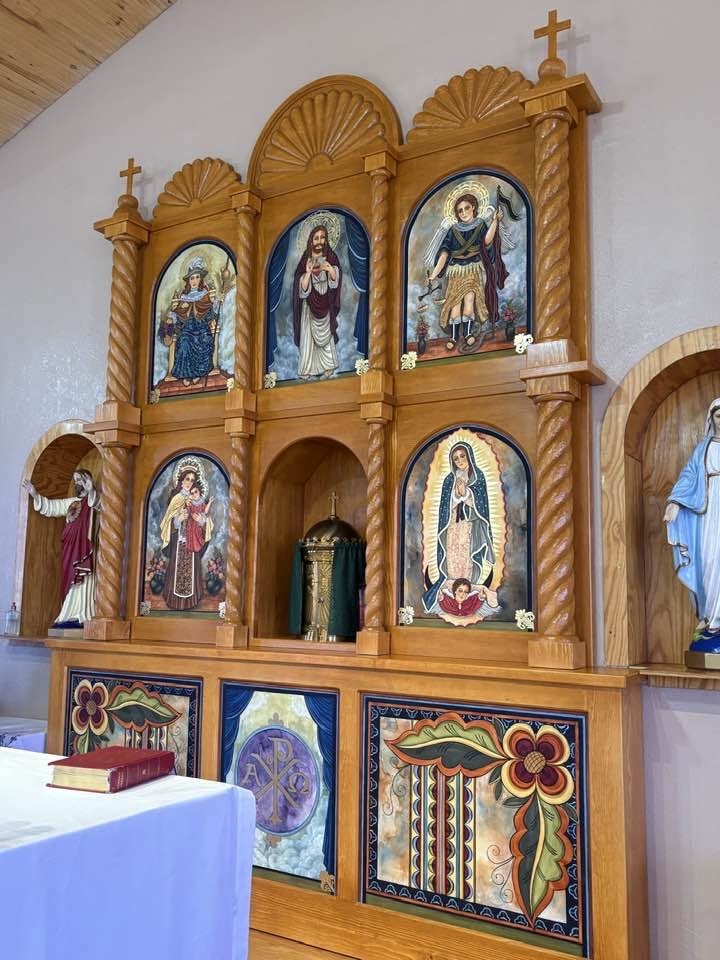
(Top row L-R):
- Santo Niño de Atocha – Patron saint of Santo Niño Parish, Amalia NM is deeply connected to New Mexico. Survivors of the Bataan Death March of World War II started a famous pilgrimage to thank him for their survival. Patron of travelers, protection from danger, prisoners and those unjustly imprisoned; Against illness especially those that are crippled; protector of children.
- El Sagrado Corazón – Patron saint of Sagrado Corazón Catholic Church, Costilla, NM. Protection of family and home; forgiveness of sins; for good health; against jealousy and hatred.
- San Miguel Arcángel – The original name of the church in Costilla. Early settlers built the first church in Costilla named San Miguel de la Costilla. Patron against evil forces, patron of police, soldiers, guardian of small children, defender of faith, opponent of the devil.
(Middle row L-R):
- Nuestra Señora del Carmen – Under this title Our Lady is the patroness of the Carmelite Order and La Cofradia de Nuestra Senora del Carmen (Carmelitas). The Carmelitas and the Penitentes were formed so that they could continue to pray for the people of their communities when the priest was not available. Patron against all dangers, for souls in Purgatory, for healing, in the hour of death.
- Nuestra Señora de Guadalupe – The Guadalupana Society (also known as the Cofradia de Nuestra Señora de Guadalupe) is a traditional religious group. Members are devoted to Our Lady of Guadalupe, and in places like northern New Mexico, the Cofradia acts as a support group for pilgrims, often feeding and caring for walkers. They raise money, visit the sick, and help families in need. Patron against all evil, war; for favors in sickness; motherly comfort.
(Bottom row – center)
- Chi-rho – the first two letters of Christ in Greek (Christos). The chi-rho monogram is used as a symbol of Christ, Christianity and Christians. The central PAX cross stands for peace. The Greek symbols stand for the phrase: “I am the Alpha and Omega, the First and the Last”.
The work of New Mexico artists to include santeros will be featured in this year’s Spanish Market at the Santa Fe Plaza on Saturday July 25th – Sunday, July 26th.



