


If you live in or around Taos, New Mexico, you no doubt know the Raels, Benita and husband Carlos. They are a team, in life and art. In February they will have been married for 55 years. But their hearts and souls in their art have a different timeline.
Benita, who retired from a career in healthcare, is a Maestra colchera. Carlos, besides being an accomplished musician, is known for his nearly surgically precise and inspiring santeros.
The two art mediums are a world apart, but in New Mexico and pockets of southern Colorado—mainly in the San Luis Valley—these artforms have a history that dates back centuries.
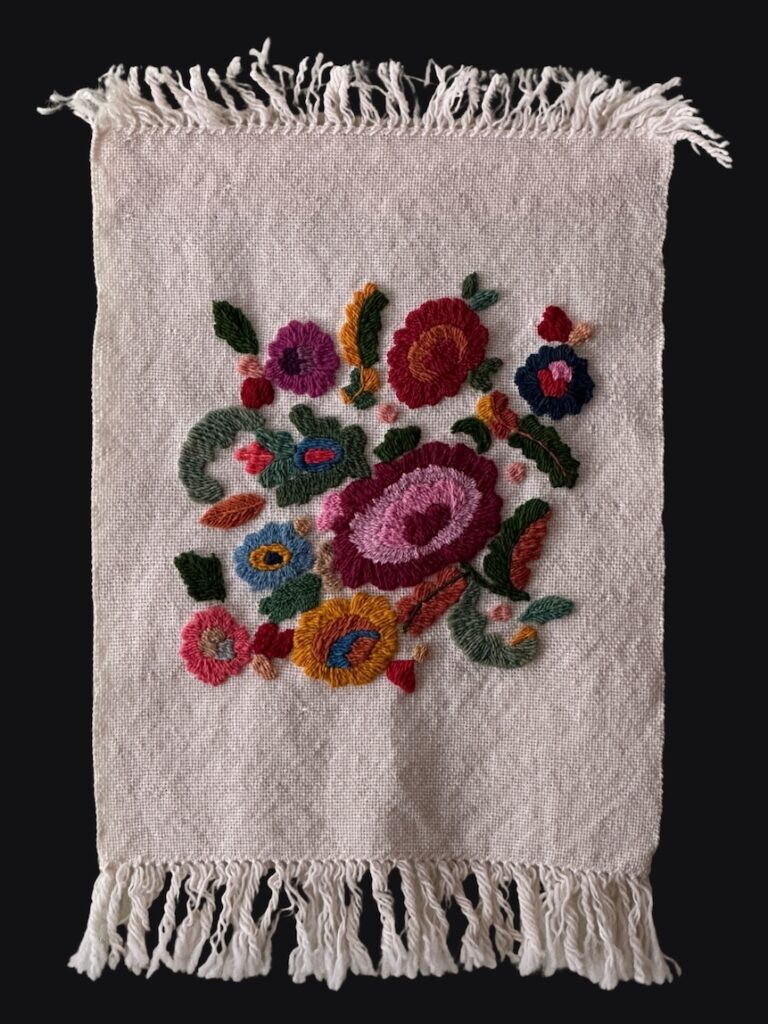
Colcha, a type of embroidery, was brought to the region by the Spanish who traveled north from Mexico via El Camino Real. The images threaded onto the sabanilla—a lightweight wool—comes from the wool of the Churro sheep, also brought to this hemisphere by the Spaniards. While this unique wool has been used for centuries, newer, easier to find substitutes are now far more common in colcha.
After retiring, Benita found herself looking for something to keep her busy. Why not try colcha, she thought. It was something she had dabbled at years before but had left by the wayside. Like so much of the world, she said, it did not adapt easily for lefthanded people.
But one day, early into her retirement, “I found a kit that I had had for the class,” she recalled. “I started trying to figure it out,” and all of a sudden, a light went on. Through a lot of reading and a bit more ‘googling’ she figured out how to overcome the challenge of her left-handedness—a challenge so many lefties face—and finally solved its puzzle.
Benita, a native New Mexican who calls Questa home, thinks of colcha as both “history and art.” She also has another word for it. “It’s mesmerizing.” But she’s adapted her work with colcha to the 21st century.
Unlike early colcheras—it was almost exclusively women—she does not harvest, clean and dye the Churro wool for her work. “I buy my wool.” Doing it this way save both time and money. Not so with the sabanilla. “Now I’m weaving my own sabanilla.”
Her skill with colcha has earned both praise and a rippling of recognition. People familiar with her work are now learning ‘at the foot of the Maestra,’ the master. “Now I am mentoring,” just as her own teacher, Annette Gutierrez Turk, challenged her to do.
Gutierrez Turk, Rael, said, passed away earlier this year. In sharing, she composes herself. Her Maestra’s passing remains difficult. She paused to compose herself in sharing that part of her story.
Husband, Carlos, has been carving santeros—wooden saints—going on thirty years. Disabled after an accident, he needed something to do, not simply to help care for his family, but to fill the void from work he could no longer perform.
“I began to draw,” Rael said. “At first, it was mainly religious work.” But soon, he thought, his dalliance with santero took on a new and serious direction. “I realized He was telling me,” explaining his almost spiritual epiphany.
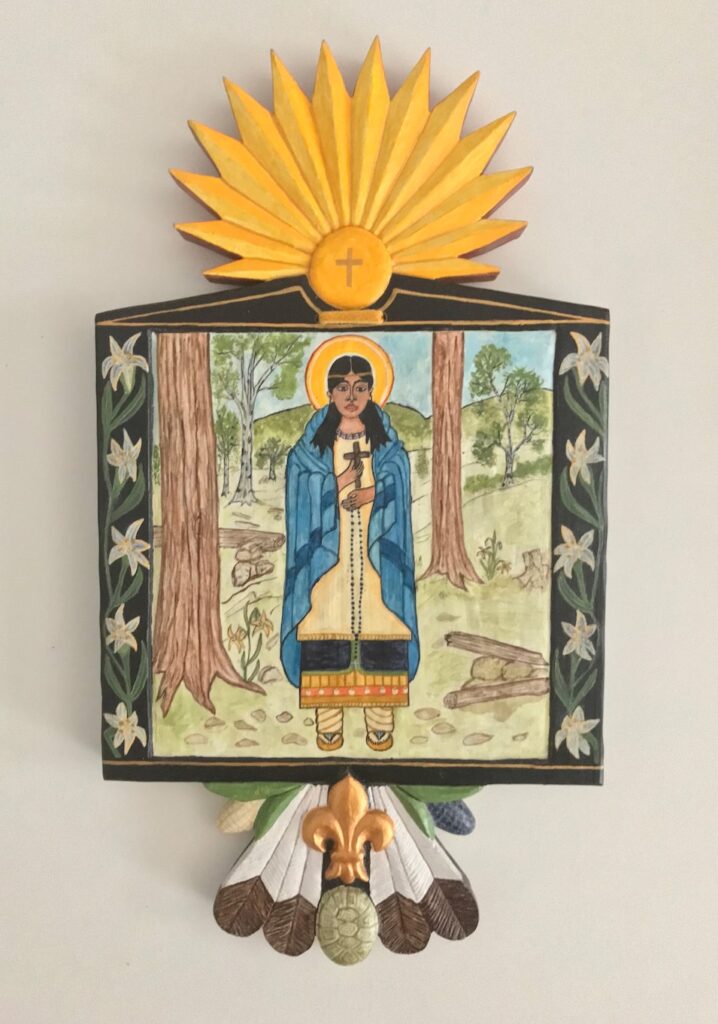
“I’ve always been very creative when it came to art,” Rael shared. His creativity began first with music. But his disability made it difficult to move the equipment for shows. “It takes a lot (of strength) to haul” he said of the keyboards, mics and speakers for a performance.
Like wife, Benita, Rael tries to stay as close to tradition as possible. But since cottonwood, the materials used by early day santeros, is not always easy to get or even affordable these days, he’s found using an imported Malaysian wood for each piece. “It has the same characteristics as cottonwood.”
A single piece crafted by Rael has a look and feel of art created decades or even centuries before. One reason is the process he uses on any one project. “I gather and process my own pigments,” he said. Making certain each meets the unique needs of a santero or saint requires sweat equity. Pigments on every piece must pass his rigid eye test.
Finding just the right materials means hours and hours of off the grid scouring. That means treks “all over New Mexico or southern Colorado.” When he finds what he needs, he grinds up what he has gathered and,” using mortar and pestle,” creates the materials to make the finished product meet his own high standards.
His skill with retablos—translated literally as religious altarpieces—has created a demand for his work. With Taos Spanish Market close by, visitors from all over the country and the world have bought Rael’s work.
To see Rael’s work, you can visit elsantero.com. You can get a sampling of Benita Rael’s work on Facebook or contact her for more information on colcha at benitaraelcolcha@gmail.com.



