






Home Blog Page 187

A Week in Review

0

By: Joseph Rios 

Africa

Top Kenyan cyclist dies – Sule Kangangi, a 33-year-old cyclist for Kenya, died after crashing while participating in the Vermont Overland race on Saturday. Kangangi represented Kenya at the Tour du Rwanda contest, Commonwealth Games and All African games. He also won the men’s edition of the first gravel race held in East Africa at the Massai Mara game reserve in Kenya.

Former South Africa railway executives arrested – Brian Molefe, former CEO of South Africa’s state-owned ports and freight rail company Transnet, and Anoj Singh, who was the company’ chief financial officer, were arrested Monday. The two were linked to a multimillion-dollar fraud corruption case. Both men are facing charges of fraud, corruption and money laundering.

Asia

Protests held over release of rap- ists in India – Across India, protests are being held against the government’s decision to release 11 men who were jailed for life for the gang rape of a Muslim woman. The men had served 15 years in prison and were seen meeting relatives outside the jail who gave them sweets and touched their feet to show respect. At least 100 retired civil servants wrote to the chief justice of India condemning the rapists’ release.

Pakistan seeks flood aid – Monsoon rains have killed at least 1,033 people in Pakistan. Countries like the United States and the United Kingdom have contributed to a disaster appeal, but Pakistan says more funds are needed. In the province of Sindh, thousands of people have been displaced from their homes. Other parts of the coun- try have also seen large amounts of people flee. Officials blamed climate change for the heavy flooding.

Europe

Drought worsens in Spain – Recent research shows that parts of the Iberian Peninsula are their driest in 1,200 years. Extreme heat and a lack of rainfall has led to a serious drop in levels of Spain’s natural water reserves. The Global Drought Observatory recently reported that Europe is in the midst of its worst drought in 500 years. The European Forest Fire Information System said more than 270,000 hectares have been burnt this year in Spain.

UN nuclear watchdog to travel to Ukraine – The UN’s International Atomic Energy Agency will travel to the Ukraine’s Zaporizhzhia nuclear power plant. The site has been occupied by Russian troops since March. Fighting around the site has caused global concern over the safety and security of the nuclear plant. Ukraine and Russia accused each other of shelling the area. The International Atomic Energy Agency said it must protect the safety and security of the nuclear plant.

Latin America

Last member of indigenous group in Brazil dies – Officials in Brazil announced that the last remaining member of an uncon- tacted indigenous group in Brazil died. The man had lived in total isolation for the past 26 years and was known as Man of the Hole because he dug deep holes. He was the last remaining member of an indigenous group who lived in the Tanaru indigenous area in the state of Rondônia. A majority of his tribe were likely killed by ranchers in the 1970s.

Peru sues company over oil spill

Peru’s consumer protection agency will sue Repsol, a Spanish oil firm, because of an oil spill that occurred in January. The spill left beaches blackened off the coast of Lima and was called the worst ecological disaster around the area by the country. At least 10,000 barrels were leaked into the Pacific Ocean. Respol denied responsibility and said the spill was caused by the oil tanker.

North America

U.S. warships pass through Taiwan Strait – For the first time since tensions between Taiwan and China increased, two U.S. warships passed through the Taiwan Strait. Tensions between the countries increased after U.S. House Speaker Nancy Pelosi visited Taiwan earlier this month. The U.S. Navy said the trip through the Taiwan Strait demonstrated the United States’ commitment to a free and open Indo-Pacific.

Former White House pastry chef passes – Roland Mesnier, who served as a pastry chef at the White House for five presidents, passed at the age of 78. He was first hired during Jimmy Carter’s presidency in 1979 and retired in 2004 when President George W Bush was in office. Mesnier wrote that in 27 years at the White House, he never served the same dish twice. Former first lady Hiliary Clinton tweeted that she has fond memories of Mesnier and that he will be missed. Mesnier died after suffering from a short illness.


CDPHE adds Multidisciplinary Center

The Colorado Department of Public Health and Environment is pleased to add the Multidisciplinary Center on Aging at the University of Colorado as a Recognized Health Navigator Training Program. Recognized programs must demonstrate that their training curricula meet the entry-level core competencies for individuals to become credentialed health navigators in Colorado. Building the health navigator workforce is a core component of the state’s strategy to eliminate barriers to accessing health care and promote positive health outcomes for all Coloradans.

“We know that individuals who have a relationship with a trusted member of a healthcare team are far more likely to be able to access critical preventive care and support for disease management,” said Yvette Camarena, a health navigation specialist at the Colorado Department of Public Health and Environment.

“We are pleased the Multidisciplinary Center on Aging will play a significant role in growing this
important career in our state.”

Health navigators (also known as patient navigators or resource navigators) are embedded in healthcare teams to help individuals overcome barriers to quality health care, including insurance or lack thereof, poor health literacy, transportation, child care, and more. Health navigation is an evidence-based practice that improves health outcomes and reduces health care costs.

Students graduating from recognized training programs are eligible to take a standardized test that, once passed, qualifies them as credentialed health navigators. Those individuals are then listed on the state registry website.

Individuals completing coursework in health navigation at the Multidisciplinary Center on Aging learn fundamental concepts in health navigation and receive a certificate of completion that can be included on a resume or portfolio or shared with potential employers.

“We are grateful for the opportunity to serve as a recognized Health Navigation Training program,” said Dr. Kathryn Nearing, principal investigator for a National Institute on Aging award that allows the Multidisciplinary Center on Aging to offer the training and health navigation credential at no cost to participants. “We hope this program will open doors for older adults who may be unemployed, underemployed, or seeking encore careers, and enable them to find meaningful roles serving the community.”

There are currently four Recognized Health Navigator Training Programs in the state. While there is currently no formal licensing for health navigators, the Colorado Department of Public Health and Environment works to ensure high-quality health navigation services through its Health Navigator Workforce Development Initiative, which includes a registry of health navigators who complete the training program and pass the competency evaluation. For more information on health navigators and how to become a Recognized Training Program, visit the health navigator credentialing program web page.

To find out more about the Multidisciplinary Center on Aging at the University of Colorado and how to become a health navigator, please visit the Center’s Health Navigator information page.

What’s Happening?

0

The CU Denver Block Party is a free and public annual back-to-school event connecting the campus community with city partners. This year’s event will be held on August 24 from 12 p.m. – 3 p.m. on Lawrence Street between Speer Blvd. and 14th St. in what is referred to as the university’s “Education Corridor.”
Now entering its 10th year, and anticipating more than 3,500 participants, the CU Denver Block Party has rapidly become a must-attend event for anyone who lives, works or studies downtown. The Block Party showcases the endless opportunities that CU Denver has to offer in business, arts and media, public affairs, architecture, and education. Some of Denver’s most poplular food trucks will be serving up delicious options for lunch. The ever-popular DJ Chonz (a CU Denver alum) will once again be spinning in between sets and acting as emcee. Visit https://bit.ly/3AHB491.

Cortesía: University of Colorado at Denver

Levitt’s Free Summer Series continues this Thursday, August 25th at 6 p.m. Calvin Arsenia is known for his elaborate and ceremonious sensory concert experiences that merge jazz and electronic influences. Arsenia will be joined by Nina de Freitas who has played Denver’s Underground Music Showcase three times taking the main stage in 2018. Visit https://bit.ly/3CrSAzE for ticket information.

Cortesía: University of Colorado at Denver

Ways to help students have a happy school year

0

By: Joseph Rios

Class is back in session across the state of Colorado.
Over this past week, thousands of students returned to school for a brand new school year. And while that’s exciting news for many Coloradan children, there is a large expense that comes for families during this time of year.
According to the National Retail Federation, families with children in elementary through high school planned to spend an average of $864 on school supplies and other items students need like clothing. That’s $168 more than in 2019. The National Retail Federation said total back to school spending is expected to match last year’s record high of $37 billion.
For some families, the burden of purchasing back to school items is heavy. However, there are plenty of options out there to assist others in need. Here are a few places to consider giving to this year to help ease students back to classrooms.

Denver Public Schools Foundation

Contact: dpsfoundation.org/donate/more/
The Denver Public Schools Foundation’s goal is to help ensure that every student has the tools and resources to reach their highest potential. The foundation’s website reads that its classrooms benefit from donations of non-cash items like office supplies, books, school supplies, clothing and more.
Those who are interested in donating to the Denver Public Schools Foundation can do so by contacting
info@dpsfoundation.org or by calling 720-423-3553.

Clothes to Kids of Denver

Contact: clothestokidsdenver.org/donate/
Clothes To Kids of Denver is focused on providing new and quality used clothing to students from low income or incrisis families throughout the Denver metro area.
The organization is accepting clothing donations on Thursday-Saturday between 9 a.m. and 3 p.m. All donated clothes should be new or gently used, clean and ready to wear, current styles (appealing to kids, pre-teens, teens and young adults) and suitable for school. Clothes To Kids of Denver is located at 2890 S. Colorado Blvd., Suite M-3.

Greeley-Evans Weld County School District 6

Contact: 970-348-6000
Greeley-Evans Weld County School District 6’s Teachers Closet is supported through in-kind donations, monetary gifts and grants.
Residents can consider donation to the Teachers Closet that include wooden and mechanical pencils, large and pencil top erasers, backpacks, calculators, spiral notebooks, colored pencils and other school supply items.

The Backpack Program

Contact: weldfoodbank.org/backpack-program
While back to school supplies are necessary for students, many children face hunger on weekends because they rely on food from their schools.

The Weld Food Bank works to combat student hunger by partnering with school counselors and teachers in Weld County to identify students who are in need of food over the weekend. Volunteers fill packs with child friendly food. To donate to the foodbank, visit weldfoodbank.org/donate-now/.

Jeffco Eats

Contact: jeffcoeats.org
Jeffco Eats is a community organization that strategically focuses on meeting gap needs for weekend food in Jefferson County Title One Schools. To date, the organization has delivered around 250,000 pounds of food. Volunteers of approximately 50 people help Jeffco Eats each week to reduce hunger. Food is delivered by volunteer drivers to over 29 nonprofits and section 8 apartments. To donate, or volunteer for Jeffco Eats, visit jeffcoeats.org.

San Luis Valley’s regional airport convenient and up to par

By: Ernest Gurulé

Flying in or out of Denver International Airport (DEN) can be a breeze or, sometimes, something completely different. Airlines are finding themselves under a torrent of criticism for everything from overbooking to cancellations to interminable delays. The list is actually longer, but for the moment, let’s keep things simple.

Smaller airports also have their problems. But, not surprisingly, they’re of a whole different nature and locals, as they often do, have found ways to work around them. They certainly have in Alamosa, the hub of the San Luis Valley.

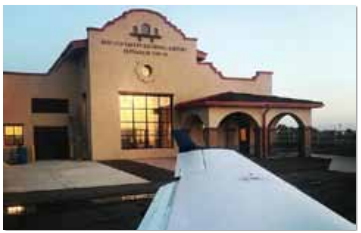
On the bright side, Valley residents have the benefit of convenience, said Alamosa City Manager Heather Brooks, an executive who periodically must leave the comfort of her town to conduct business out of town or out of state. On the other end of the scale, there are those other things over which no one has control. Alamosa, after all, is a mountain town with mountain town weather.

“Having our local airport allows us to drive five minutes to open parking with a five-minute check in/security process,” said Brooks. Presto! From home to airport in minutes and you’re ready to board. “That is pretty hard to beat.”

The town’s airport is now in its eighth decade. The first shovelful of dirt on the airport was turned in 1939 with work completed two years later. Its first commercial flight followed in 1946 when a Monarch DC-3 took to the air. Later, Frontier Airlines—a different incarnation from today’s Frontier—filled the void with its Convair 580s. Both models are today aviation history.

Today, customers boarding in Alamosa fly Denver Air Connect, a regional carrier serving nine states in the Southwest and upper Midwest. The airline also serves Cortez.

Denver Air Connect operates three different aircraft, from the 50-seat Embraer ERJ-145 Jet to the more modest to the Dornier 328 which seats 30 passengers to the efficient, ready-to-work Fairchild Swearingen Metroliner.
The Fairchild model seats nine and is often the aircraft of choice for the country’s most rural airports.

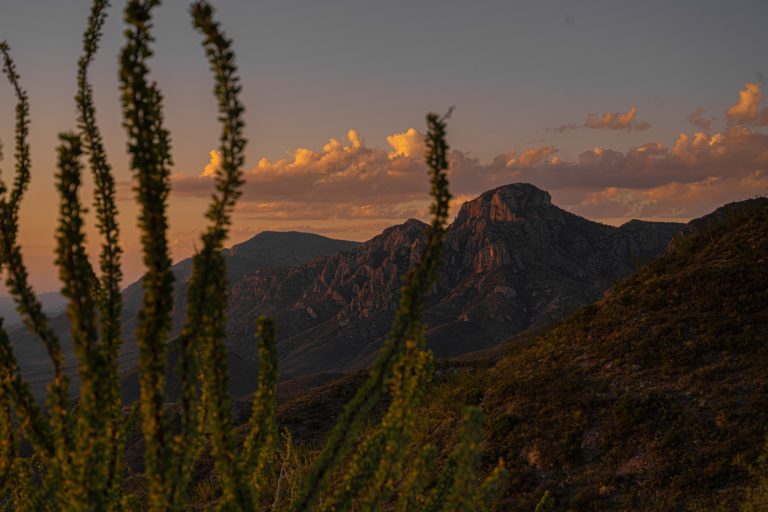
The Valley’s airport sits at an elevation of 7,539 feet making it one of the highest in the country. It is bordered to the north by the picturesque Sangre de Cristo Mountain range who boast a number of peaks rising above 14,000 feet. As a result, flying in or out of the Valley during one of the region’s rough winters when temperatures can plunge to arctic-like levels can also be problematic. But, said Brooks, because of the importance of having an airport—which is essential for maintaining the economic vitality of the community—Valley residents have found a way to work around these issues.

There are times, said the city’s chief executive, when weather might demand a several hour drive to Pueblo or Colorado Springs to make connections. It’s a fact of life here, she said, but it’s rare.

“Airports are critical for tourism, economic development, and quality of life,” said Brooks. Alamosa’s major employers, she said, need to fly out on business or fly people in. SLV Regional airport is also essential for Adams State University. “With the presence of ASU, we oftentimes have parents and family members fly in for ASU events, activities and games,” she said. The airport, she added, is also indispensable for the town and region’s hospital which regularly “utilizes the airport to transport materials to and from hospitals in the front range.”

SLV Regional Airport may seem quaint by certain standards. At its busiest, it may handle just over 80 aircraft operations in an entire day, slightly more than 30,000 for the year.
There is simply no comparison with an operation like DIA, now the third busiest airport in the world. But the contrast doesn’t change the airport’s importance to the town or the Valley, an area of more than 8,000 square miles and a swath of land several times larger than the state of Rhode Island.

It’s a small town, say locals. You give up a few things here and there for the benefit of having so many more, including a predictable and comfortable quality of life.

Airports like SLV Regional are essential for rural communities. In Alamosa’s case, they provide a lifeline
for local business and business people who, like everyone else, depend on airlines delivering essential equipment or ferrying business people to and from important meetings.
They’re also vital for hospitals who depend on them to carry seriously ill patients to facilities more capable of dealing with complicated medical issues.

Rural airports operate under federal subsidies. In 1978, Congress enacted the Essential Air Service program for towns like Alamosa and hundreds of others like it. Millions in federal aid is dedicated to rural airports where the driving distance is more than 70 miles from the nearest medium or large hub.

Photo Courtesy: Sangre de Cristo National Herritage Archives Twitter

Foundational roots for the Mexican American

0

By: David Conde

David Conde Senior Consultant for International Programs

One of the greatest efforts on the part of the Chicano Movement was to explore the reestablishment of identity signposts in a more collective way. Sociology, Anthropology, Psychology together with a revision
of an existing History combined to give our origins a sense of place.

Much went into the notion of roots best expressed in the term of the concept of Aztlan. To youth especially, this mytho-historical manifestation was something to rally around.

In the concept one can find an American indigenous past, a connection with the epic lands of antiquity and a space that people can call their own. However, when it came to the Chicano as a person, as an individual that sought to find a personal identity, there was something lacking.

The notion of a Mestizo born on the American continent was insufficient to individual feelings of belonging. The history of American oppression had seen to it that this character became somewhat place-less and forgotten.

The great wave of Mexican immigrants coming to the United States has gone a long way to reverse that sense of solitude brought on by displacement. The healthy identity immigrants have brought with them has revitalized what was a dilapidated state of Latino individual self-awareness.

However, there is a lot more to do. When Mexicans or other Latin Americans speak about home, it almost always not about the country, but about the village or town they came from. The identity with those small places is precious and cements the notion of coming from somewher personally important. It is that kind of detail that Alex Haley referred to in tracing the family story found in Roots (1976).

When I was a child, I listened to tales told around the table about the journey my grandfather took to join the family that already had members on both sides of the Rio Grande border. The story telling about the journey is exciting.

But I found more important a little known place in the Tuxtla Mountains of southern Veracruz that I have endeavored to find in my travels to the area. I was encouraged to put more focus on that when, years ago, I met someone from the family living in Tres Zapotes, an ancient Olmec site that was our group’s destination on that day of study. The Tuxtlas is a small mountain range with the major towns of Santiago Tuxtla to the northwest, San Andres Tuxtla in the center and Catemaco to the east. What makes it intriguing is that Catemaco is the center of pre-Colombian religion and worship that is still practiced.

From there, the road to the east and then north takes us to the Yucatan Peninsula where the first Mestizo was born on the North American continent after a Spanish ship wreck in 1512. The story of Spanish conquest involves the conception, birth and growth of a Mestizo community that eventually became the dominant group in the Americas.

Yet, it also became important to find that place that marks personal and family beginnings. The spirit calls from that land is quite rewarding when they are answered. The question of identity has been one of the predominant themes of the Latino journey in America. So much has had to be overcome in order to reach a measure of equilibrium in an area so full of thoughts and feelings.

The human condition in our world today offers challenges that only a strong people can face and overcome. We hear the cry of that history and those challenges.

A week in Review.

0

By: Joseph Rios

Africa

Dozens dead after Algeria wildfires – At least 43 people were killed because of wildfires that swept throughout the northern part of the country. Fire officials put out more than 30 fires and arrested 13 people on suspicion of involvement in starting the fires. Around 1,000 families were forced to evacuate areas like the El Tarf region near Tunisia.
Kenya elections head to court – Kenya presidential candidate Raila Oding is going to court to challenge the country’s presidential election results. The country’s electoral commission ruled that Odinga took 48.8 percent of the vote while William Ruto’s secured 50.5 percent of votes. Four of the seven electoral commissioners recently refused to endorse the results, calling the finally tally “opaqe.”

Asia

Philippines students return to school – After almost two years of distanced learning, millions of students across the Philippines returned to in-person lessons. Less than half of the country’s public schools will implement five-day face-to-face classes. By November, all 27 million registered students are expected to head back to in-perso learning for full-time lessons.
Singapore ends ban on gay sex – Singapore is ending a ban on a law that bans gay sex, essentially making it legal to be homosexual. Prime Minister Lee Hsien Loong announced the decision on national television. LGBT activists in Singapore called the end of the law a win for humanity. Singapore is known for being conservative and joins other countries like India, Taiwan and Thailand who have moved on LGBT rights.

Europe

Russia seeks military recruits – Russian military officials are ramping up efforts to recruit soldiers to the Russia army. Recruiters are urging Russians to sign shortterm contracts with the military to fight in Ukraine on channels like social media, television and billboards. Approximately 70,000 to 80,000 Russian troops have been killed or wounded since the country invaded Ukraine six months ago.

Third heatwave in Portugal – Officials in Portugal sent a text warning about extreme risk of wildfires as the country faces a third heatwave. Temperatures are expected to reach 100 degrees with strong winds in the coming days. Rural areas were warned to not start any fires. Access to forests has also been restricted. So far this year, 92,000 hectares of land have already burned in Portugal.

Latin America

Heart of Brazil emperor returns to country – The heart of Dom Pedro I, Brazil’s first emperor, will go on public display at the foreign ministry in Brasilia. It was returned to the country on a military plane from Portugal. Brazilian officials plan to host a cannon salute, a guard of honor and full military honors for the heart. Pedro was born in 1789 and issued Brazil’s declaration of independence in 1822.
Former Mexico attorney general arrested – Jesus Murillo Karam has been charged with forced disappearance, torture and obstruction of justice in connection to the disappearance of 43 students. The students disappeared in 2014 while traveling on a bus through the city of Iguala to go protest in Mexico City. Karam led a controversial investigation into what happened to the students. His findings were criticized by independent experts and loved ones of the missing students.

North America

Arkansas officers suspended – Three Arkansas police officers were suspended after a video showed them pinning a suspect to the ground and repeatedly beating him. One officer kneed the man in the back repeatedly and while another bashed his head against the pavement. The video of the incident has been viewed millions of times across social media.
South Korea/U.S. host joint military exercises – South Korea and the United States are hosting large joint military exercises on the Korean Peninsula. It is the first time in four years the countries will run field exercises to practice how they would respond to a North Korea attack. The exercises haven’t occurred since 2018 when they were canceled as the countries tried to convince North Korea to get rid of its nuclear weapons. This year, North Korea has fired more missiles than in any other single year.

Our Government

White House

The White House Initiative on Advancing Education Equity, Excellence, and Economic Opportunity for Hispanics will kick off its fifth Latino Economic Summit in partnership with the Aspen Institute. U.S. Rep. Carolyn Bourdeaux and Biden-Harris Administration officials from the U.S. Department of Education, U.S Department of Agriculture, U.S. Department of Health and Human Services, U.S. Department of Transportation, U.S. Office of Personnel Management, and U.S. Small Business Administration will participate in the summit that will be Held at Georgia Gwinnett College in Atlanta.

Colorado Governor

Gov. Polis announced the launch of six free tax clinics starting this Saturday, August 20, 2022 to save Coloradans money on tax preparation services. Coloradans can file taxes up to October 17, 2022 to receive their tax rebate of $750 for individuals and $1,500 for joint filers, in addition to the Earned Income Tax Credit and Child Tax Credit for eligible Coloradans. “We encourage all eligible Coloradans to file taxes and not miss out on the tax rebate checks of $750 for individuals and $1500 for joint filers, and we are making sure these free tax clinics are available to support Coloradans who still need to file taxes before the October 17th deadline,” said Gov. Polis.

Denver Mayor

Mayor Hancock joined Gov. Jared Polis and U.S. National Summit Coordinator Kevin O’Reilly at a breakfast meeting of the Colorado Latin American and Caribbean Consuls to announce the first Cities Summit of the Americas will take place April 26-28, 2023 here in Denver. The Cities Summit will promote regional cooperation, convening sub-national leaders from across the entire Western Hemisphere with diverse and inclusive representatives of government, civil society, business, academia, youth, culture and the arts, and indigenous and under-represented groups.

Health and Human Services Director, Lily Griego tackles health priorities

0
Photo Courtesy: U.S. Department of Health and Human Services-Region VIII

By: Ernest Gurulé

Before heading off to work, Lily Griego must often make one quick stop before getting to the office.
That stop is Denver International Airport (DEN) where she might be flying off to any one of the seven different states that she regularly visits. Of course, when her job doesn’t require her to fly, she’s driving across Colorado to check in with the leaders of scores of cities and towns to make certain her agency is meeting constituent needs.

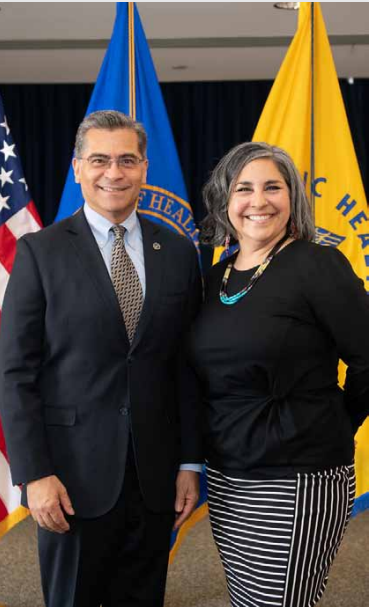
Griego, Regional Director of the Department of Health and Human Services Region 8 since last September, works with governors, mayors, county commissioners and tribal leaders as the official representative of Secretary of Health and Human Services, Javier Becerra.

The mission of Griego’s agency is no small undertaking. HHS is in business to maintain or enhance the overall health and well-being of all Americans, all 330-plus million of us. And the affable Griego, a career-long civil servant, takes her work seriously.

Over the last nearly three years, Griego, while doing her job, has had to deal with a pandemic—COVID-19— that her agency was charged with managing. In the case of COVID, there was no blueprint. And while there were a number of fits and starts, in the end, the virus, thanks to an extraordinary effort by HHS, was brought under control. The only comparable national health emergency in recent times was 1918’s Great Influenza. And while it was inarguably a devastating and often overwhelming challenge, COVID was different.

As COVID swept across the land, Griego, like so many others, often could not make the physical appearances she might have wanted to make. “Meeting face-to-face,” she said, “is worth their weight in gold.” But with a deadly virus, the safest option was meeting via Zoom.

And while HHS is still not ready to call COVID over, it is today a virus that the nation and the world now understand.
It is now, at least, under control. But when you work for an agency whose mission is health, said Griego, there is always something else to keep you focused.

HHS and the nation have for the last several years been dealing with an opioid crisis that has quite literally devasted scores of communities, many of whom Griego has visited and seen exactly how they have been ravaged. The U.S. government estimates that since 1999, nearly a million men and women have died of drug overdoses.

While the focus of the drug-induced wreckage has been in the small towns that dot the ‘Rest Belt,’ it has also been felt sharply on tribal lands, many of which are in Griego’s Region 8. But drugs and drug abuse are not the only matters that warrant attention on reservation lands, said Griego.

“They have issues that are not only native,” she said, “they have historical trauma.” Listening to tribal leaders, Griego said, is vital and the exact kind of information that needs to be taken back to Washington.

Griego, while careful not to elevate tribal health issues over others, does acknowledge that there are serious and often unseen health challenges facing Native Americans.
“Health equity is what we’re working on right now,” she said, including mental health issues. “If we have policy and mandates from tribal leaders that gives us guidance.”

Griego said she is proud of President Biden and the attention and priority he has made of mental health. When he gave the State of the Union address, she said, one of the things he did was directly address thi issue and promise a ‘health tour’ across the country. For her, it was a signal to direct her energy toward fulfilling the President’s commitment across her Region 8. ”I’ve done a maternal mental health round table in Utah and North Dakota,” she said.
”We’re also looking at the San Luis Valley, at Adams State (University) and at the agricultural population.” As firmly as she can, Griego said, “We are going to talk about it.”

Part of Griego’s prioritizing of mental health comes from her own experience growing up in southern Colorado and Wyoming. “Being Latina,” she said, “I’m comfortable saying this…we did not grow up talking about it.” Griego said few ever broached the subject. She said the issue was talked around, “we had to be strong…we had to pull ourselves up.” Mental health cannot be beaten through silence, she said. “We need to break down the stigma of what mental health is about.”

The Southern Ute and Ute Mountain tribes, both located in southwestern Colorado, regularly meet with Colorado’s Lieutenant Governor, Dianne Primavera, along with HHS to discuss issues important to Native Americans. In addition to the opioid/substance abuse and mental health issues, said Griego, a lot of time is spent addressing maternal health a serious health concern “which deeply impacts native women.”

HHS, she said, is always responding to ‘five-alarm’ health issues. Some are clearly visible, as is the case with drug abuse, others are not immediately identifiable like mental health. But, said Griego, there is always something on the horizon that poses an existential health challenge.

The latest national health emergency is a Monkeypox outbreak that has mushroomed into a public health concern.
“It’s extremely serious,” Griego said. “It really underscores our stakeholders engagement and what local populations need to address.” “One of the messages that we can deliver is the importance of getting vaccinated.”

Griego is a career-long public servant having experience in both local and federal agencies. In 2020, she worked for the U.S. Census, leading a number of state teams that helped ensure a timely and accurate official count. She is a native Coloradan with a bachelor’s degree in political science and a graduate degree in history from the University of Colorado at Denver.

Broncos second stringers walloped by Bills first team

0

By: Brandon Rivera

Coach Nathaniel Hackett has stuck to his guns about putting starters in to play during the preseason and as a result game two of the preseason was a brutal beat down by Von Miller’s new squad.

The game of course was just preseason and not much can be said about the significance of a preseason loss except, this is Broncos Country and fans tend to take most games seriously. So how do fans come to grips with the way the new coaching staff has approached the preseason? It’s easy of course; just wait for the regular season, because those games matter.

On Saturday the Broncos were in New York to face the Bills and though Denver marched down the field on an impressive drive from Josh Johnson. The drive unfortunately stalled leading to one of Denver’s three field goals.
Johnson remained in the game for a total of 5 series while Brett Rypien accomplished 22 completions on 26 attempts for 191 yards through the air and the only touchdown of the day.

Both Johnson and Rypien have both impressed over the two games played this preseason and game three against the Vikings will likely be the final gauge for Denver’s Hackett to fill the number two spot behind Russell Wilson.
The Broncos lost 45-15 to the Buffalo Bills.

It’s apparent that Coach Hackett understands the fans as he issued this apology Monday after practice, “The first thing I’d tell fans is I’m sorry for that game two days ago, because that is not what we’re looking for.”

This weekend the Broncos wrap up the preseason with a game at home versus the Minnesota Vikings.

In other sports the Colorado have lost four of their last six to both the St. Louis Cardinals and the San Francisco Giants. Last Thursday, the Rockies wrapped up a threegames series with the Cardinals losing all three games before kicking off a three-game series with the Giants winning two of three at home over the weekend.

This week the Rockies face the Texas Rangers (game on results not available at the time of this writing) at Coors field for a two-game series before heading to New York to play the Mets in a four-game series.

Any hope of the Denver Nuggets making a move to acquire Kevin Durant (KD) was extinguished on Tuesday when news-outlets reported that after the Brooklyn Nets and the perennial power forward agreed to ‘move forward’ and stay with the Nets. Durant had previously requested to seek a trade.

The likelihood that Denver would have made any move to obtain KD is almost nil, but some fans dreamt about the prospect of a KD, Jokic, Murray lineup. The Nuggets are less than two months away from the start of the 2022-23 season.

The Colorado Avalanche have officially lost Naze Kadri to the Calgary Flames in a deal that would send Kadri to Calgary for seven-years and $49 million contract. While the loss of Kadri is a tough one, it doesn’t take mean that Colorado can’t make it back to the ‘Can,’ next season.

Colorado’s preseason is just around the corner, and frustrated Colorado Avalanche fans are upset that no resolution was accomplished between Altitude Sports and Comcast (one of Colorado’s largest cable providers) earlier this summer. Fans will have to rely yet again on various streaming services for a chance to watch the NHL’s Stanley Cup Champions.