






By: Ernest Gurulé
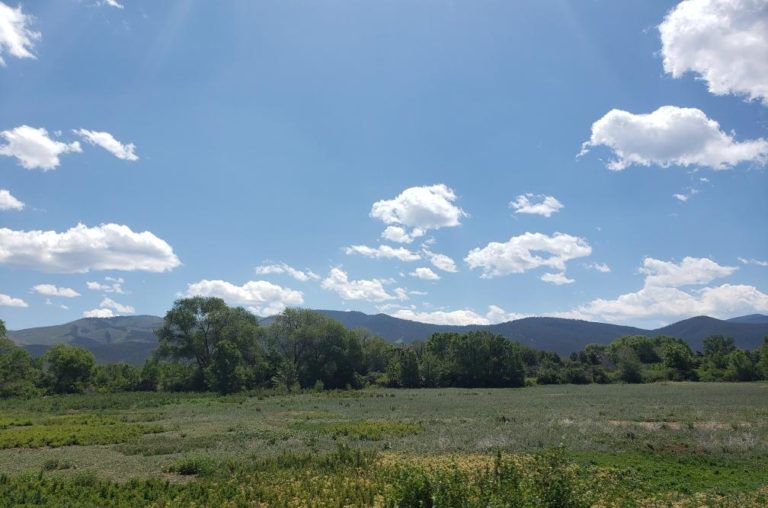
New Mexico has long been known as ‘The Land of Enchantment.’ The familiar slogan adorns everything from teacups to tee shirts. But there is nothing remotely enchanting about the reality San Miguel County and its hub city, Las Vegas, are dealing with. In a catastrophic, nearly unimaginable partnership, nature and the U.S. Forest Service have conspired to squeeze the region’s water supply to relative drops. Las Vegas has only three weeks of fresh water left.
“It’s been a perfect scenario,” said Las Vegas City Manager Leo Maestas, in commenting on nature’s latest one-two punch. Already in a prolonged drought, the region was hit by the largest forest fire in the state’s history. But the story begins a year earlier.
A planned burn by the U.S. Forest Service in April 2021 was never properly extinguished. It reignited this April at around the same time the Forest Service was conducting another planned burn, this one to clear out dead pine needles, fire’s most natural and abundant kindling. But windy conditions that were either not forecast or ignored caused the two fires to grow almost exponentially and merge resulting in New Mexico’s largest fire in its history. By the time the fire, now known as the Hermit’s Peak-Calf Canyon fire, was doused, nearly 350,000 acres of forest were gone. Property damage is still being calculated.
Then, unimaginably, said Maestas, things only got worse. “We didn’t know we would have one of the greatest monsoons on record,” he said in a recent phone interview. The combination of drought—now well into its second decade—fire and epic monsoon rains conspired to create the region’s current problem. “Right now, give or take,” said the city manager, “at normal consumption rate…we have 23 days of water (as of last Friday).”
The residue of the fires, the lingering drought, the record rainfalls and gravity, were all that was needed to add to the misery of this northeastern corner of New Mexico.
Ash, mud, and the burned remnants of the fires washed down into the region’s water supply, the Gallinas Reservoir and Storrey Lake. The reservoir, normally a pristine spot for boating and fishing, is now an eyesore filled with tons of muck from the epic fires.
As city officials, along with state and federal agencies, figure out a quick solution to a dire challenge, Maestas said locals are being urged to conserve water and limit their use to 44 gallons a day. That is hardly enough for the reality of one local resident who told Albuquerque station KRQE, “I have nine people that live in my household. I have got myself, my husband, my five kids and then I have got my aunt and my uncle. So, it is, you know, 44 gallons a day is really not doable for me. I have got to get my kids bathed, I have got animals drinking water, I’ve got you know, laundry to do and dishes.” Local restaurants have stopped serving water except on request and using paper plastics and plasticware to avoid washing dishes.
While there has been a free distribution to locals of bottled water as an immediate source, there has also been a run on bottled water in local stores. School has also begun in Las Vegas and Maestas said that the city is working with officials to make sure that the water supply remains constant for students and staff. The local college, New Mexico Highlands University, has also begun Fall classes.
The state’s governor, Michelle Lujan Grisham, has declared a state of emergency for the region, making it eligible for federal grants. More immediately, it has allocated $2.5 million to immediately address the calamity. The state money, however, will only be a bandaid. Some estimates for dredging and cleansing the region’s water sources have been placed at $100 million, the current rate of water purifications systems.
Las Vegas Mayor Louie Trujillo was also adamant that the Forest Service be held responsible. “We are going to insist that they continue to assist our residents with what we need.”
During some of the worst days of the fire, President Joe Biden visited and met with local leaders. He promised that the federal government would do whatever was necessary to help.
It is not just city residents enduring the pains of this latest chapter of misery but also many from the nearby and nearly invisible farming and ranching villages like Maῆuelitas, Monte Aplanado and El Oro that have dotted the area from the days when Spanish explorers arrived in the area and married into the local Native American population.
When the fire moved in, it moved in so rapidly that longtime resident Miguel Martinez told the New York Times that he left with nothing more than what he was wearing leaving behind the only life he had known. “I left 25 goats, 50 rabbits, 10 chickens and two dogs…I have no idea if my house is standing or my animals are alive.”
The fires that have upended the lives of thousands in this northeastern New Mexico region took a toll that is still being calculated. The latest property figures include 277 total structures destroyed, a figure that also includes 166 homes, 108 buildings and three commercial structures. At least nine homes also suffered serious damage.
Las Vegas, a town of slightly more than 13,000 residents, will survive; it may take time, but normalcy will return. The same can’t be said, at least with unbridled confidence, for the tiny, off-the-beaten-path villages that have been part of New Mexico for centuries. Places where locals often use titles like ‘primo’ and ‘parientes’—cousins and relatives—instead of first names, will have to assess their futures.
“This is not the first time that a municipality has gone through this,” said Maestas. “All we can do,” he said, “is look for the positive.” But with massive forest fires, long-term drought and weather patterns—climate change—that seem to defy historical patterns, that may be a bigger challenge than rebuilding.















9/11 initiated the challenge to a new generation
By: David Conde
September 11, 2001 was a watershed moment for our family as we had a military son in the Washington D.C. area with a major connection to the Pentagon. 9/11 created a high point of anxiety as well a decisive moment about the value of military service in the defense of the country.
These type of decisions were being made across the country as young men and women stepped forward to join and serve under a new spirit of patriotism. It was in part a Pearl Harbor moment as 9/11 brought home the reality of a war to the very doorstep of the American people.
Although many saw the event as the work distant enemies with relatively little power, everyone came to feel the potency projected by terrorism. This kind of conflict also had a profound affect on the Millennium generation that had experienced war only in books and movies.
Curiously enough, the Al-Qaeda attack on our institutions and people occurred as the Millennium community was reaching voting age. To be sure, it had just begun to come into adulthood when they came face to face with the first existential moment of their national life. The generation had grown up thinking that their country was the most powerful nation in the world and that their role was to pro- tect others from harm rather than themselves. World War II, Korea, Vietnam, the fall of the Soviet Union and the Gulf War were distant memories held by older folks and had little to do with their own future.
The trauma of the war on terror in Afghanistan, the invasion of Iraq and the ascendancy of ISIS was followed by the Great Recession another event that increased the fear and suffering of young people struggling to understand themselves. This was compounded by the disintegration of relationships between races and classes because of the changing demography of the country and the fear it is creat- ing.
The fear, especially among the radical elements of the dwindling majority, has led to finding cause with Donald Trump, a man that stoked those fears to gather enough support to capture the presidency of the United States. The fascist tendencies of President Trump and his followers showed themselves openly at the same time that Millennials became the majority in the country.
The compilation of trauma and fear represents the “baptism of fire” for a community that is now being called on the lead the country. Democracy and the guarantee of the right to vote rest more and more in the hands of the new majority.
One of the major characteristics of our new national leading group is that it tends to share values across racial, ethnic and cultural lines. Because of this, there is a sense that Millennials have a higher loyalty to their generation, as diverse as it is, than to their groups of origin.
For this reason, there is increasing confidence that the divided nature among the different communities in the country will turn around as the new majority gains enough in social and political power to govern. Without effective influence by this community on America we can expect to have a hundred years of division or even worse.
Millennials can be called the 9/11 generation because it is in that moment of great trauma that they came into their own. It is also on their shoulders as the new 21st Century majority to lead our country in finding solutions that will bring us back to our democratic roots.
The views expressed by David Conde are not necessarily the views of La Voz Bilingüe. Comments and responses may be directed to News@lavozcolorado.com.