






Home Blog Page 32

A whole new way to see the City of Pueblo

We have all heard it, the old saying about lemons and lemonade. Well, the city of Pueblo just made lemonade. And it was a stretch of the iconic Arkansas River, at least the part that bisects the city, that it metaphorically turned to this sweet summer drink. 

For as long as Pueblo has been around, there has been a section of the Arkansas that has created a conundrum for the city. Locals always knew it had possibilities, but no one knew exactly how to thoughtfully exploit them. Until now.

The city, with a big helping hand from the Pueblo Water Works, finally tamed an often-dangerous part of the river, turning it into what may now be southern Colorado’s most inviting surfing, boogie boarding and watersports venue. But that’s just the bait. There’s a ton of more reasons to check things out.
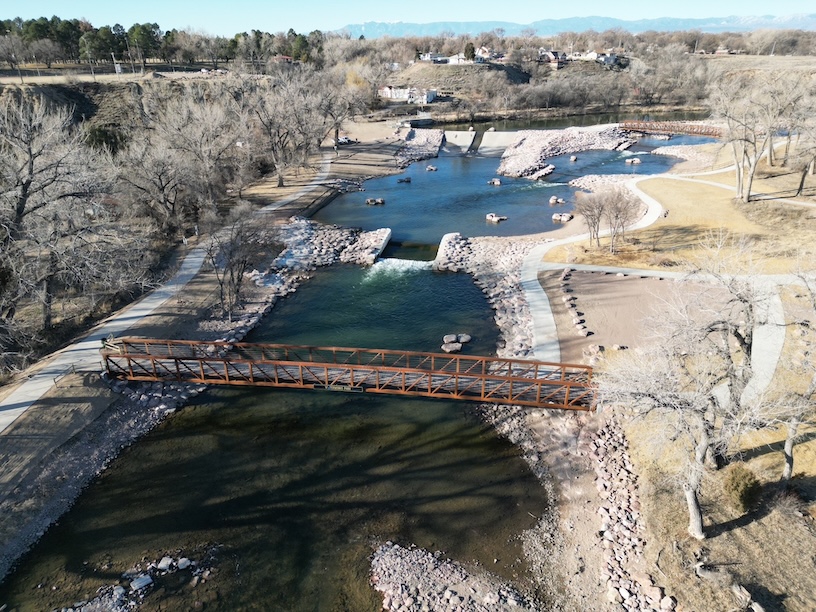
Photo courtesy: City of Pueblo – Pueblo Conservancy District

The river’s redesign, said Pueblo Conservancy District’s Corinne Koehler, has now made it safe for Puebloans and anyone else to dip their toes into the water. For years, the spot where Pueblo’s new water park now sits was an invitation for disaster. “Several (drowning) deaths,” tragedies that are almost predictable, occur each year, said the past Conservancy president. That, along with a desire to turn a chronic life-threatening issue into something positive, she said, “necessitated the reconfiguration.”

Most rivers have spots like this where swimmers can often get trapped in churning waters, where a strong flow creates aerated circulating currents. So dangerous are these spots that even the strongest swimmers can’t escape. Boaters, kayakers, swimmers and anglers have all been casualties.  

The river’s flow can be both placid and unpredictable, said Koehler. But thanks to an $11 million effort by the city’s water works, “they just did it,” transformed an often-unforgiving stretch of river into the proverbial ‘lemonade.’  

Earlier this summer, the water park was christened and opened to the public. Success came almost immediately. “It’s eleven acres,” Koehler said, and “a whole new way to enjoy the river and areas for surfing, tubing, for little kids. It’s created a new amenity for the community to enjoy.”  

The new venue, for which the water park is but a single element, complements the city’s Riverwalk that cuts a line across Union Avenue. Over the last few years, said the Wisconsin ex-pat, new hiking and biking trails and two pedestrian bridges have been added. “People can walk for miles.”

While the city’s ready to entertain locals and, ideally, lure out of town visitors to ‘dip their toes,’ Koehler said there remains one big challenge that, when complete, will make it perfect for a visit. “It’s still in the stage where the city is a little behind on getting decent parking…we’re working on a master plan.”

The location where the river’s evolution has taken place, said Koehler, has been nothing short of amazing. “Over the years, going back to the thirties, when you needed to dump something, you just dumped it on the banks of the river. It was not a ‘recreation thing.’ But today, “people are now realizing that it’s a gem.”

The new ‘gem,’ said Koehler, was on full display in mid-July with SCARF, the first-ever Steel City Arkansas River Festival. It included something for everyone. “It was just one day,” she recalled. “At least 1,500 people came.” She estimated that close to half of those taking part in the inaugural event were from outside Pueblo. 

But the new water park is just one link in the city’s stretch of the river. “I think it would be 22-30 miles” of things to do along the river, Koehler estimated. “There are trails from Lake Pueblo where you can ride from there all the way to the University.” 

There is also the lure of ‘catching the big one,’ for anglers curious about fishing this part of the Arkansas. The region is also a gold mine “for birding and enjoying nature.” 

One extra bonus that will certainly entice just about everyone, said Koehler. Not only is everything free, but “it’s a whole new way of seeing the city of Pueblo.”   

Perseid meteor shower inspired legendary song

A young singer-songwriter went on a camping trip with his friends into the Colorado Rockies to watch the Perseid meteor shower in the summer of 1970. The beauty and wonder he saw on that trip inspired him, and over the following six months, John Denver worked to capture that experience in his music. The result was “Rocky Mountain High,” an enduring classic and one of Colorado’s two state songs.

A view of the Milky Way arcing over the Black Canyon of the Gunnison National Park.
Photo courtesy: Rob Hazzard of National Park Service

While growing cities have encroached on the forests and the streams, Coloradans have worked hard to preserve the natural beauty that makes our state special. In addition to the clear-blue mountain lakes, Colorado is home to eighteen certified International Dark Sky Places, ideal for stargazing—an increasingly rare privilege in our light-polluted times. Many of these are also some of the most beautiful natural sites in the country, like the Black Canyon of the Gunnison and the Great Sand Dunes National Park and Preserve.

As Coloradans, we’re incredibly lucky to have such ready access to these beautiful sights. That Perseid meteor shower John Denver watched returns every summer. This year it will peak in the late night of August 12 and early morning of the 13th. If you have the chance, head out into the mountains (or if you’re lucky enough, just your backyard) that night to catch a sight of it rainin’ fire in the sky. You won’t regret it.

Source: Devin Flores, the Colorado Encyclopedia

The rehabilitation of La Malinche

David Conde, Senior Consultant for International Programs

2025 marks 1,200 years since the founding of Mexico-Tenochtitlan in the Valley of Mexico. On March 13, 1325, a small island on Lake Texcoco became the home of what was to become the great Mexica-Aztec Empire. 

The founding was based on a vision that described the designated place as having an eagle perched on a Nopal plant devouring a serpent. That image is the central part that dominates the view on the Mexican flag.

President Claudia Sheinbaum Pardo has proclaimed 2025 as the year of the indigenous woman. That decision has brought to the forefront questions about the role La Malinche played in the Spanish conquest of the Empire. 

La Malinche also known as Malinalli, Malintzin and Dona Marina was born to Nahuatl nobility in the Yucatan peninsula in 1500, during a period when both the Aztec and the Mayan Empires were vying for control of the area. Evidently her family was on the losing side of a political struggle and at the age of 8 Malinalli was sold into slavery.

It is in the peninsula city of Pontonchan that in 1519 she was given along with other women to Hernan Cortes and his men who were on their way to Veracruz where they were to begin the conquest of the Aztec Empire.

Because of her noble birth and education Malinalli was versed in Mayan, Nahuatl, high Nahuatl and soon learned Spanish under the tutelage of one of the Spanish priests. She became most useful to Cortes as an interpreter, especially in her ability to speak high Nahuatl that was the language of Aztec nobility.

As the primary interpreter, Malinalli had the power to affect the course of Spanish history in America. Because she did not use this power to benefit Cortes’ adversaries she was judged as a traitor to her people.

She became “La Malinche” a pejorative take on her name that Octavio Paz in the Labyrinth of Solitude (1950) cites as the mother of a rootless Mexican with a confused past and identity. She was also branded “La Llorona,” the wailing mother that searches in the wind for the children she lost to destiny.

However, women voices have risen to defend Malintzin’s struggle to overcome her condition as a slave in the middle of a historic moment that was the Conquest. Among those voices is that of Mexican novelist Laura Esquivel of Agua Con Chocolate (1989) fame that in her novel Malinche (2006) humanizes the character and presents her as a victim of circumstance.

To her defense also comes author Veronica Chapa and her novel Malinalli (2025). It is important to note that Chapa is a Mexican American from Chicago. She sees Malinalli as a complex character that history has somewhat misunderstood. Taught by her grandmother the story of Quetzalcoatl Topiltzin’s promise to return on his birthday, Malinalli believed that Hernan Cortes was that returning god and endeavored to do everything she could to help Cortes (Quetzalcoatl) regain his throne as god of the Nahuatl people.

As time goes on, Malinalli begins to realize that Cortes is all too human and all too willing to sacrifice those closest to him in his effort to gain the riches and power that the Empire offers. She eventually achieves her freedom, marries into Spanish nobility and has Mestizo children.

The issue of Identity because of conquest and cultural duality has haunted not only the Mexican but also the Chicano in America. Like Octavio Paz, Esquivel and Chapa’s recapitulation of history in this regard seek the same answers.

Denver DPHE Confirms First 2025 human case of West Nile Virus in Denver 

0

The Denver Department of Public Health & Environment (DDPHE) is urging residents to take extra precautions after disease intervention specialists confirmed the city’s first human case of West Nile virus this season.  

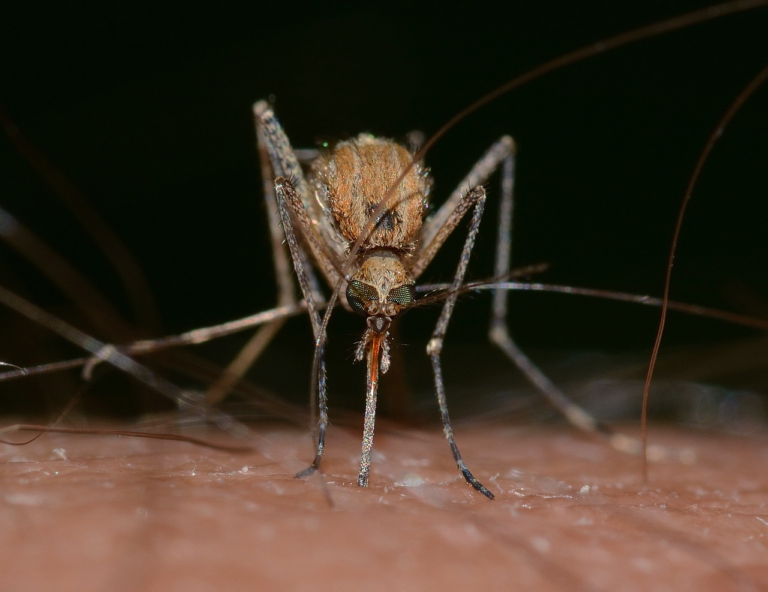
West Nile virus is primarily spread through the bite of an infected mosquito and can be transmitted anytime when mosquitoes are active. In Colorado, mosquitoes can be active as early as May but are typically in higher numbers during summer through fall. Mosquito season ends after the first hard freeze of the year, usually in October or November. 

The best way to prevent West Nile virus is to avoid being bitten by mosquitoes. Mosquitos need water to breed, so getting rid of standing water is key. Eliminate standing water where mosquitoes can breed. Once a week, empty and scrub, turn over, cover, or throw out items like tires, buckets, planters, toys, pools, birdbaths, and trash containers. Clean out street and house gutters that may hold water. 

Additionally, DDPHE recommends the following preventive measures: 

  • Avoid watering cement or streets, which can create mosquito-friendly puddles. 
  • Use insect repellents, like DEET, which are safe and effective when used as directed, even for pregnant or breastfeeding individuals. 
  • Limit outdoor activity at dawn and dusk when mosquitoes are most active. 
  • Wear long sleeves and pants when outside. 
  • Ensure windows and doors have intact screens to keep mosquitoes out. 

Common symptoms of West Nile virus disease include fever, fatigue, headaches, and body aches, with some people also experiencing rashes or swollen lymph nodes. Symptoms typically appear 3–14 days after being bitten. While anyone can be infected, those over 50 or with weakened immune systems are at higher risk for severe illness. Severe infections begin suddenly and can include symptoms of high fever and headache, neck stiffness, disorientation, and tremors. Severe infections may lead to a serious brain infection such as encephalitis or meningitis, paralysis, coma, or even death. 

Residents experiencing symptoms should consult their healthcare provider immediately. Treatment can help ease symptoms and aid recovery. 

For more information on West Nile virus in Colorado or local mosquito monitoring, visit CDPHE’s website. You can also learn how Denver manages its mosquito population on DDPHE’s Environmental “What If” Podcast.

Our Government

White House

President Donald J. Trump and First Lady Melania Trump are excited to continue the tradition of welcoming volunteers to help celebrate the holiday season at the White House. Americans from every U.S. state and territory are invited to apply for the opportunity to assist with decorating at the White House or showcase their talents as a performer at the holiday open houses.

Colorado Governor

Governor Polis verbally declared a disaster emergency to support response efforts for the Elk Fire in Rio Blanco County, Southeast of Meeker, Colorado.  The order provides for additional, external resources and State support to more effectively manage and suppress the fire, and protect the values at risk. Fire conditions in northwest Colorado are at near record levels, and elevated fire weather and fire risk is forecast for the coming week. 

Denver Mayor

The City and County of Denver today shared a revised Vibrant Denver Bond package as part of the latest round of revisions made in collaboration with Mayor Mike Johnston and Denver City Council. The updated project list adds $15 million to the American Indian Cultural Embassy for a new total of $20 million in funding. The updates follow a Denver City Council discussion on bond priorities last week.

A Week In Review

0

Africa 

Ethiopian migrants feared to be dead 

Local reports suggest that around 68 migrants died after a boat carrying 157 people sank off the coast of Yemen. Most of those who were on board were Ethiopian. Many migrants from the Horn of Africa travel through Yemen to Gulf states looking for work. Last year, more than 60,000 migrants arrived in Yemen. 

Kenya looks to raise minimum drinking age 

Officials in Kenya introduced new proposals related to alcohol including changing the minimum drinking age from 18 to 21, banning alcohol sales in supermarkets, restaurants, and on public transport, and online sales and home deliveries. Lawmakers said the measures will help address substance abuse, especially among youth. If the proposals are approved, alcohol will only be available in pubs and bars. 

Asia 

Former Indian politician sentenced to life for rape 

Prajwal Revanna, a 34-year-old former member of India’s Parliament, has been sentenced to life in prison for rape. He was found guilty of raping one of his staff members. Revanna is from an influential political family, and it’s rare that a figure with an influential political background gets punished in similar cases in India. 

Dozens killed at Chinese nursing home  

At least 31 people were killed at a nursing home in China due to flooding. Video footage showed chest-high water in the facility, and many of the victims were immobile. China has been hit by record heatwaves this summer in its eastern regions while flooding has impacted the country’s south-west. 

Europe 

French cyclist wins Tour de France Femmes 

For the first time in 36 years, a French nationalist has won the Tour de France Femmes. Pauline Ferrand-Prevot became the first French nationalist to win the race since Jeannie Longo won in 1989. Ferrand-Prevot had not participated in road racing in seven seasons and competed as an Olympic mountain bike champion. 

German zoo culls 12 baboons 

At least 12 healthy Guinea baboons were slaughtered in a southern German zoo because of overcrowding in their enclosure. After the culling, the animals were fed to predators. The zoo said overcrowding caused increased conflicts and no alternative could be found for re-housing them. Many animal rights groups have filed a criminal complaint against the zoo since the incident. 

Latin America 

Gunmen kill 17 at Ecuador bar 

Police in Ecuador said at least 17 people were killed by gunmen in an Ecuador bar, including a 12-year-old boy. Witnesses said the gunmen shouted, “active wolves,” which authorities believe may have referenced a local gang. At least 14 others were also injured in the attack. Ecuador had a homicide rate of 38 per 100,000 people in 2024. 

Former Colombian president placed under house arrest 

A judge in Colombia has sentenced former President Alvaro Uribe to 12 years of house arrest for witness tampering and a fraud charge. He is the first former president in Colombia history to be convicted of a crime. Uribe, who was president from 2002-2010, denied the charges and said he plans to appeal his conviction. 

North America 

ICE recruiting workers 

The US Immigrations and Customs Enforcement (ICE) is working to hire 10,000 new personnel. Among the incentives it is offering new recruits includes bonuses up to $50,000 and student loan assistance. ICE is seeking to add 100,000 new employees, including deportation officers, attorneys, criminal investigators, student visa adjudicators, and other roles. 

Police search for Montana bar shooting suspect 

Police in Montana are searching for a 45-year-old suspect who is accused of shooting and killing four people at a bar. The victims were Barmaid Nancy Lauretta Kelley and customers Daniel Edwin Baillie, David Allen Leach, and Tony Wayne Palm. The suspect, Michael Paul Brown, fled to nearby foothills after the incident. The shooting occurred last Friday, and police said Brown was a regular at the bar. 

‘Big beautiful bill’ affects Colorado’s aging community

It was one hundred years ago this year that then President Calvin Coolidge said, what many consider his most memorable line. When asked about the state of the economy, the man of few words blurted out, at least for him, a torrent, uttering his famous, ‘the business of America is business,’ line. It was reassurance that the country was in good shape.

Of course, that may have been the case in 1925 when the ‘Roaring Twenties’ had the country’s economy humming. But in the almost month since President Trump signed into law his ‘big, beautiful bill,’ rather than crow about anything, city and state leaders are wondering if it is this president who is, in fact, ‘giving them the business.’ 

The legislation—Trump’s ‘Big, Beautiful Bill’– has cut, in some cases dramatically, funding for programs designed to help those most in need and forcing states and municipalities to make some rather painful decisions on cuts of their own. Compounding the challenge in Denver, said City Councilwoman Selena Gonzales-Gutierrez, “We’re predicting a $200 million shortfall.” Others have pegged the shortfall closer to $250 million.

The total cost of the recently signed legislation is estimated at $3.4 trillion over the next decade and rising to more than $4 trillion when including interest on the national debt. Some of its key components include tax reform, government assistance and border policy and immigration. 

Most economists acknowledge that the biggest benefits will favor the country’s richest individuals and corporations. The legislation does, however, include provisions that eliminate tax on tips and overtime. It should be noted that those provisions expire in 2028.

But states will be responsible for making up cuts in SNAP, what used to be called food stamps, and Medicare and Medicaid. Gonzales-Gutierrez says it’s too early to say when the city will feel the actual impact of these changes, but she promises, they are coming. 

“There will be a huge impact in our city for those that rely on Medicaid,” she predicted. Those who will feel it first, said the at-large councilwoman, will be the elderly, people with disabilities and children who rely on it for health care and not just physical health. Other ripples of the legislation, she believes, will resonate among the city’s homeless, a population that continues to vex not just Denver but the entire nation. Whatever the city has been doing to ease this issue, she said, “will triple…we’re going to see more people needing assistance.”

AARP, a national organization that lobbies on behalf of seniors, said the 900-plus page bill will also land hard on the elderly, especially low-income older Americans. While there are some provisions of the bill that temporarily reduce their tax burden, Medicare and Affordable Care Act cuts and programs for food assistance will be affected. Cuts to ACA, also known as Obamacare, predicted the Congressional Budget Office, could cause as many as 12 million people to lose their health insurance by 2034.  Seniors, however, may get a tax break in the new legislation. The bill calls for an additional $6,000 deduction for individuals aged 65 and older which could reduce their taxable income making their Social Security fully tax free. 

While the gigantic new legislative package reduces funding for healthcare and other social programs, Gonzales-Gutierrez points out that it also pours unprecedented amounts of money into immigration enforcement and border policy.

In crafting the bill, Republicans dedicated a steroid-level $170 billion for immigration enforcement and border security, an amount that includes roughly $75 billion additional funding for ICE. The money will pay the salaries of up to 10,000 new ICE agents who are now being offered a $50,000 signing bonus and, in some cases, salaries of $100,000.

It is the largest allocation of funds set aside for immigration enforcement in our history but also lines up perfectly with the president’s vow to deport any and all who are in the country illegally, a number estimated at 12 million. 

The big, beautiful bill has included $45 billion for the expansion of a spider web of detention facilities across the country, including potential sites in Colorado, to hold single adults and families, including children for future deportation. It is possible that ICE could detain as many as 100,000 men, women and children. Currently the number in ICE detention is estimated at 58,000 individuals.

“It’s like we’re going back to times when a lot of our ancestors were deported,” said Gonzales-Gutierrez while offering advice to anyone—including American citizens. “From day one,” she said, “make sure we have passports and documentation. It’s happened before; history is coming back. What makes us believe it can’t happen again?”

Gonzales-Gutierrez says it is difficult to reconcile the big, beautiful bill’s slashing of programs aimed at helping those least able to help themselves while, at the same time, empowering the government to execute a program with the singular purpose of hurting so many people simply looking for a better life.”

“These are not our values,” she said. “The people now holding power are acting this out and trying to harm people. Let’s be honest; It’s dehumanizing people of color.”

The Aging of Colorado: A Warning

0

By Bob Semro, Health Policy Analyst at The Bell Policy Center

Colorado is facing a demographic and long-term care crisis that may directly affect more than a million of our fellow citizens. 

Let’s start with some statistics about Baby Boomers.  Did you know that……?

  1. There are more than 1,340,000 “Baby Boomers” in Colorado and they represented about 37 percent of the labor force in Colorado in 2010
  2. Approximately 1,000,000 workers will be aging out of the work force over the next 20 years, effectively ending Colorado’s “Demographic Dividend” to state and local government tax revenues.
  3. According to the Volunteers of America’s “Boomer Bust 2011, Still Unaware and Unprepared” study in April 2011
  4. 27 percent of the workers surveyed reported that they have less than $1,000 in savings
  5. More than half of the workers surveyed have less than $25,000 in savings if you exclude the value of their primary home and pre-defined benefits plans. 
  6. 54 percent of those workers surveyed reported that they have not calculated how much money they need to save for retirement

How about some statistics on Seniors? 

  1. Colorado’s 65+ population will increase by 123 percent between 2010 and 2030
  2. By 2030, 18.5 percent of the state’s population (1,243,000 people) will be over 65.
  3. According to the “From Bad to Worse” policy brief from July 2011 by Demos and the Institute on Assets and Social Policy:
  4. The number of seniors at risk of outliving their resources in the United States increased by nearly 2 million households between 2004 and 2008.
  5. More than 1 out of every 3 seniors in the U.S. is economically insecure today and almost 50 percent of all senior households of color and single women households are economically insecure.

How about Long-Term Care? 

  1. At some point in their lives between 70 and 75 percent of individuals over 65 will require some form of long-term care. 
  2. The average time span for long term care is 3 years
  3. The average cost of a single occupancy room in an Assisted Living Facility in Colorado is $108 dollars a day or $39,450 per year.
  4. The average cost of a semiprivate room in Nursing Home in Colorado is $202 dollars a day or $73,730 per year. 

Medicare doesn’t pay for long term care only Medicaid does.

The state’s Medicaid budget, which funds the only long-term care safety net for middle- and lower-income Coloradans, is expected to triple by 2025 from $1.8 billion to $5.5 billion.  There are no quick or cheap solutions to solve that problem.  What we do know is that our population is aging in an unprecedented way, the baby boomers are leaving the workforce, and many of them are financially unprepared for retirement let alone long-term care.  Government doesn’t have a game plan for addressing the problem and the legislature is prevented from raising the revenue that will be needed to keep a strong safety net in place.  This is an issue of both individual and governmental responsibility.  The longer we wait to deal with both sides of this problem the more unsatisfactory the solution will be.

Source:  Consumer Health Initiative

Courtland Sutton and the Broncos reach extension

0

The Denver Broncos and perennial receiver, Courtland Sutton reached a $92 million dollar extension on Monday. The deal would keep Sutton in Denver for four more years that includes $41 million in guarantees. 

Sutton was in his last year of a four-year extension he signed in 2021 that paid the wide-out $60.8 million which was set to pay him nearly $14 million this season with $500,000 in workout incentives. 

Sutton has made it clear to fans and the organization that he wants to finish his career with the Broncos and since he’s the second longest tenure on the team, this extension could be the final years of his career putting him at 33 when his contract is up. 

Denver, now less than two weeks away from their first preseason game in San Francisco. The Broncos have been firing on all cylinders at practice with both the offense and defense showing flashes of greatness. Unfortunately, one of Denver’s reliable linebackers 

Drew Sanders went down last week with a foot injury that included a tendon. Last season Sanders suffered a season ending Achilles injury that took him most of the regular season and off-season to recover from. This injury was a huge blow to the defensive backfield but Denver remains positive of his outcome despite being told that he’d likely not return until after the regular season begins. 

In other sports the Denver Nuggets superstar Nikola Jokic broke down in tears over the weekend after his horse Demon Dell’Est won at the annual Duzijanac event in Serbia over the weekend. Jokic hopped the fence to greet his horse and rider while sobbing into his hands happy.

Rumors have been swirling around the league about LeBron James possibly being traded to Denver as he was spotted over the weekend after Jokic’s agent (Misko Raznatiovic) posted a picture on Instagram with both James and his agent Maverick Carter on a trip in France on board a yacht. 

The Colorado Rockies are just two games away from reaching 30 wins just four months into the season. The Rockies have won two of four with wins over the Orioles and a single win against the Cleveland Guardians on Monday. 

Colorado will wrap up two-games with the Guardians this week in Cleveland before heading home to host the Pittsburgh Pirates. 

‘Big beautiful bill’ decreases older adult benefits

The era of ‘business as usual,’ may have come to an end on our birthday—the nation’s birthday. The candles may have blown out on July 4th when President Trump, with a backdrop of Republican congressmembers, signed legislation he’d nicknamed his ‘big, beautiful bill.’ 

The legislation—900-plus pages in length—signaled a change in the way the country works, most especially for states and cities who are the overseers charged with keeping ‘the trains running on time.’

With the president’s signature, a surreal form of cursive that by now everyone knows, but few can precisely interpret, rechanneled the way federal money will be dispersed. 

For states dependent on a set amount of federal money to fund schools, build and maintain roads and bridges, handle public health and, otherwise, maintain a degree of predictability in everyday life, the ‘big, beautiful bill’ was a wake-up call. 

The legislation slashed anticipated money for a slew of things, from SNAP (Supplemental Nutrition Assistance Program), the program designed to lend a hand to low-income families for food assistance, to Medicare and Medicaid, decades-old programs that address senior health and low-income families. 

Cuts to social service programs, including SNAP, WIC (Women, Infants and Children), and Medicare and Medicaid, may be devastating to millions of Americans who rely on them for basic survival. Combined cuts to these programs equal an estimated $1.75 trillion. Cities are now left wondering just how they’re going to adjust to this new and ‘stream-lined’ way of doing business.

Steve Nawrocki, Executive Director of Pueblo’s Senior Resource Development Agency, says passage of the new legislation has his organization—one already facing daunting fiscal challenges—scrambling to move into this new era of austerity.

“Last year we cut a half million dollars,” from its operating budget, Nawrocki said. Trump’s pet legislation, the BBB, means once again trimming programs, including Meals on Wheels, a program that delivers meals to low-income seniors who often are homebound or have no other means of getting out to do their own food shopping. 

In the last few years, the former Pueblo City Council president said, Meals on Wheels had already been pared down. “We had seven days a week (delivery)…and three to four hundred stops.” Today that number, he said, is half. 

But it’s not just delivering meals that makes the program a lifeline. “That delivery could be the only person they have contact with,” While drivers are told to keep a schedule, “we’ve always encouraged them to stop and speak. Sometimes people are desperate to speak to another person.” 

Even before passage of the president’s July 4th legislative passage, a ton of American cities were facing their own fiscal challenges. In Pueblo, Mayor Heather Graham recently forewarned that the city was looking at a $25 million-dollar budgetary shortfall. She floated the idea of a one percent tax increase voters may decide in November. 

While the shortfall is serious and needs to be addressed, Pueblo City Council’s Dennis Flores said, the BBB is a compounding factor. The loss of SNAP funds, cutbacks in Medicare and Medicaid and the need to deal with the day-to-day business of the city, which depends on federal grants to cover the costs of so many of these things, “You don’t really know the impact.” 

But while the impact may be unknown, said Flores, there are some very real guesses that not only Pueblo, but cities across the country are already bracing themselves for. 

Medicare and Medicaid “have been propping up hospitals for a long time,” said the retired insurance man. With announced funding cutbacks, “you will be seeing outlying hospitals shutting down.” With existing medical options disappearing in smaller communities, hub cities, like Pueblo, will be obvious landing places for people seeking medical attention. “We’ll be seeing an influx” at Pueblo hospitals, including emergency room visits “which are more expensive.”

Another tax being considered is one that has been on Pueblo’s books for 40 years. It is a half-cent sales tax that funds the Pueblo Economic Development Corporation’s efforts aimed at attracting and bringing new businesses to Pueblo. 

Flores says he does not like the mayor’s proposal to hike the sales tax. But maintaining the half-cent sales tax, he said, has proved its worth in bringing economic growth to the city.