Home Blog Page 2

Our Government

White House

President Donald J. Trump signed an Executive Order rescinding restrictions on access to Federal lands, restoring balanced land management and reducing unnecessary regulatory burdens.  Department of Agriculture took action to rescind the 2001 Roadless Rule that prevents road construction, reconstruction, and timber harvest on nearly 45 million acres of the National Forest System.

Colorado Governor

Governor Polis appointed Lochlin I.S. Rosen to the 17th Judicial District Court. This appointment fills a new judgeship created by Senate Bill 25-024 and is effective July 1, 2026. Mr. Rosen is a Deputy State Public Defender in the Brighton Office, a position he has held since 2017. His practice consists of criminal defense. Mr. Rosen earned his B.A. from Elon University in 2011, and his J.D. from The University of Texas School of Law in 2017.

Denver Mayor

Mayor Mike Johnston today joined leaders in housing and homelessness, members of City Council, and frontline employees in announcing that Denver has achieved the city’s first reduction in overall homelessness in nine years and a 64 percent reduction in street homelessness since 2023.  “This is a historic accomplishment, and it is one we celebrate with every city employee, partner, and Denverite who shares the belief that our neighbors deserve better than to sleep on the streets,” said Mayor Mike Johnston.

Colorado Avalanche Season Ends in Stunning Collapse

0

The Avalanche’s season and dominant playoff presence came to a devastating end Tuesday night following game four of the western conference finals as the Golden Knights rallied together four back-to-back wins to bring Colorado’s blistering presence to an unexpected end. 

The Avalanche, setting the all-time record for fewest regulation losses throughout the first forty games, led the western conference, and recently set the franchise record most goals scored in a single playoff game, just couldn’t pull it through this series. 

Cale Makar, a key role on the squad played just two out of the four games throughout the western conference finals. Playing through a lingering upper body injury many fans speculate on whether or not he will start this upcoming season. Nichushkin another key role was absent during game four with an apparent lower body injury sustained during game three.

 The Av’s were expected to put up a worthwhile matchup against the Knights which makes this loss even more devastating. What was thought to be their fourth finals appearance turned into questions about the future of the team and the future of Jared Bednars role as head coach for the organization. In the presser following Tuesday’s game when asked about the team’s abrupt end, Coach Bednar responded with: “I don’t know…It takes a little bit of time to do that…I can’t really answer that.”

Through it all however, die-hard Denver sports fans remain faithful moving into the offseason. 

With the release of the 2026-2027 NFL schedules, The Broncos first pre-season game is set in Falcons territory at the Mercedez-Benz stadium August 14th, while the regular season kickoff takes place in a highly anticipated matchup in enemy territory, (Monday Night Football) September 14th at Arrowhead Stadium against the Kansas City Chiefs, the Broncos hold a franchise record of 59-73 against the Chiefs and will hopefully look to close the all-time deficit. 

The 20-36 Colorado Rockies were pummeled Tuesday night in a 6-15 outing against the Dodgers, marking their second loss in a three-game series against the Dodgers. Although they began this season miles better than last year’s 8-42 start, the dark ages for Rockies fans persist as they remain the worst team in the MLB.

The end of one way of life, and the beginning of another

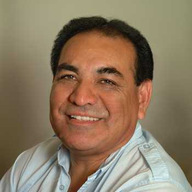
David Conde, Senior Consultant for International Programs

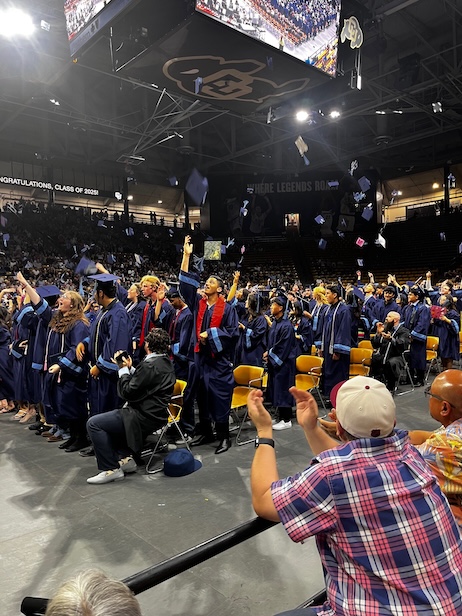
This is the season for school graduation and commencement, two words that stand in opposition and yet have the same understanding. Graduation refers to the certified completion of an academic or training journey while commencement signifies the beginning of a new one.

Both concept are part of the same ritual that formalizes the end of one way of life and the beginning of another. It is a transformative experience that emulates the life cycle that has an ending and a new birth as well.

The hard work of achievement results in what can be called a miracle that actually creates a new significance for an individual. The magic and life-changing wand is the sufficient acquisition of knowledge to deserve public recognition.

This year, I have two granddaughters finishing an educational stage. One completed an engineering specialty at the Colorado School of Mines and the other is graduating from North High School.

Both planned their program of study, and both will be going on to the next phase of their lives. The plan also included the ritual of graduation and commencement.

Graduation and commencement were not always available in the past. In most cases, it was because graduation from college or high school was not part of the experience for many in the Latino community.

As a migrant farmworker, school was something I attended after coming back from the fall harvest and something I left early in the spring before the academic year was over. To have a truncated year of school time after time allowed for no thought about the ceremonial part of educational advancement.

For those like me that were looking to a second chance at school completion, there was the General Equivalency Development (GED) program that offered an alternative way to finish high school. In the military, I was also offered and took on the opportunity to test out of the first two years of a university education.

A combination of circumstance and a little bit of luck allowed me to participate in graduation and commencement ceremony on completion of my undergraduate degree. Over time, that event became a marking point in finding the future direction of what was to become my career.

I realized that the ceremony allowed me to “die” to the previous condition and be “born” to a new life with what I saw as a new set of rules. I became convinced that for these reasons among others, graduation and commencement had to be an essential part of the life of family and loved ones.

It is a well-known axiom that education is deemed the “light of the world.” It is the only transformative legacy available to everyone, rich and poor. That and hard work have been the major instruments in the elevation of the Latino community to a certain prominence beyond the demographic and political issues that consume the country today. In a very quiet way, education is changing the Latino contribution to nature of the evolving backbone that holds America together.

In this time of great division in the country, it is the leadership through example rather than hollow words and promises that will endure and make a difference. There is no going back from what we are becoming.

For this reason and others, celebrating true success and true accomplishments must stand and be one of our major priorities.  In honoring excellence, we honor the best in all of us.

There is no better place to start than with the accomplishments of our young. Graduation and Commencement is their day.

A Week In Review

0

Africa 

Vehicle runs into elephant 

Three people were killed at a national park in Uganda when a vehicle collided with an elephant. The car was carrying officials from the Uganda Revenue Authority, and four others were taken to a hospital. No information on the elephant’s condition has been released. 

Police fire shots in air at Ebola treatment center 

Police in the Democratic Republic of Congo fired gun shots in the air while guarding an Ebola treatment center. Crowds have recently attempted to reclaim the bodies of loved ones who died from Ebola. Bodies from Ebola victims are highly contagious and can lead to the virus spreading even further.  

Asia

Hong Kong astronaut set to travel to space  

Li Jiaying is set to become the first Hong Kong astronaut to be launched into space. She currently works as the payload scientist in the three-member crew. Jiaying is a police officer and mother of three. The space trip is the latest effort in China’s attempt to send humans to the moon by 2030. 

Hundreds climb Everest in one day 

Around 274 people climbed Mount Everest via Nepal in one day last week. Tourism to the area got a late start this year because of a chunk of ice blocking the climbing route. The 274 climbers surpassed the previous high set in 2019, when 233 climbers ascended the mountain from its southern side in Nepal. 

Europe 

Four dead in Ukraine from Russia attacks 

Four people were killed and 100 others were injured from deadly Russian strikes against Ukraine. Russia fired off hundreds of drones and dozens of missiles on Ukraine this past Saturday. The country said the attacks were in response to Ukraine’s “attacks on civilian infrastructure.” Ukraine denied targeting civilians. 

French couple held after abandoning children 

A French mother and her partner are in custody after the couple allegedly abandoned the mother’s two young children on a roadside in Portugal. The accused are identified as Marine R and Marc B and were arrested last Thursday. They are accused of child endangerment and abandonment. The children are aged four and five are with a French foster family until the are returned to France. 

Latin America 

Venezuelan prisoners protest 

Inmates and security personnel clashed recently in Barinas, Venezuela. Prisoners climbed the roof and burned mattresses in protest to alleged mistreatment. Local reports suggest hearing explosions while inmates allege they were shot at. Venezuela has poor jail conditions and local groups have warned that many do not meet minimum standards guaranteed by law. 

Man dies at Machu Picchu 

A 52-year-old Australian man died after falling down a ravine while walking the Inca Trail in Peru. The victim, Matthew Cameron Paton, had three children and was married to his wife for 31 years. Officials are expected to investigate the cause of the fall, and Paton’s body will be transferred to a nearby town. 

North America 

Nascar champion dies 

Nascar champion Kyle Busch passed away last Thursday at the age of 41 after suffering from severe pneumonia that progressed into sepsis. Over his career, Busch won two Cup Series titles and 63 races. Nascar honored Busch by displaying his number and truck ahead of the Coca-Cola 600 at the Charlotte Motor Speedway in North Carolina. 

Suspect killed near White House 

A man who shot at a White House security checkpoint was shot and killed by Secret Service agents. The suspect, 21-year-old Nasire Best, was known to police and had a history of mental health conditions. Best allegedly pulled a gun from his bag and fired outside the White House near the Eisenhower Executive Office Building. President Trump was at the White House at the time but no operations were impacted. 

Fort Logan, the most enduring honor for the nation’s fallen

0

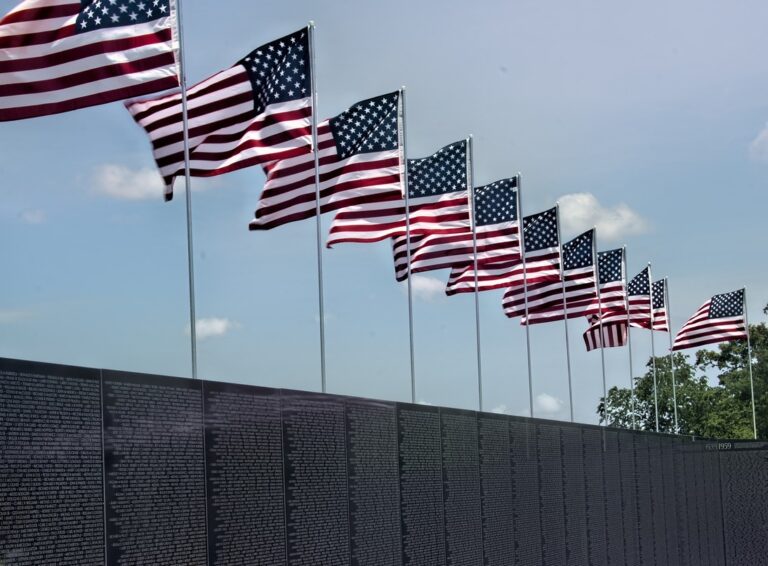
Nearly every day across America, a simple, yet unmistakable melody plays countless times. The song, “Taps,” a deeply haunting 24 notes played on a bugle is a final tribute and thank you to a veteran who once answered his or her nation’s call. 

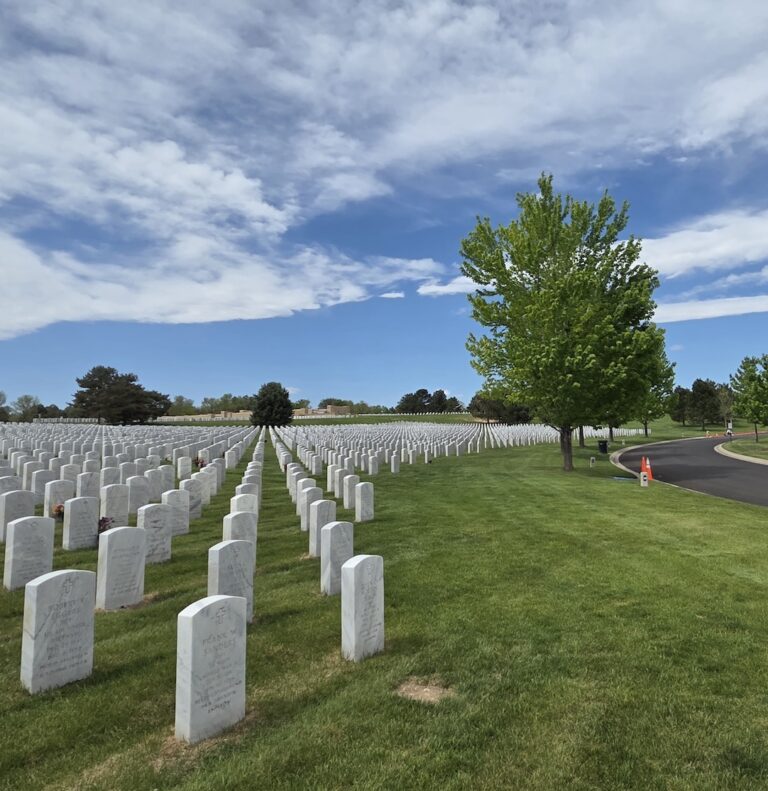
Denver’s Fort Logan National Cemetery, a pristine and immaculate resting place located on the southernmost end of Denver, holds the remains of more than 148,000 American veterans and family members. Its rolling hills cover an expanse of more than 200 acres. The graves are of veterans of every American conflict going back to the Civil War. 

The protocol for each burial is a uniform, respectful simplicity. It includes the same decades-old staples for every ceremony that has ever taken place in a national cemetery. They are a final note of appreciation “from a grateful nation,” the presentation of a tri-folded American flag to the family and the playing of “Taps,”an unembellished refrain that long ago simply signaled “lights out.” 

But in a practical concession to reality, with World War II, Korean War and Viet Nam veterans aging out, an in the flesh bugler is now often replaced with the song played electronically. Another reality? A shortage of volunteer veterans to serve as honor guard, the result of aging and mortality, has downsized the heretofore full military presence at the ceremony.

Across the country, there are more than 150 national cemeteries with, perhaps, Arlington National Cemetery the most well-known. But while Arlington is best known, it is not the largest. That distinction goes to California’s Riverside National Cemetery which covers more than 1,200 acres, nearly twice the acreage of Arlington.

Outside of the U.S. there are also 26 American military cemeteries and memorials. According to the National Cemetery Administration, there are approximately 124,000 veterans of World War I and II buried on foreign soil, including Belgium, France, Mexico and the Philippines.  France’s St. James American Cemetery holds the remains of 4,410 American soldiers who died during the Brittany and Normandy campaigns.

There are also Americans who fought and died and are buried in the Mexico City National Cemetery. Most fought in the Mexican American War (1846-1848). A number of others who died in the Civil War and Spanish American War are also forever interred in Mexico. The cemetery has one common grave for 750 Americans whose names remain unknown. All told, there are more than four million veterans in the country’s national cemeteries and memorials.

“The first time I came on it,” said Fort Logan’s acting director Edward Bremer, “It was just beautiful…I was just blown away by its presence.” Bremer knows every section of the cemetery by heart and, since 2022, has watched countless families come and go with some staying to chat to learn the history of the grounds.

“Every day is special,” said Bremer. “Every family that comes through has a different story or different value to the place.” But not everyone who comes here comes for a funeral, Bremer says. Some come just to peruse the grounds, for serenity, to read the names on the headstones, some made from granite, others marble. 

At Fort Logan, they see markers of Medal of Honor recipients—there are two. There are also veterans from wars going back to the 19th century, including the Buffalo soldiers, all Black U.S. Cavalry soldiers who fought in plains battles in the 19th century. The name ‘Buffalo soldier’ was attached to these troops because of their ruggedness, tenacity and looks, many comparing the texture of their hair to that of the buffalo. The name ‘Buffalo Soldier’ is revered in U.S. military history. 

As Memorial Day approaches, many veterans, including Metropolitan State University-Denver military history professor William ‘Bill’ James Parker thinks not only of other veterans but family members whose final resting place is on the grounds of a national cemetery. To Parker, a retired Navy captain, it is simply sacred ground. 

“It’s about the men and women who put our nation’s uniform on and never came home,” he said. “They gave their last full measure of devotion,” to the nation. Whether it was “one year or forty-five, they deserve some devotion.” 

Parker, a 1988 Air Force Academy graduate, descends from generations of military families, including a number who achieved flag officer rank. He also remembers the simple but hallowed grounds at his alma mater where a number of Academy graduates rest in peace and the two structures at the Academy honoring two significant names, both Medal of Honor recipients. Mitchell Hall is named for William ‘Billy’ Mitchell and Doolittle Hall honors James ‘Jimmy’ Doolittle who led the first aerial attack on Japan in World War II. 

Parker, a Maryland native, now permanent Coloradan, has visited Fort Logan countless times and marvels at its serenity. “It’s extremely special,” he said. Hearing the distant melody of “Taps,” he said, only adds to the austere quality of a special place. “It makes the hair on your neck stand up.” But what makes Fort Logan and other similar places especially reverential is what they symbolize. They show, Parker said, that “We respect you enough for what you have done for your country and that you will be honored in a special place.” 

The rows upon rows of alabaster headstones at Fort Logan and all U.S. national cemeteries catch the sun and the eye in an almost surreal way. The uniformity is also no accident. Each headstone measures 42 inches in height, 13 inches in width and is four inches thick. The marble or granite marker weighs approximately 130 pounds.

While the headstones rise 42 inches from tip to tip, Bremer said, “you won’t see all of that.” He explains that only “24 to 28 inches” remains visible. Each headstone is marked with lifespan and era of the enlistment of each veteran or family member. Also, each headstone is imprinted with one of 98 government approved emblems “of belief”. Most, but not all, are reflections of faith. Among the symbols adorning the headstones are symbols of Christian, Judaism, Muslim, Native American, Sikh, Humanist Emblem of Spirit, Wiccan and faith. 

While Fort Logan today is identified as a national cemetery, it did not begin that way. The fort, named for Civil War General John Alexander Logan, began life in 1887 as one of many western military posts. It continued as an Army post until 1946 when it officially closed as a military facility. The land was transferred to the state of Colorado that same year and became home to the Colorado Mental Health Institute. In 1950 it was officially designated as a national cemetery. 

Fort Logan also holds a unique, historical legacy. It is often referred to as the ‘birthplace of the Air Force.’ In 1894, when it was the base of the military’s Signal Corps. Its balloons were used in Cuba for enemy surveillance in the Spanish American War.


Colorado Hispanic & Latino Heritage Museum

0

More than 300 Civic and Community Leaders are expected to attend the launch of the Colorado Hispanic & Latino Heritage Fund this Wednesday, May 20th. The building fund is a vital component for constructing a future Museum which will become a central repository for stories and exhibits that have too often been overlooked and excluded from history.  By integrating three narratives into the broader discourse, the museum and educational lab will enrich our understanding of Colorado heritage and promote a more inclusive future.  

“We know this work is shaped by many voices.  This museum is not a finished idea.  It is a starting point, and we are committed to listening, learning, and co-operating alongside the communities we serve,” said 501(c)3 President, Patricia Barela Rivera.

CHLHF is proud to announce major progress toward creating a permanent home for Colorado’s rich yet often untold Hispanic narratives and history. The museum will be built on the Auraria Campus in the heart of downtown Denver. A premier facility that aims to fill a critical gap in the historical narratives of Colorado.  These narratives span from the earliest inhabitants of what is now Colorado to the present day. The museum will highlight the immense value of the three cultures that Indigenous, Spanish, and Mexican, along with today’s new generation of Latinos, have and will continue to contribute to the State of Colorado.

In addition, the project is endorsed by the Colorado 150/250 Commission.

The Board of Directors vision is that the Museum will be Colorado’s leading Hispanic and Indigenous cultural; ecosystem – a living treasure that uplifts the past, celebrates the present, and shapes the future of our ancestral and cultural heritages.

Former Councilwoman Ramona Martinez stated, “It has always been meant to be a community effort, and with the launch party, the community will have its first look at the progress already made, but most importantly, the Board of Directors will hear ideas and input from the community.” 

Donations can be made through the Website www.cohhf.com.

Source: Colorado Hispanic & Latino Heritage Museum

Avalanche coach says he thinks all players will play for game 1

0

Coach Jared Bednar offered some insight about the Colorado Avalanche and injuries heading into their best of seven against the Las Vegas Golden Knights on Sunday stating that he thinks everyone will be available for game one for the Western Conference Finals. 

The Las Vegas Knights defeated the Anaheim Ducks in six games winning four, finishing off Anaheim last Thursday night in Anaheim. The Golden Knights ended the season atop of the Pacific Division with 39 wins, 95 points. The Avs finished off the Minnesota Wild in five game (a gentlemen’s sweep) after beating the Wild last week in an amazing comeback win after being down 3-0 in the first period. 

The Avs finished the season atop of the Central Division with 55 wins and 121 points a league best, winning the Presidents Trophy. 

Colorado has been the favorites to win the Cup this season but many thought both the L.A. Kings and the Minnesota Wild were going to be much bigger problems for Colorado than they actually were. Both the Wild and Kings were solid teams with a chance to make it deep into the playoffs, a feat the Wild accomplished after beating the Dallas Stars. Colorado proved to be too much for Minnesota in the end. 

This week the Colorado Avalanche will kick off their best of seven against the Golden Knights on Wednesday night at Ball Arena. 

The Colorado Avalanche are heavy favorites to win the Western Conference Final series but Las Vegas will likely be Colorado’s biggest challenge thus far. 

Wednesday nights game is scheduled at 6 p.m. MST. Game two will be played this Friday at Ball Arena at 6 p.m. before the Avs travel to Las Vegas to face the Golden Knights at T-Mobile Arena for gam three at 6 p.m. MST. Game four is scheduled for Tuesday night, time TBD. 

The Colorado Rockies lost their three-game series with the Arizona Diamondbacks over the weekend, 3 games to 1. This week the Rockies are hosting the Texas Rangers in a three-game series that kicked off on Tuesday with a Rockies 7-6 win over the Rangers. Game two is scheduled for Tuesday at 6:40 p.m. and game three is scheduled for Wednesday at 1:10 p.m.

The numerous parks across Pueblo

One of the perks for living in the city of Pueblo is its parks. Spread across the city, there are an estimated 86 parks, each with its own unique character. Many are traditional, bucolic and verdant, others landscaped more in line with 21st century water-saving architecture. But each has its own value and special quality. And this time of year, all promise to be used as much and as often as possible, says Pueblo Parks and Recreation Director Steven Meier. 

“We’ve got all of our seasonal crews,” ready to answer the call, said Meier. Whether making certain that lawns are mowed and manicured or tending the rides at the city’s crown jewel, City Park, everything’s covered, he said. But this year, because of drought that has punished every part of the state or finances, also a blow to every municipality, the summer season has been approached in a slightly different way than in the past. 

While drought has not had as severe an impact on Pueblo on some other parts of the state, it has forced it to reevaluate how things are done. “This year,” Meier said, “we’re trying to cut back on water,” by doing it things in a reasonable and sensible way. To that end, he said, the department will only be watering “an every three days kind of thing…trying to be more efficient.” 

On a fiscal level, while trying to meet the recreational desires of city residents, there have been cutbacks on certain programs. “We did away with the tennis program and we’re not doing movies in the park.” Meier says this season’s budget has been reduced “15 to 20 percent.” Still, he promises, the city’s parks experience will still be pleasant.

One bright spot under Meier’s leadership is the facelift given to the city’s historic ‘Slab,’ an outdoor basketball mecca for anyone looking for a game. Surface areas for the courts have all undergone total renovation. But these courts, as a long ago and repurposed ad campaign might have said, are ‘not your father’s basketball courts.’ In fact, there may not be anything like them in the state. “It’s a different animal,” Meier said. The once uniform shade of concrete that was showing both age and wear, is now brand new and showing a totally different look. “We solicited artists, went through a judging program” and selected four artists to paint unique designs on each of the surfaces. “It was quite the endeavor and turned out quite unbelievable,” he said. The new designs have already won a few regional awards for originality and, Meier said, “we’ve gotten some writeups in national parks magazines.” 

While everything is in place for a good summertime experience in Pueblo’s parks, there is one issue that might legitimately called an eyesore. But, Meier explains, it’s something that had to be done. 

Lake Clara, the small body of water at the city’s Mineral Palace Park, had to be drained and will remain that way until it completely dries out and is ready, once again, to be replenished. 

As Meier explains, the aqua life in the lake was dying, both plant and animal. The combination was creating an odor that his department was being told about on a regular basis. “Everybody was complaining,” Meier remembered. Draining the lake, which sits on the west side of Interstate 25 as you enter the city from the north, was the only choice. 

Pueblo’s summer heat will accelerate the drying out process. But until it is completely dry and regular checks to make that determination show only dry dirt and not mud, work to restore it will be in a holding pattern. That could be months, Meier predicted. But once he is confident it’s ready to be filled and fish can be reintroduced, work will begin. The state’s Department of Wildlife will also play a role in restocking the body.

Governor Polis’ decision to grant clemency to Tina Peters

Letter to the Editor:

Tina Peters is a convicted felon and election denier. She illegally interfered with our elections and sought to undermine the will of Colorado voters in service of Donald Trump — another convicted felon and election denier.

At sentencing, District Court Judge Matthew Barrett told Peters, “Your lies are well documented… I’m convinced you’d do it all over again if you could.” Judge Barrett sentenced Peters to nine years in prison, though the Colorado Court of Appeals later found that punishment too harsh. Re-sentencing was pending.

Within the past 24 hours, Gov. Jared Polis granted clemency to this convicted felon and unapologetic election denier. His decision is a bipartisan head-scratcher that has made national and international news. Democrats and Republicans alike are expressing deep dissatisfaction with and objection to Polis’ decision. There is simply no justification for clemency for someone so defiantly unrepentant.

Speculation is rampant as to why Polis acted, with much of it centering on appeasement of Trump. If true, Polis has learned nothing about dictators: they cannot be appeased.

For my part, I don’t care what his rationale is. There are no excuses. His decision is also in defiance of an orderly system of government — defiance of jury verdicts, court sentencing, and election laws that protect our most fundamental right: the right to vote. He could have waited for re-sentencing. He defied that process too.

As Colorado Democrats, we need to show the nation and the world that even governors can be held accountable. If Polis wants to embarrass our state with this deplorable decision, then he should be publicly censured by the Colorado Democratic Party. We should not be left to bear the stain of his unacceptable decisions. Instead, it is up to us to show that Colorado still believes in an orderly system of government.

Polis secured his legacy with this decision. Colorado Democrats must stand apart from and in opposition to Polis. A public censure from his own party would provide deserved embarrassment, meaningful accountability, and a clear message that abuse of clemency power in Colorado has consequences. 

We are not powerless unless we choose to be.

Joseph Salazar – Former House of Representatives (2013-2019)

Publisher’s Note: 

As of Monday May 18th, a formal complaint was filed with the Colorado Democratic Party against Governor Polis. The complaint seeks a public censure.

Every single day is Memorial Day

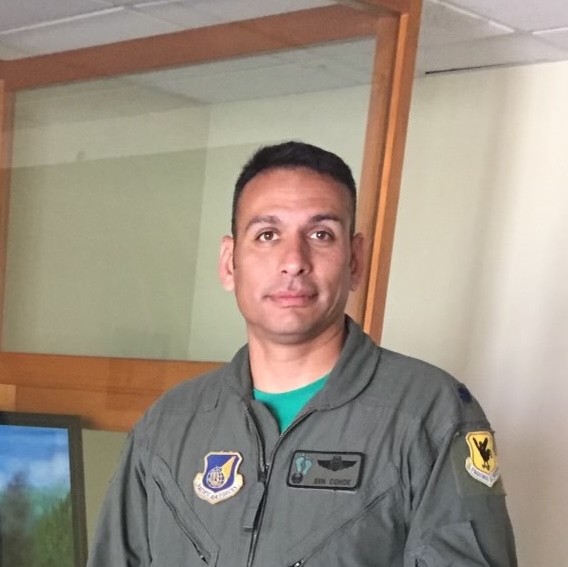
Benjamin D. Conde

In early April, like many other Americans, I watched, listened and read about the miracle Air Force Rescue forces performed, fighting their way through enemy fire to rescue an F-15E Strike Eagle pilot that was shot down over Iran, ensuring that pilot’s return to their family.  While I am extremely proud of the people and teams that planned and executed this legendary feat, I also recognize that the grit, skill and courage they exhibited during this mission were borne of a tradition of service to others and sacrifice that they, their families, their predecessors, and their predecessors’ families built over the course of several decades.  “These things we do that others may live” is not just Air Force Rescue’s motto, it is a testament to a life well spent in the service of others; a promise made by a small group of people that they will be there on the worst day of your life and will bring you home.

The day after I left Afghanistan for the last time in June 2010, my friend called me while I was in Kyrgyzstan awaiting transport back to the United States.  Pedro 66, an Air Force Rescue helicopter, had just been shot down during a mission to evacuate battlefield casualties in southwestern Afghanistan, instantly killing four Airmen.  A fifth Airman eventually died of his wounds later that summer.  My friend told me that he’d already talked to my wife and told her that I was okay.  After I called my wife to reassure her that I was alive, I gathered my teammates and told them that our friends were dead.  We’d spent almost every day with these brothers for months while we worked together to save life after life under some of the most challenging conditions I have ever experienced. Then they were gone.  

Other stories of sacrifice serve as reminders that being good enough to perform miracles in places like Iran requires accepting a life full of danger, where every loved one’s hug, kiss, or goodbye could be their last.  Of all these stories of sacrifice, August 5, 2013, still stands out in my memory.  I had just joined the 33rd Rescue Squadron in Okinawa, Japan a couple of weeks prior when I was informed that casualties were in route to a nearby hospital.  From that moment, it took several minutes for me to digest the fact that one of our helicopters had crashed in the mountains of Okinawa while on a training mission in preparation for the squadron’s deployment to Afghanistan, killing one of our brothers.  The aftermath of this date is still a blur to me today, but I do remember vividly the anguish and pain the tight-knit Rescue family had to overcome to convince itself that we had to continue to live up to the tradition of selflessness that we helped to create.  

Even so, I still see how that day and its aftermath haunt my friends and my wife.  

We set aside the last Monday in May to honor and mourn the members of the military that died while serving the rest of us.  For me, the sacrifices made in Afghanistan and Okinawa reverberate throughout the small Air Force Rescue community scattered around the world, with ripples that I still experience today, especially when I talk to my Rescue family.  With that, I am reminded of two things: we shouldn’t wait for Memorial Day to express how grateful we are for those that have died for us; and we should strive to be people that are worth their and their families’ sacrifice.