





Home Blog Page 207

Inflation is the enemy of “Build Back Better”

0
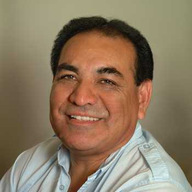
David Conde, Senior Consultant for International Programs

I made my second career moves in 1973 going from what is now CSU-Pueblo to New Mexico Highlands University in Las Vegas, New Mex. It was the first time that I had the opportunity to spend extended time with the people of that beautiful part of the state.

It was there in that small town that I experienced the long lines at gas stations caused by the Arab oil embargo that elevated the price of gasoline at the pump by 400 percent. The sudden amount of change in the price of gas was a sobering introduction to an enchanting part of rural America.

I also came to understand the role of the rise in gas prices in the trajectory of an inflationary spiral that emerged into the open during the 1970s. It appeared that the combination of spending on the Great Society programs of the 1960s together with the cost of the War in Vietnam had sparked the cost of living rise that was hard to resolve.

When President Jimmy Carter took office in 1977, inflation was already out of control. In 1979, inflation reached 13.3 percent as the Iranian Revolution that brought Ayatollah Khomeini to power also caused oil prices to double again.

I remember buying an apartment immediately before the last inflation push and got a decent mortgage rate. I also remember later thinking that I was paying the mortgage off with funny money.

The appointment of Paul Volcker as Chairman of the Federal Reserve also brought the tough medicine remedy that eventually got inflation under control. He instituted a 20 percent interest rate program that reduced inflation to 3 percent by 1983.

The administration’s ability to get bipartisan congressional approval of the Infrastructure Investment and Job Act in 2021 represents a signature moment in a politically fragmented country. Other presidents, including Biden’s predecessor, talked about it but could not get it done.

This signature legislation that includes funding for roads, bridges, rail, ports, drinking water, high speed inter- net, climate crisis intervention and environmental initiatives among others has a similar effect as Obamacare. Yet, even before it was passed by both houses of Congress, the bill was diminished in importance, especially by its propo- nents that referred to it as only half of the agenda and Build Back Better the other half.

To be sure, Build Back Better includes forward looking items like child care, housing and a more effective tax on large corporation. However, it also has the appearance of an over the top inflationary initiative.

There is a need for more thought about this given the fact that, like in the 1970’s, the cost of living increases have reared their head and promise to again affect the life of the country. This can have severed political consequences. President Carter lost his reelection bid in part because of an inflationary spiral that matured during his adminis- tration. President Biden stands to be accountable for the present one.

The Progressive Movement and other elements of the left wing of the Democratic Party are pushing hard for the Build Back Better initiative even in the face of a national and international economic reality that does not favor the approach. This can translate into a difficult political land- scape for the 2022 and 2024 elections.

Inflation is very menacing as it affects every sector of our living. We can feel it day to day as the price of every thing goes up and eats away our earnings. It requires tough medicine that can not be delayed and must be strong.

The views expressed by David Conde are not necessarily the views of la Voz bilingüe. Comments and responses may be directed to news@lavozcolorado.com.

LAEF lands First Lady, Dr. Jill Biden for 2022 Gala

0

By: Ernest Gurulé

Like so many things upend- ed by the COVID pandemic that swept the nation and the world, LAEF is back and ready for its closeup. While the Latin American Educational Foundation never actually went away, the COVID pandemic, which claimed more than 900,000 American lives and counting and more than five million worldwide, forced it to cancel one gala altogether and hold one virtu- ally over the past two years. But on March 26, 2022, it not only returns but returns in grand style.

This year’s honored guest will be Dr. Jill Biden, First Lady and wife of President Joe Biden. Dr. Biden, a lifelong educator and current faculty member at Northern Virginia Community College, is the nation’s first First Lady to hold a full-time job. Her predecessors, with few exceptions, held mostly ceremonial roles, though a handful of them took on specific tasks—many high level—as requested by the President.

Photo courtesy: James Baca

Landing a name like Dr. Biden was both a coup for LAEF and also a natural. The mission of the 73-year-old organization is education and in 2022 there is, perhaps, no other person—certainly one with as high a profile—who represents the values of education in the U.S. like Dr. Biden.

“Dr. Biden’s appearance at the LAEF gala will be invalu- able and beyond measure,” said Jim Chavez, LAEF Executive Director. LAEF and Chavez praised Dr. Biden as “the most accomplished woman, a dedicated public servant, the nation’s greatest advocate for a higher education and an educator at her core.”

LAEF has been in existence for 73 years and in that time has awarded nearly $7 million in scholarships to aspiring Latino young men and women pursuing college degrees or vocational certificates. “The growth of LAEF and its importance in the pursuit of higher education among Latinos from the few and tiny seeds planted in 1949 by a small corps of Latino professionals,” said Chavez, still astounds. Former Denver Judge Roger Cisneros, Bernie Valdez, one of the first Latinos to serve on the Denver Public School Board of Education and Lena Archuleta were just three foundational members whose long ago idea sprouted into what LAEF is today. Unlike in 1949, Denver has a cadre of professionals, many of whom serve or have served on the LAEF Board of Directors, including banking executive Pat Cortez, com- munications executive Sol Trujillo and Pauline Rivera, publisher of La Voz Bilingue.

La Voz Staff Photo

The work of Cisneros, Valdez and Archuleta resonates all the way to the highest levels of government where Chavez modestly said a bit of influence may have been used to get Dr. Biden and her staff’s attention. “LAEF sent an invitation to Dr. Biden this past fall, including information about our programs and services, as well as the impact LAEF makes. With the encouragement from some of LAEF’s great supporters and our Congressional representatives, she accepted our invitation to join us for our gala.”

Scholarship awards are open to Hispanic/Latino stu- dents who are “actively involved in the Hispanic/Latino community” regardless of their immigration status or U.S. citizenship. Recipients must carry a minimum 3.0 cumulative GPA in their high school or college. A designated LAEF committee makes the awards based on financial need, leadership potential and service to community. Applications have closed for the 2022-2023 academic year.

Dr. Biden has taught in both high school and college. In 1976, the year she met and began her relationship with now husband, President Biden, she was an English teacher at a Catholic high school in Wilmington, Delaware. Later, she taught at a Delaware psychiatric hospital and at Delaware Technical Community College. The current First Lady has two master’s degrees and a doctorate in educational leadership.

Her timeline at Northern Virginia Community College goes back to 2009 when her husband served as Vice President under former President, Barack Obama. She has remained at the school from then until now, though the pandemic did take her physically away from the classroom and, like millions of other educators, forced her to teach remotely.

More than three decades in the classroom has provided a perspective on education and particularly teaching scores of non-traditional students at the community college level to the First Lady. “There is nothing like helping students find their confidence and begin to use their voices or seeing that spark light up in their eyes the moment a concept falls into place,” Dr. Biden said in an interview with Good Housekeeping Magazine.

Community college students, many fresh out of high school, others returning to school after years of being in the workforce provide her with a new appreciation, she said, for the task teachers are given. “My students work incredibly hard to make it to class,” said Dr. Biden. Many must juggle both work and families just to be there. “They want to learn. They bring diverse perspectives to our studies…It is such an honor to be the person to walk them through their studies, to give them the key that could unlock something life-changing.”
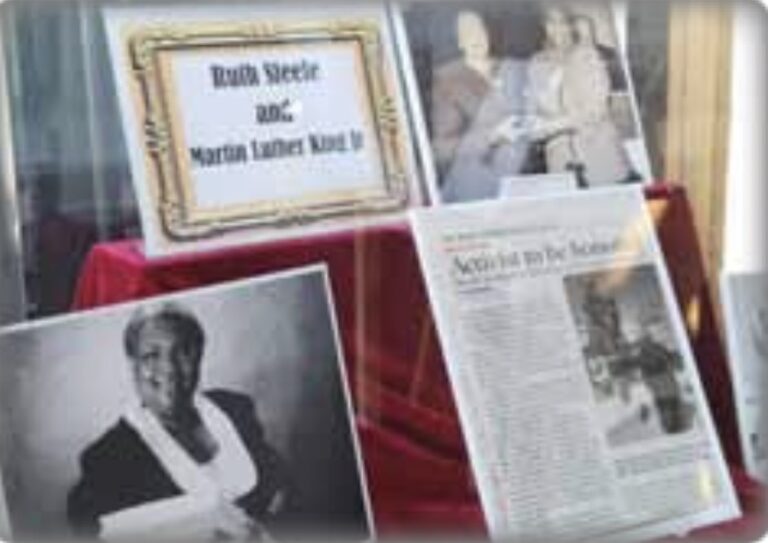
Black Americans who helped mold Pueblo

Outside of Pueblo, Colorado, the name James Pierson Beckwourth or Beckwith as it has also appeared, has little modern resonance. Beckwourth was born into slavery in 1798. His father was white, his enslaved mother, African American. Beckwourth’s father freed him in his teen years so that he could apprentice with a local blacksmith. It would be a skill he would add to a handful of others over the course of his life, including Army scout, fur trapper and trader, professional gambler, cowboy and merchant. It was as a merchant that he came to Colorado and where he is often credited with establishing the first trading post in what would become Pueblo in 1842.

Photo courtesy: Ernest Gurulé

But while Beckwourth’s name is, perhaps, more ephemeral in Pueblo than topical, that is not the case for another local Pueblo legend, the late Ruth Steele, an African American woman who dedicated her life to making certain Black history would be far more than a 28-day annual commemoration. Miss Steel died in 2021 but her story remains one of Pueblo’s most endearing and important for African Americans and everyone else who calls the southern Colorado city home.

The story of Ruth Steele began in Texas in 1935. But two weeks after she was born, her family brought her to Pueblo where she was raised and where she would make her mark by her grandmother. The precocious young woman skipped a couple of grades allowing her to graduate from Centennial High School at age 15. She would later earn degrees from then Pueblo Junior College and later the University of Colorado. Professionally, she was a paralegal. But her passion, her life’s work, was civil rights.

As a young woman she was in Washington for Dr. Martin Luther King, Jr’s, “I Have A Dream,” speech. In an interview with The Pueblo Chieftain, she would modestly recall how she “had been one of the ladies sent to Washington to set up for the historic speech. Later, in 1965, she was in Selma, Alabama, marching with King and others on ‘Bloody Sunday,’ as they crossed the Edmund Pettis Bridge.

Miss Steele counted among her friends King’s wife, Coretta, also the late Congressman John Lewis and civil rights advocate and entertainer Harry Belafonte. The red dress she wore for the iconic ‘Dream’ speech and later in Selma were keepsakes until the day she died.

After King’s assassination in 1968, Miss Steele worked relentlessly to honor the King name and ensure that Black his- tory and civil rights remain beacons of both light and hope in Pueblo and southern Colorado.

She along with other members and friends of Pueblo’s African American community lobbied former Denver Mayor Wellington Webb to donate a statue of Dr. King standing with Emmett Till, a fourteen-year-old Black boy savagely killed in 1955 for allegedly whistling at a White woman in a Mississippi dime store. The statue was removed from Denver’s City Park and now resides in Pueblo where it sits outside of another of Miss Steele’s passions, The Lincoln House, a home that once served as an orphanage to African American children and seniors, mostly older women.

The structure, now restored after years of inattention and long past its days as an orphanage, is known as Friendly Harbor, a mental health services center. Its role as an orphanage ended in 1963. But in its heyday, it provided shelter for African American orphans who came from as many as seven different states. It is also listed on the State Register of Historic Properties.

In 1983, President Ronald Reagan signed legislation mak- ing January 15th, Dr. King’s birthday, a national holiday. But the law making it official did not take effect until 1986. Again, Miss Steele found herself working in Pueblo and Denver to get Colorado lawmakers to do the same and make MLK Day a Colorado holiday. She and friends successfully staged the first in the nation Dr. Martin Luther King, Jr., program in Pueblo two years before the first official MLK holiday.

Miss Steele died one day after the 2021 MLK March in Pueblo. Her illness, however, did not stop her from taking part in the program she had ushered in more than thirty years earlier. From her hospital bed, she listened to the speeches at the Pueblo march and the later the formal program over the telephone.

Friends who knew and worked with Miss Steele said she lived her life in accordance with words from one of Dr. King’s favorite hymns, “If I Can Help Somebody.”

“If I can help somebody, as I pass along…if I can cheer somebody with word or song…then my living shall not be in vain.”

It is not a place one thinks about when the topic of Black History Month comes up. No surprise, Pueblo, Colorado, a city of roughly 112,000, has only a 2.4 percent African American population. We pay tribute to those Black Americans who helped shape Pueblo.

Russian security as a defensive maneuver

0
David Conde, Senior Consultant for International Programs

When I see Russian reaction to NATO at its doorstep I am reminded of America’s own perceived need to put troops along the border with Mexico and even invade it for reasons of security on the surface and to make a land grab as part of Manifest Destiny. The Russians do not appear to need any more land as they have a continent size country with 11 time zones that stretches from the North Atlantic to the North Pacific.

Just like the United States, Russia as the leader of the Soviet Union last military adventure was in Afghanistan where it, like the U.S., lost “its shirt” trying to turn that country into an expression of its own ideology. Yet still, the projection of presence as world powers continues to be the major agenda of both countries’ foreign policy.

Ukraine however, is not Afghanistan and an invasion of the country has to have a territorial goal in order to justify the expected bloodshed. This goal appears to be more a matter of political control that can turn Ukraine into a buffer state against NATO and its European alliance.

This ambition is part of a broader desire to stay relevant as the world transitions to a U.S.-China contest for economic and military power. Let us not forget that it was the Soviet Union that helped birth the Mao Zedong China and that this country has gone on to create an economy challenging for supremacy.

The military aspect of the U.S.-China contest is still on the horizon. That is where Russia as the “junior” partner of the Russian-Chinese relationship comes in as it still has the old Soviet capability of an arsenal of advanced weapons that China is still developing.

In order to be an effective partner with China, Russia must secure its borders using a federation of buffer states just like it did when it was the Soviet Union. Standing in the way is Ukraine that sees itself as an evolving political democracy looking to join the European community.

The inconvenient truth is that Ukraine borders Russian controlled territory on three sides. Its vulnerability to military and political pressures makes it look like another Poland before World War II.

We saw what happened to Poland as we watched it disappear at the hands of the Soviet Union in the east and German Reich in the west. I have read of the sense of helplessness on the part of its allies and the half-hearted declaration of war obligated by their treaty that then turned into a world conflict.

To be sure, Putin’s Russia is diminished in terms of political power and influence across the globe. Its oil and natural gas resources are the leading sector of an economy that is placed 11th in the world.

It is its military might made up of the most advanced weapons and a nuclear arsenal that separates it from others in its class. That is the instrument President Putin is using to make his point about his country’s national security.

The issue for the United States as the leader of the free-world is to understand that the situation has less to do with ideology and more to do with an authoritarian leader wanting to stay relevant and wanting to secure his country’s exposed flanks. A security guarantee is the diplomatic challenge to be met.

The question for Putin is complicated by the fact that he has over 130,000 troops on the border ready to go. How can he deescalate without losing face?

The views expressed by David Conde are not necessarily the views of la Voz bilingüe. Comments and responses may be directed to News@lavozcolorado.com.

Nameless Black Americans, ‘their light should not be ignored’

0

By: Ernest Gurulé

It doesn’t matter who you are when February and Black History Month arrive. There is—guaranteed—something new to learn about the one group of Americans that does not come from immigrant stock. Despite everything said about this being a nation of immigrants, by the very nature of our history, African Americans are not immigrants. Instead, they are a people that 421 years ago, were kidnapped on the other side of the Atlantic Ocean and arrived on this continent against their will.

Still, despite a painful, often bloody and tortured history in this country, African Americans have endured and woven extraordinary contributions into the American fabric. And Black History Month, an official federal commemoration since 1976, illuminates the amazing contributions Black men and women have made over four centuries. Various incarnations of Black History Month were celebrated long before, but it wasn’t until 1976 when President Gerald Ford made it official. February was chosen because it marked the birth month of Abraham Lincoln who signed the Emancipation Proclamation and famed abolitionist Frederick Douglas.

African Americans, the well-known and the unfamiliar, have made contributions in science, education, medicine, architecture, the arts and every discipline despite the birthright challenges and roadblocks they endured.

Coloradans should learn the name of Azalia Smith, Colorado’s first Black journalist, but also an accomplished musician and teacher. Her husband, Edwin Hackley, was our state’s first Black attorney. Together they also published the Colorado Statesman, Colorado’s first Black newspaper. 

Barney Ford, who escaped slavery via the Underground Railroad, made his way to Colorado along with his wife, Julia. He was a gold miner, entrepreneur, and hotelier. He also staked out the then unpopular position against Colorado statehood because the first incarnation of the movement included an amendment that would have barred African American men from voting. He later opened a school for  African American students. Colorado’s state capitol now honors Ford with a stained glass image located on the west wall of the House Chambers. 

Their stories and others are on full display at Denver’s Black American West Museum at 3091 California Street. The Museum’s Facebook page says it is “temporarily closed for interior restoration & exhibit design.” 

The National Museum of African American History and Culture in Washington D.C. is also an amazing resource for learning of the journey African American’s have made from 1619 to today. It chronicles the lives and contributions of iconic African Americans on land, sea, space, in the arts, literature, science, technology, and social movements. Also on full display at the center are the ugliest and most heart wrenching chapters of their story, from enslavement to Jim Crow.

While the center also tells the story of the easily recognizable like James Baldwin, Duke Ellington, Fanny Lou Hamer and Rosa Parks, it also attempts to fill in the blanks with the stories of others who have made their marks but remain both less well known or simply unknown. And that’s why Denver’s Metropolitan State University’s Professor Devon Wright has been rethinking Black History Month. He wants America to know the names and the stories of the unfamiliar, names like Claudette Colvin. 

Before Rosa Parks entered the pages of American history, Wright said, it was a fifteen-year-old Colvin who refused to move to the back of the bus. Wright has told this young woman’s story countless times.

In the spring of 1955, months before Parks refused to give up her seat, Colvin did the same. But unlike Parks who was quietly escorted from the bus, Colvin was handcuffed, physically removed and jailed. She was Park’s opposite, not formal but loud. Not demur, but profane. Also, not a hew of cinnamon but ebony in skin tone. Colvin, the NAACP thought, was not a witness it could rely on. Parks, on the other hand, was perfect from head to toe.

Wright wants stories like Colvin’s and others fully told, explained and shared. He also wants Black History Month to offer school children and others a more fulsome telling of the African American story.

“Mainstream approach to Black history has condensed it to very prominent figures,” said Wright. This American story, he contends, is often replayed on a loop, condensed and reduced to cliché, including Dr. Martin Luther King, Jr.’s, “I Have A Dream” speech. 

Wright argues for a recalibration of Black History Month’s icons, including a new and more fulsome explanation of Dr. King’s Civil Rights journey. He believes that King is too often portrayed as a peaceful, “bland, generic” figure when he was, in reality, just the opposite. And that view and that opposition to King in the sixties made him as reviled as it did respected.

“Contrary to what pop culture might want to quote, he was a vociferous critic of America,” who talked about “exploited labor practices and White supremacy. Full inclusion was what he wanted.” Wright believes it’s time to see Black History Month “updated, revised, more 21st Century.” 

Wright advocates “a bottom up approach, not top down,” to Black history. “What about all those unnamed individuals that made up the Southern Leadership Christian Conference, the NAACP or those who were not members of those organizations, the contributions of everyday people.” “There were people who, with bullhorns, were giving speeches. It’s not as if they were standing there by themselves.” 

More recently, Wright believes there are plenty of heroes who remain anonymous but deserving mention for standing up and giving aid during Black Lives Matter rallies and demonstrations. They were also there following the killings of Breona Taylor and George Floyd. Taylor was killed by Louisville, Kentucky, police in a ‘no-knock’ raid. Floyd died when a Minneapolis cop kneeled on his neck, essentially suffocating him as people implored him to render aid.

The nameless and faceless, said Wright, deserve acknowledgment if not name recognition. “They were there, people giving out free bottled water at rallies and demonstrations,” he said. “That may not seem very important,” he said. But they did what was “critically important.”

The Metro State professor said these men and women may not shine like a super nova in this amazing galaxy of African American History. But, he said, they are nonetheless stars in their own right. Their light should not be ignored.

Northern New Mexico’s Brian Garcia, a mix of talent and integrity

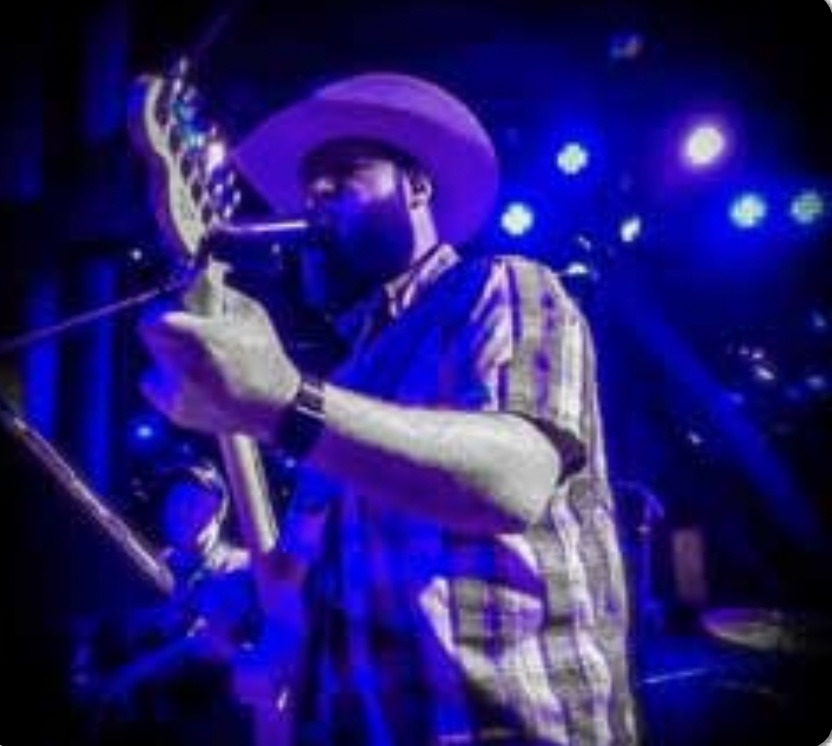
It would be hard to say that New Mexico native Brian Garcia is a cop trapped in a musician’s body or a musician trapped in a cop’s. Whatever the case, Garcia’s found a way to balance these competing forces. He does his police job as a patrolman in Taos during the week and performs—weddings, anniversaries, birthdays and graduations—on the weekend and as often as he can.

Photo courtesy: Brian Garcia

The soft spoken Questa, New Mexico, native has been playing an instrument of one kind or another for most of his life. “I started out in middle school learning to play guitar,” he said. He still plays guitar with his band, The Most Wanted, but also plays drums and when necessary, picks up the saxophone. He’s mostly a saxman when he’s gigging with another band.

Garcia has no allusions about where his music will take him. But neither does he place limits on where his dreams will take him. “One of my dreams is to play The Grand Old Opry,” he said. People who’ve heard him—and that includes audiences in scores of the towns, big and little that dot New Mexico—believe he has the talent to punch his ticket for Nashville and ‘the Opry.’

Before he put on a badge, Garcia drove a truck on a route that took him through a lot of the same towns where he plays gigs today. His band plays mostly country, “about 80 percent,” he said, with Al Hurricane tunes, the man he calls ‘the godfather of New Mexico music,’ a good portion of the rest.

While he likes artists like country stars like George Strait and Chris Stapleton, Garcia does not see himself as a clone by any means. “I don’t think I sound like anyone. I think I have a unique voice.”

While he’s well known from east to west and north to south across the ‘Land of Enchantment,’ Garcia and The Most Wanted, have also played up and down the Front Range with periodic stops in Denver. And they’re ready with C&W, Top Forty, Doo Wop and, for good measure, cumbias and rancheras. They are, he said, a band for all seasons.

When the band’s hitting on all cylinders and the audience is cooking, he knows what’s coming next. “’Tennessee Whiskey’ is the biggest request we get,” he said. Other times it’s ‘Don’t Close Your Eyes,’ by Keith Whitley or Johnny Cash’s ‘Folsom Prison Blues.’

There are four members in the band, including a younger brother, Kevin, who mans the skins—drums, for the uninitiated. And before COVID, Garcia said they were booked nearly every weekend of the month. Things are slowly returning to normal.

Garcia and his wife, Veronica, also his high school sweetheart, have two sons, ages eight and fourteen. He said his wife isn’t nearly as troubled about his being away on weekends performing as she is concerned about his job as a police officer. “It’s a little scary for my family,” he said, “but they’ve always been supportive.” Still, everyday when he puts on the uniform and leaves home, he makes sure to “tell them I love them.”

Garcia has found a way to balance his music with his other job and, in a way, he said, there’s a connection with the two. When he’s playing, he said he’s doing it to make people feel good. When he’s patrolling, he said, he looks for opportunities to help people out, to lend a hand. “It’s kind of nice being in Taos. It’s a smaller community and it’s nice to get out and know a lot of people,” he said. “You can take extra time to make sure that things get resolved satisfactorily.”

But there’s an emotional side of the job that, Garcia said, is heartbreaking. Opiates, a scourge that has ravaged small town America, have found their way into rural New Mexico. “It’s bad. A lot of good people have turned to that for comfort,” Garcia said. It’s a big challenge, he said, that makes the job more dangerous. “People can become unpredictable…the nature of crime is just more violent.”

While hitting the stage in Nashville is a dream tons of country singers harbor, Garcia won’t be heartbroken if it doesn’t happen. Playing music, to him, is far more important than where he’ll play it. It would be nice to be on ‘the Opry’ stage, he said. But if it doesn’t happen, he’ll still be landing weekend gigs and performing with the same energy as if it were the big time. “I’ll be playing until I can’t play anymore,” said Garcia, “even if it’s not in a gig.” Even it means strum- ming the guitar alone in his studio.

News of where Garcia and The Most Wanted will be performing as the music season heats up is a work in progress. The band’s website is under construction. But he suggests visiting the New Mexico Hispano Music Association website. It posts the latest information on scores of the state’s performers and can be found at www.nmhma.org.

It’s Cañon City and don’t forget the tilde

If you ask for a single reason to visit Cañon City, southern Colorado’s off the beaten path hamlet, don’t ask a local and especially don’t ask the town’s Mayor, Ashley Smith, unless you have a lot of time on your hands. For starters, the Mayor will tell you that Cañon City is celebrating its sesquicentennial, 150 years as a town and it doesn’t stop there. As you might expect, Smith is the town’s biggest booster.

Fremont County and Cañon City, the county seat, are nearly dead center in Colorado and home to just under 50,000 countywide residents. The region’s first White settlers arrived in early 1858 after gold was discovered just north of where the city lies today. But it wasn’t until 1862 when oil was discovered just north of the city’s boundaries that the town incorporated and began to grow.

The first well drilled in the region also became the first commercial well west of the Mississippi River. But any dreams of it becoming an oil boom town faded over time. But while the town didn’t become an oil patch, it became something else and something so much better.

The town of Cañon City, despite a population nearing 20,000, might easily be described as a bedroom community, nearly equidistant from Pueblo to the east and Colorado Springs to the north and east. Both sit approximately 40 miles away.

“We’re a small town,” said Smith, before adding that it’s also a town with both charm and authenticity. She describes it as a place where “everybody waves at you when you pass ’em on the street.’ She sells the town as something akin to ‘Mayberry at the foot of the mountains.’

Cañon City is approximately 120 miles southwest of Denver and an easy a drive in good weather. While there are other routes to take, most drivers take I-25 to Colorado Springs before cutting off to state highway 119 and on to Penrose. From there, it’s an easy twelve miles to the west before arriving.

Once there, you might hit one of the town’s many seasonal celebrations or take in one of a handful of what Smith might call Cañon City’s ‘must see’ tourist attractions. And there are a bunch.

Photo courtesy: Canon City Colorado website

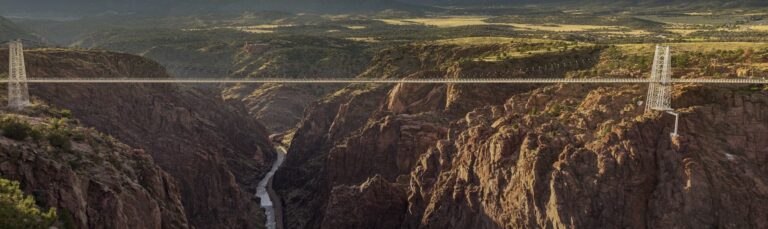
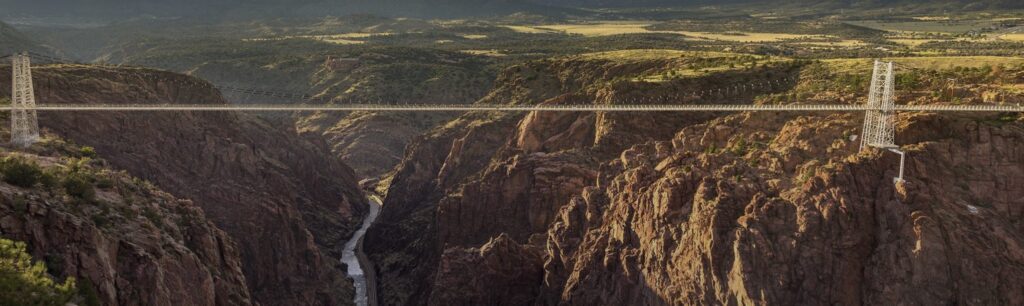
In warm weather months, there’s the Royal Gorge and the country’s highest suspension bridge. Or, said the Mayor, you can ride the train that runs beneath it and parallel to the Arkansas River which, according to Smith, is the “most rafted river in the country”. Not for you? Then, she suggests a visit to the Territorial Prison Museum, a facility that traces the history of the state’s and town’s famous or infamous prison legacy. And, though, the town is rich in prison lore—it either houses “nine or ten” correctional facilities, said Smith, Cañon City is so much more than prisons. Nonetheless, Smith is not afraid to drop a little prison minutiae when the time is right and, during the interview, did drop this nugget: Colorado’s prisons not only make all of Colorado’s license plates, “they make them for the whole country.”

But, not unlike a butterfly, Cañon City is emerging from a cocoon. Its downtown, said Smith, is slowly undergoing something of a minor renaissance. The once abandoned Hotel St. Cloud, a hotel that is on the national registry for historic places, has been bought and transformed into “a boutique hotel and high end experience,” the Mayor said. Smith also recommended a visit to the town’s Fremont Center for the Arts or a visit to the Gibson Mansion. Also, if you’re hungry, there are also a few restaurants that have recently opened, including an Indian restaurant, Nirvana, “that rivals any big city restaurant,” she said.

One thing that may surprise, even shock, about Cañon City is that “71 percent of our community commutes outside the city” for jobs, said Smith. A good portion of the town’s workforce holds jobs in high tech. A lot of workers commute to high tech jobs in Colorado Springs, she said. A lot of others stick around town and telecommute to work, “renting office space with everything you would need for your profession.”

Weatherwise, there may not be a more predictable place in Colorado to visit. Despite an elevation that exceeds Denver’s 5,280 feet, the town claims to be ‘the climate capital of Colorado.’ Sitting at 5,300 feet, it’s earned the nickname for its warm winter temperatures and temperate spring and fall readings.

The town officially celebrates is 150th birthday on April 2nd. Part of the celebration will be the unveiling of “a new ‘C,’ for Cañon City, one that will be lit up every night of the year. The idea of two ‘C’s,’ said Smith, was abandoned because it might appear too blurry.

America’s bridges past due for improvements

0

By: Ernest Gurulé

Photo courtesy: Diana Russell

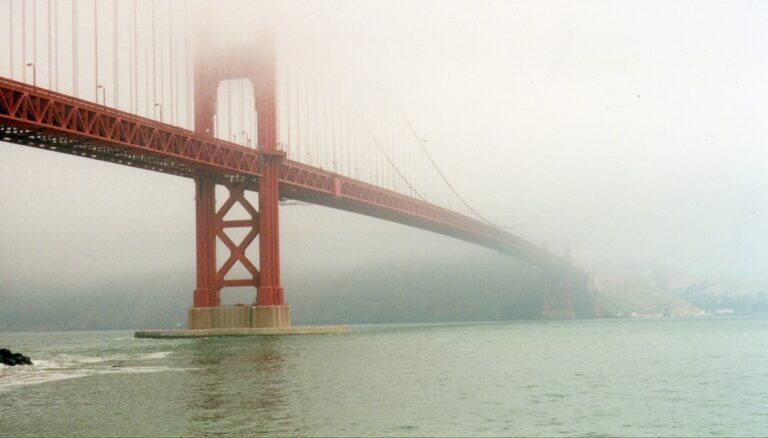
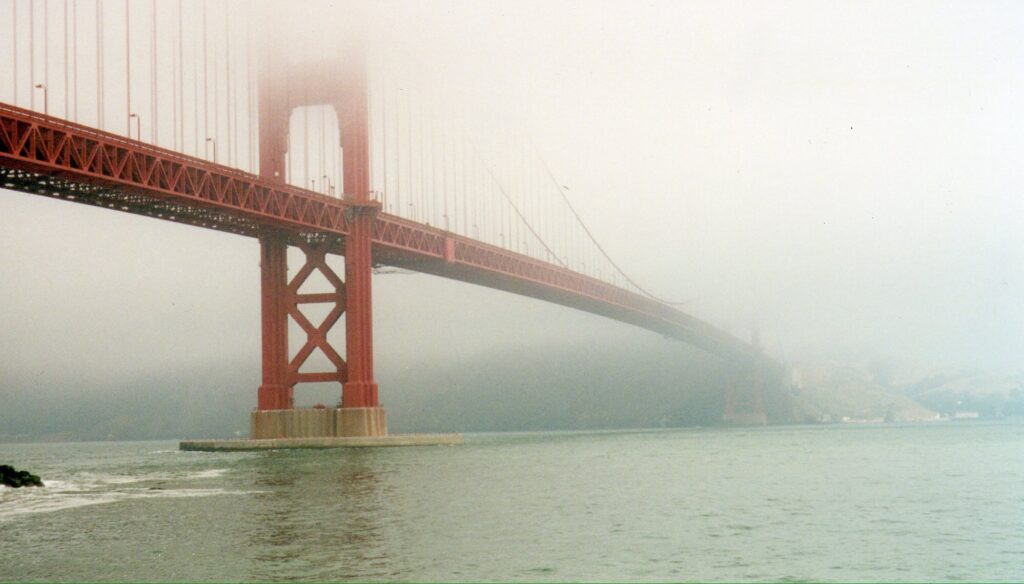
It may be America’s most romanticized bridge, San Francisco’s Golden Gate. And despite the near daily sea salt baths it receives, this rust-colored, 1.7 mile wonder connecting San Francisco to Marin County, seems almost ageless. But the truth is that this architectural masterpiece is not far away from turning one hundred. But all indications are that when it reaches that magical number in 2033, it should still be good for a few more decades.

But while the Golden Gate may be in great shape, the same cannot be said for a huge portion of the country’s 620,000 other bridges. According to the American Road & Transportation Builders Association, there are nearly a quarter of a million U.S. bridges past due for major improvements.

The Association also says that nearly 80,000 of these structures should simply be demolished and replaced.

The country’s aging and ailing bridge problem could not have been punctuated more dramatically than late last month when Pittsburgh’s Forbes Avenue Bridge collapsed just before rush hour and only a few hours before President Joe Biden was scheduled to arrive in the city to tout his $1 trillion infrastructure bill, a bill that includes an estimated $1.6 billion for Pennsylvania’s bridge maintenance effort. By some miracle, the January 28th bridge collapse only resulted in three hospitalizations. Ten others were injured. But the failure set off warning alarms across the country, including in Colorado.

But, said CDOT spokesman Matthew Inzeo, Colorado’s bridges are regularly inspected to make sure that the kind of situation that occurred in Pittsburgh won’t happen here.

“The main point we have made to reassure the public is to explain the extensive process and dedicated funding Colorado dedicates to bridges,” said the state transportation spokesman.

In 2009 the state legislature passed a bill that autho- rizes $200 million annually “to improve roadway safety, repair deteriorating bridges, and support and expand transit.” The legislation, FASTER, stands for Funding Advancements for Surface Transportation and Economic Recovery Act.

The money is generated by fees on state drivers. An average Colorado vehicle owner, said CDOT, pays approximately $6 monthly. The funds are equally divided between state and local government.

Inzeo said CDOT has statewide staff “who maintain a complete inventory of our 3,447 bridges and are regularly performing inspections and identifying upcoming needs” on safety. Inspections, he said, are conducted on state bridges on a quarterly basis.

In the recently passed federal legislation totaling $1.2 trillion, states will receive $550 billion that will pay for improving the country’s bridges and roads along with a number of other things, including broadband and water and energy systems. The legislation comes at a time when the American Society of Civil Engineers has labeled America’s infrastructure at C-levels.

The bill, called the Infrastructure Investment and Jobs Act and signed in November 2021, was President Biden’s first major legislative accomplishment. While it is still to be determined just how much Colorado will receive, “We expect to see about $700 to $900 million above what we receive in formula funds over the next five years,” said Inzeo. “Those funds will support the completion of our 10 year plan on capital projects.” Colorado recently received “a five-year allocation of $225 million in bridge funds, which will supplement our existing programs and allow us to complete additional bridge projects,” he said.

While the Pittsburgh bridge collapse may have been an anomaly, it may also have been an ominous precursor to what could lie ahead. Because of exponential growth in some U.S. states and cities, “You just have these cities which are growing to an unprecedented extent, and the infrastructure was never designed to handle the amount of traffic that these structures are expected to deal with very day,” said the National Association of County Engineers Keven Stone.

While Pittsburgh’s bridge collapse is a serious infrastructure incident, it is by no means unique in this cat- egory. Also, say civil engineers, not all bridge failures are connected to aging, though aging and failure to address structural integrity are common issues in these catastrophes.

In August 2017, thirteen people died and nearly 150 were injured when Minneapolis’ I-35W bridge over the Mississippi River gave way during the height of rush hour. The span had been classified as structurally deficient and work to repair it was actually being undertaken when the incident occurred. Coincidentally, federal inspectors later determined that one thing that made have accelerated its collapse were the 300 tons of heavy equipment and materi- als for repairing it.

While Colorado has been vigilant in monitoring the safety of its nearly 3,500 bridges, a number of states have found themselves in catch-up mode, a situation that has only skyrocketed the costs for repairs or replacement. Many of these structures were built decades earlier at a fraction of the cost of what it will take to bring them up to 21st century safety standards. This ‘pay me now or pay me later’ philosophy on bridge maintenance will surely come as a heavy dose of cold water when current bills come due.

One example of how inflation would factor into replacement is the Golden Gate Bridge. When built in 1933, the San Francisco landmark came with a whopping $37 million dollar price tag. Should it somehow have to be replaced in today’s dollars, experts say the price tag could top out at a minimum of a billion dollars.

Mexico City many decades ago

0
David Conde, Senior Consultant for International Programs

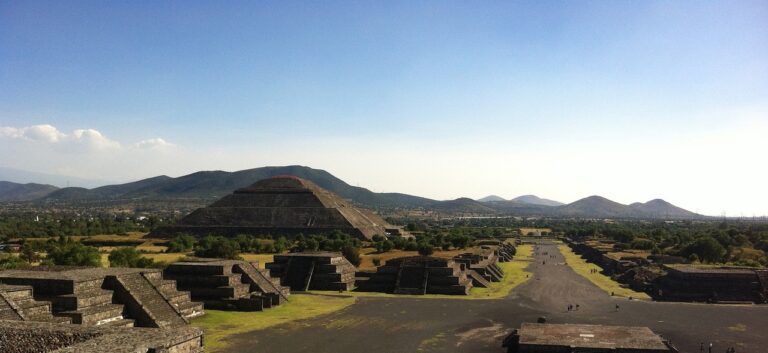
On my first visit to Mexico City as a young student I toured Teotihuacan and fell in love with the country’s pre-Columbian past. It almost happened by accident as the trip itself was made because Aeronaves the airline that later became AeroMexico had a sale offering a round trip from the border to Mexico City for $89.00.

I was home from school visiting my parents in Mercedes, Texas in the Rio Grande Valley and decided to take up the offer. When I arrived at my destination I did not know where to go and so a taxi driver took me to the Hotel del Bosque on Paseo de la Reforma promising that it would be inexpensive.

Later I learned that the hotel was walking distance to the National Museum of Anthropology and History that became a must visit every time we were in the city. It was outside the hotel that I met a man with a car and for $10.00 took me to Teotihuacan, the most important city of pre-Colombian Mesoamerica.

The National Museum of Anthropology and History is the typical event of the day I am describing. This time I stayed downtown in the Historic District, a block from the famous Juarez Avenue with its Alameda Park and the beauti- ful Instituto de Bellas Artes with its unique architecture and hometoperformancesbytheBalletFolkloricoDeMexicode Amalia Hernandez that I attended over the years.

I got up very early in the morning and took a walk along the freshly cleaned streets and the magic of no people and little traffic all the way to the Zocalo Square and its monumental buildings that include the Presidential Palace and back to begin the day.

Breakfast was at Sanborns House of Tiles restaurant, a beautiful mansion off Cinco de Mayo Avenue that is covered with Puebla tiles and has been a prominent part of the city’s colonial and independent history. Stories of how the outside walls got tiled this way add to the mystery of its grandeur.

The visit to the museum itself began at an entrance dominated by a round obelisk depicting Mesoamerican designs covered by a fountain roof that rains water on the monument. The building itself is U shaped with artifacts of the Aztec world dominating the displays at the bottom of the U.

The tour began on the right side that includes displays of human evolution followed by the archaeological history of Classic Teotihuacan and Post-Classic Toltec civilizations. The center of the U is occupied by the famous Sunstone calendar carved during the last period of the Aztec civilization and an artifact that I have studied and am still trying to understand.

The left side of the museum holds a Mayan collection that includes written records in stone and displays of its unique architecture. It also holds the Olmec collection with its giant human heads and ocean motives that testify to a strong beginning of Mesoamerican civilizations.

The museum has an excellent cafeteria where I had lunch before coming back to visit the Historic District again. This time it was bustling with people, traffic and the intense activity of a world-class city.

I arrived at Templo Mayor next to the Zocalo and the center of ancient Tenochtitlan to visit the uncovered base of the pyramid temples that were the most sacred ground of the empire. Visiting the monuments and the museum there, I thought of what those silent stones might be thinking about a future they helped to shape.

The views expressed by David Conde are not necessarily the views of la Voz bilingüe. Comments and responses may be directed to news@lavozcolorado.com.

CBS4’s Latino duo leads the morning news

0

By Ernest Gurulé

Think of famous pairs. Hope and Crosby, Rogers and Astaire, Thelma and Louise. Now think early morning Denver television and something else comes to mind: Griego and Garcia, CBS4’s first, and very likely, also Colorado’s first ever Latino television news co-anchor team. Denver natives Michelle Griego and Dominic Garcia say ‘good morning’ to thou- sands across Denver and beyond every Monday through Friday beginning at 4:30 a.m.

Photo courtesy: CBS4 Denver

While most stations were not late to the show with male-female co-anchor teams or even two women as the face of a newscast, seeing two Hispanic news anchors as a station’s brand was rare. You might see it in a Houston or San Antonio, even a Los Angeles, but not in Denver, a city whose Latino population exceeds thirty percent.

But Griego and Garcia greet the city and region every weekday professionally and affably with all the news that’s fit to share. For Griego, this is a rebound relationship with Denver, where she worked before getting an offer she calls too hard to refuse. The offer was the morning news gig in San Francisco where she worked for nearly a decade. “I loved its beauty and diversity,” she said of the city. “There was always something to do. If we wanted, we could get out of the Bay area and in ninety minutes be in Carmel.”

The ‘we’ she refers to is the family that has grown as she’s built her career over the last two decades. In addition to her husband, Macario, the pair also have three daughters ranging in age from six to 22. Working mornings as she does, she said, is not only a professional decision but also a personal one. “When you have a family, it really is the best shift,” though admitting, it can be exhausting. “I have to drink a lot of coffee,” she jokes.

If Griego seems familiar to Denver news watchers, it should shock no one. Hard to believe, but she began earning her ‘chops’ while still in elementary school as the anchor of a kids news show on Denver’s KWGN, Channel 2. The news bug never left and followed her to Fort Collins and CSU and later to Denver’s Metropolitan State University.

Garcia was similarly bitten. He’s been fascinated with journalism and news from his earliest memory. He said his father, a college professor, sort of steered him in that direc- tion. “He didn’t see me sitting in an office,” Garcia recalled. His mother, an attorney, apparently agreed. And Garcia, who readily admits to his rocky, though not necessarily irrecon- cilable relationship with math, found something everyone could agree on.

It was at Denver’s Thomas Jefferson High School, where he read the school’s daily news and information that he bonded with what would become his career. Like his morning news partner, he also went to CSU where he immersed himself in the journalism school’s student newscast. The training would ultimately land him in Albuquerque, New Mexico, where he got his first on-air job and stuck around for three years.

Like Griego, Garcia’s followed a slightly nomadic career path. From New Mexico, he returned to Denver and Channel 4 but then followed his wife, Meghan, to San Diego. There he landed at the CBS affiliate where he did everything from reporting to anchoring, including anchoring sports when needed. The couple returned to Denver in 2018.

Television news diversity has changed dramatically over the years. The Griego-Garcia team is just one example. One look at News4’s webpage and its newsroom staff is a light year removed from just a generation ago. There is a cornucopia of hues and surnames that would never have been found not that long ago. But while diversity continues to grow in newsrooms, there remain undercurrents and, in some cases, obvious challenges.

Last year, Denver’s KUSA’s newsroom was rocked by the story of the firings of three Latina reporters. Both the Denver Post, Westword and scores of other news outlets reported on the terminations of Lori Lizarraga, Kristen Aguirre and Sonia Gutierrez. Each was let go after not having their contracts renewed within the course of a single year. All three had complained about the difficulties they had in the Channel 9 newsroom particularly in their reporting of stories involving the Latino and immigrant communities.

Having a diverse newsroom, both Griego and Garcia agree, elevates the quality of the news product. It helps illuminate different perspectives and experiences. That’s why the product he puts out, said Garcia, has to reflect substance over style. “I have always wanted to pride myself on my work,” adding, “I definitely have an obligation to give voice to certain communities.”

The face of television has evolved in a positive way, said Griego. But it’s not just who you see that is important. “It’s important to have that representation not only on TV but behind the scenes,” said Griego. She’s an undiluted advocate for a newsroom that looks like the community it serves.

One advantage Griego has parlayed in her newscasts, is having the ‘ear’ for surnames. It’s just respectful, she said, to pronounce them not only the way they should be pronounced but also accepting the way the person themself says it. She just wants to get them right. Passing judgment on the way someone might say their name is not part of her makeup. “You have to understand how they grew up,” she said.

Being the faces of a major city and entire region via television more than a dozen hours a week might make one a ‘celebrity,’ but neither Griego nor Garcia think that way. Each sees themselves as just people doing the best job they can. But each acknowledges respect for those who either inspired or helped steer them in the direction they ultimately charted.

For Griego, long-time Denver’s 7 news anchor Anne Trujillo was and is the North Star for her own career. Former Channel 7 anchor Bertha Lynn was also a television role model.

For Garcia, himself a prototypical news anchor, stylish, urbane and smooth, the late Peter Jennings was the gold standard. Watching Jennings’ ad lib coverage of the September 11th attacks on New York nearly two decades before was and is, he said, as amazing today as it was nearly two decades before.